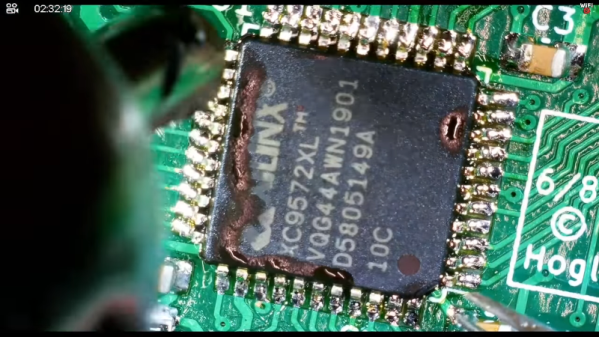
[Adrian] has a lot of retrocomputers, so he uses an RGB to HDMI converter to drive modern monitors. In particular, he has a box that uses a programmable logic chip to read various RGB signals and ships them to a Raspberry Pi Zero to drive the HDMI output. Sounds great until, of course, something goes wrong.
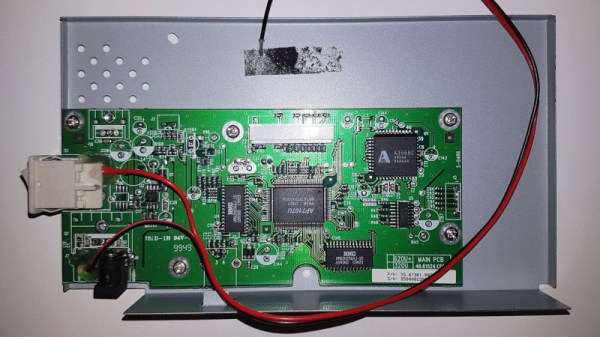
A converter that had worked stopped working due to a bad board with the programmable logic chip on it. Unlike the retrocomputers, this board has little tiny surface mount components. A little analysis suggested that some of the chip pins were not accepting inputs.
Despite what it looks like in the movies, it is hard to communicate with astronauts from Earth. There are delays, and space vehicles don’t usually have a lot of excess power. Plus everything is moving and Doppler shifting and Faraday rotating. Even today, it is tricky. But how did Apollo manage to send back TV, telemetry, and voice back in 1969? [Ken Shirriff] and friends tell us part of the story in a recent post where he looks at the Apollo premodulation processor.
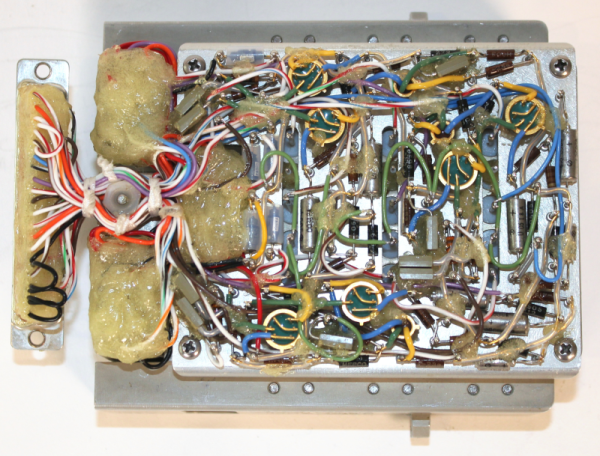
Things like weight and volume are always at a premium in a spacecraft, as is power. When you look at pictures of this solid box that weighs over 14 pounds, you’ll be amazed at how much is crammed into a relatively tiny spot. Remember, if this box was flying in 1969 it had to be built much earlier so there’s no way to expect dense ICs and modern packaging. There’s not even a printed circuit board. The components are attached to metal pegs in a point-to-point fashion. The whole thing lived near the bottom of the Command Module’s lower equipment bay.
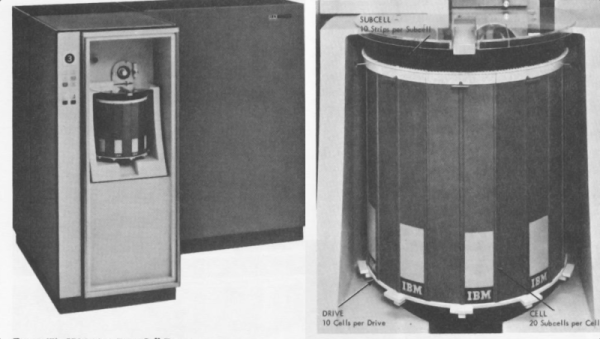
These days, mass storage for computers is pretty simple. It either uses a rotating disk or else it is solid state. There are a few holdouts using tape, too, but compared to how much there used to be, tape is all but dead. But it wasn’t that long ago that there were many kinds of mass storage. Tapes, disks, drums, punched cards, paper tape, and even stranger things. Perhaps none were quite so strange though as the IBM 2321 Data Cell drive — something IBM internally called MARS.
What is a data cell you might ask? A data cell was a mass storage device from IBM in 1964 that could store about 400 megabytes using magnetic strips that looked something like about a foot of photographic film. The strips resided inside a drum that could rotate. When you needed a record, the drum would rotate the strip you needed to the working part and an automated process would remove the strip in question, wrap it around a read/write head and then put it back when it was done.
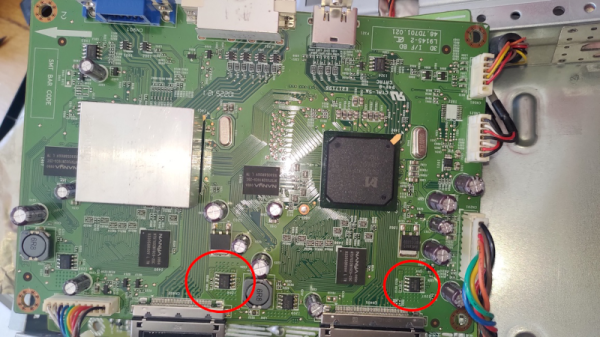
[Johnny] had a monitor that he was particularly fond of. The whole monitor appeared dead, and he decided to open it up and find out what could be wrong. He wound up fixing it — sort of — using a hairdryer. While we think his explanation of the problem is unlikely, we hate to armchair quarterback, and we applaud that he opened it up and got it working.
When something is dead, it is always a good idea to check the power and power supply, but that didn’t pan out in this case. In fact, the power supply board inside had what looked like reasonable voltage values throughout. The problem had to be something more subtle.
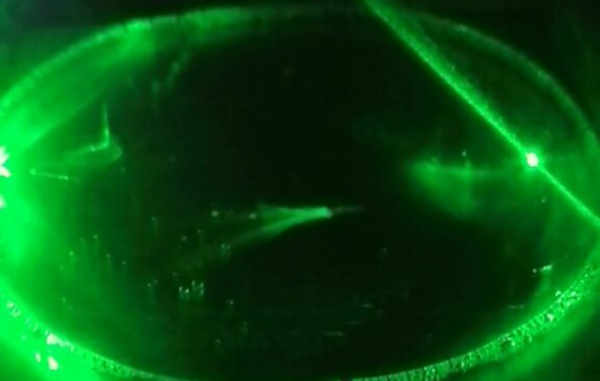
You might think that anything to do with a soap bubble is for kids. But it turns out that observing light scattering through a soap bubble produces unexpected results that may lead to insights into concepts as complex as space-time curvature. That’s what [stoppi] says in his latest experiment — generating “light whiskers” using a laser and a soap bubble. You can watch the video, below, but fair warning: if videos with only music annoy you, you might want to mute your speakers before you watch. On the other hand, it almost seems like a laser light show set to music.
The setup is simple and follows a 2020 Israeli-American research paper’s methodology. A relatively strong laser pointer couples to a fiber-optic cable through a focusing lens. The other end of the fiber delivers the light to the soap bubble, where it separates into strands that exhibit something called branched flow.
Our physics knowledge isn’t deep enough to explain what’s going on here. However, if you have an interest in reproducing this experiment, it doesn’t look like it takes anything exotic. The original paper has a lot to say on the topic and if that’s too heavy for you, there’s always the Sunday supplement version.
If there is ever a practical application for this, we’ll see an uptick in the design of bubble machines. Oddly, this isn’t the first time we’ve seen lasers married with bubbles.
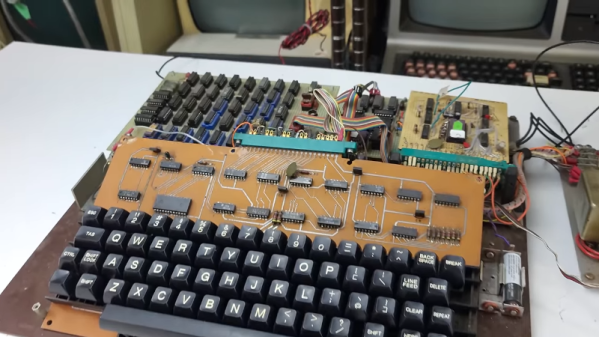
[Tech Time Traveller] has a lot of voices in his head this week, and most of them are worried about his wife’s reaction to him buying other people’s garbage. We don’t blame him, though. He bought it from an estate sale and it was billed as a TV typewriter. The device looked completely homebrewed from somewhere around the late 1970s to the early 1980s. It contains a mess of components obviously hand-built in a combination of neat construction and messy wiring.
[Tech] videos most of his tests and exploration to get the thing working and tested. Given its age and construction, it worked surprisingly well, although it did take a little work to get it back to complete function. In fact, he bought the device three years ago and is finally getting around to finishing the project and putting together the video.
[Piffpaffpoltrie] had a 20-year-old Acer flatbed scanner that they just couldn’t justify keeping. But it does seem a shame to throw away a working piece of gear. Instead, the old scanner became a light table. We’ll admit, as projects go, it isn’t the most technically sophisticated thing we’ve ever seen, but we do think it is a worthy way to upcycle something that would otherwise be filling up a landfill.
The scanner was old enough to have a CCFL light source inside. However, it was too small, so it came out along with many other components that may yet find use in another project. If you didn’t know , scanners are good sources for small stepper motors, straight rods, and first-surface mirrors.