Linux Fu: Fusing Hackaday

Unix and, by extension, Linux, has a mantra to make everything possible look like a file. Files, of course, look like files. But also devices, network sockets, and even system information show up as things that appear to be files. There are plenty of advantages to doing that since you can use all the nice tools like grep and find to work with files. However, making your own programs expose a filesystem can be hard. Filesystem code traditionally works at the kernel module level, where mistakes can wipe out lots of things and debugging is difficult. However, there is FUSE — the file system in user space library — that allows you to write more or less ordinary code and expose anything you want as a file system. You’ve probably seen FUSE used to mount, say, remote drives via ssh or Dropbox. We’ve even looked at FUSE before, even for Windows.

What’s missing, naturally, is the Hackaday RSS feed, mountable as a normal file. And that’s what we’re building today.
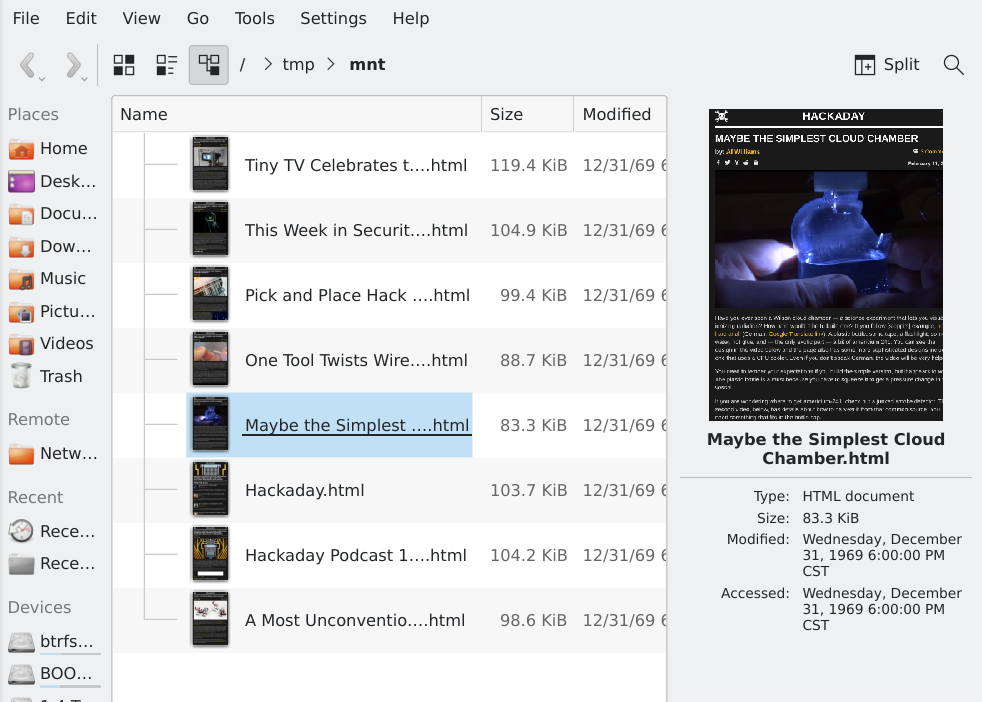
Writing a FUSE filesystem isn’t that hard, but there are a lot of tedious jobs. You essentially have to provide callbacks that FUSE uses to do things when the operating system asks for them. Open a file, read a file, list a directory, etc. The problem is that for some simple projects, you don’t care about half of these things, but you still have to provide them.

Luckily, there are libraries that can make it a lot easier. I’m going to show you a simple C++ program that can mount your favorite RSS feed (assuming your favorite one is Hackaday, of course) as a file system. Granted, that’s not amazing, but it is kind of neat to be able to grep through the front page stories from the command line or view the last few articles using Dolphin. Continue reading “Linux Fu: Fusing Hackaday”

A Hombrew Retro Laptop

We feel bad when we see a retrocomputer project and think, “Hey! That’s not that old.” But, usually, when we think about it, it really is. Take the Penkesu. It looks like one of the little organizer computers that were popular — ok — a long time ago.

Inside is a Raspberry Pi Zero 2W, a 7.9 inch 400×1280 screen and a 48-key mechanical keyboard. Unsurprisingly, the case is mostly 3D printed, but it does use Gameboy Advance SP hinges.

Continue reading “A Hombrew Retro Laptop”

Printing Magnets

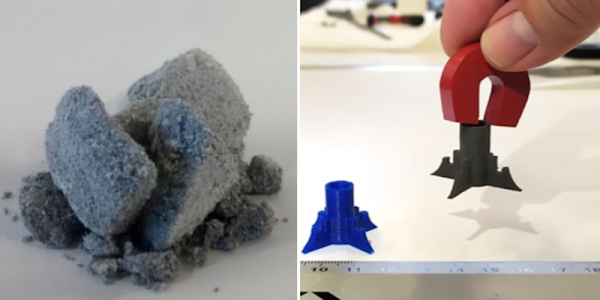
A research center in Spain has been working on ways to solve recent supply chain issues. One of these issues is a shortage of materials to make magnets. Their answer? Recycle ferrite residue by treating it and mixing it with ABS for 3D printing.

The mixing of ferrite with a polymer isn’t the key though, instead the trick is in the processing. The team collected strontium ferrite waste and ground it to a powder. Heating to the point of calcination (about 1000C) creates a superior material with a 350% increase in coercitivity and a 25% increase in remanence over the original waste material.

Continue reading “Printing Magnets”

As Fast As A Speeding Bullet

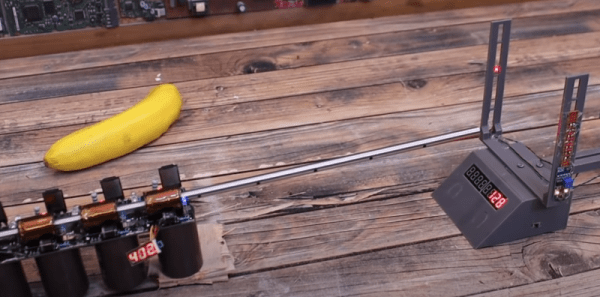
[Electronoobs] built a coil gun and the obvious question is: how fast is the projectile? To answer it, he built a chronograph suitable for timing a bullet. The principle is straightforward. A laser and a light sensor would mark the entry and exit of the projectile over a known distance. As it turns out, there are some issues to resolve.

For one thing, a laser is too narrow and might miss the projectile. The first attempt to rectify this used mirrors, but the loss was too great — we suspect he was using a second surface mirror. The final answer was to use an array of detectors and removed the laser’s collimation lens to cover a wider area.

Continue reading “As Fast As A Speeding Bullet”

3D Printing Tiny Metal Parts

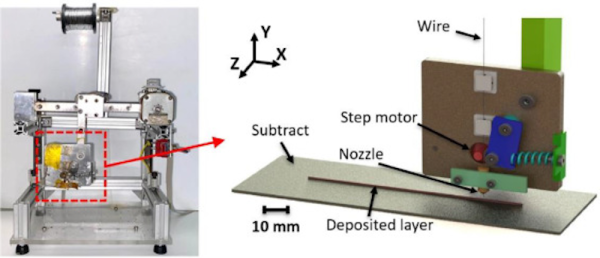
It may sound like a pop band, but μ-WAAM is actually a 3D printing technique for making small metal parts from the NOVA University Lisbon. Of course, WAAM stands for wire arc additive manufacturing, a well-known technique for 3D printing in metal. The difference? The new technique uses 250 μm wire stock instead of the 1mm or thicker wires used in conventional WAAM.

The thinner feed wire allows μ-WAAM to create fine details like thin walls that would be difficult to replicate with traditional methods. Typically, for fine structures, printers use fused metal powder. This is good for fine details, but typically slower and has higher waste than wire-based systems.

Continue reading “3D Printing Tiny Metal Parts”

Predicting The Future: How’s That Working Out?

With 2022 off to a good start, it is about time to let go of all those New Year’s resolutions that didn’t quite work out. The scale’s needle didn’t reverse, our nails are still bitten, and we are still binge-watching Breaking Bad instead of reading the classics. But, of course, there’s always the future where we just know we’re going to stick to our resolutions. Besides, the future will be replete with fat-eating nanobots, 3D printed nails every morning, and a pill you can take that will make you remember reading Ulysses.

Predicting the future is fraught with peril, which is why launching a new company or product is so risky. However, there have been a few prognosticators that have made some impressive forecasts. For example, in 1922 popular (if not critically acclaimed) author W. L. George wrote a piece for The New York Herald titled “What the World Will be Like In a Hundred Years.” Since May will see that piece’s 100th anniversary, let’s see how he did.

Continue reading “Predicting The Future: How’s That Working Out?”

Pump Up The Resin

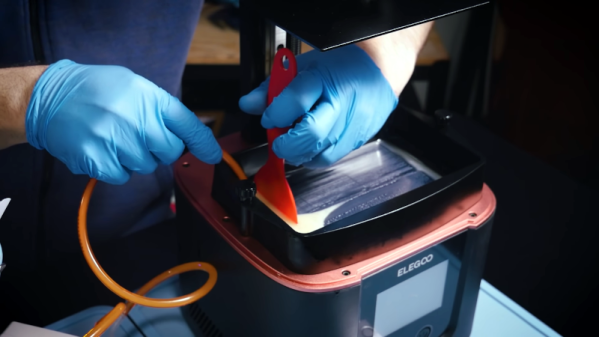
Sometimes the best ideas are simple and seem obvious after you’ve heard them. [Danny] showed us a great idea that fits that description. He uses a peristaltic pump to move resin in and out of his print bed. (Video, embedded below.) Normally, you remove the tank and pour the resin out into a container. With the pump, you can leave the tank where it is and simply pull the resin through a tube. The process is slower than pouring, but not as messy and doesn’t risk damage to your FEP film.

You can also use the pump like a vacuum to clean up resin. According to [Danny], the biggest value is when working with very large printers. He shows a Peopoly Phenom which has a huge tank compared to the other printers he shows in the video.

Continue reading “Pump Up The Resin”