$60 PC Oscilloscope Review

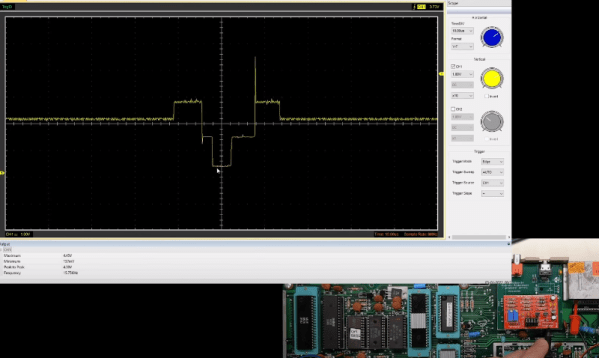
Owning an oscilloscope is a real gamechanger and these days, scopes are more capable and less expensive than ever before. However, there is a big difference between scopes that cost several hundred dollars which are usually quite good and many of the very inexpensive — below $100 — instruments that are often — but not always — little more than toys. [Adrian] looks at a PC-based scope from Hantek that costs about $60. Is it a toy? Or a useful tool? He answers the question in the video below.

The Hantek 6022BE sports two channels with a 20 MHz bandwidth and 48 million samples per second. The device included probes, too. Of course, you also need a PC, although there is apparently third-party software for Android if you don’t want to lug a laptop around.

Continue reading “$60 PC Oscilloscope Review” →

3D Printed CPU Bracket Reduces Temperatures

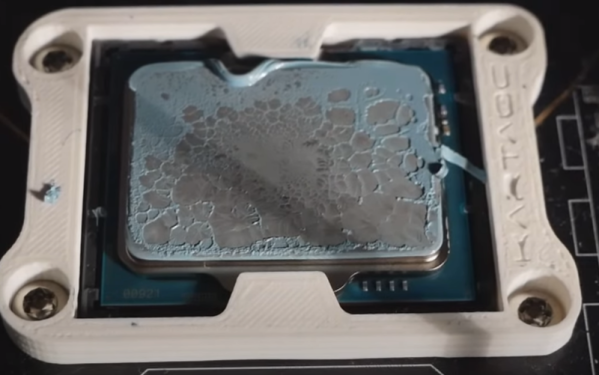
What do you do when your motherboard bends your CPU? If you’re [Karta] or [Luumi], you 3D print a new retaining bracket to fix the problem. [Karta] originated the design, and [Luumi] also tried it and produced the video you can see below.

We think we find flat surfaces all the time, but it is actually very difficult to create something truly flat. You usually learn this when you try to maximize heat transfer between two surfaces. Getting two supposedly flat surfaces to touch is quite hard. CPU brackets use a combination of pressure and some sort of thermal media or paste to fill in any gaps between the CPU case and the heat sink. Intel’s LGA1700 bracket is an example, but there’s been a problem. Apparently, with recent CPUs, the bracket is a little too tight, and it bends the CPU’s case. It doesn’t hurt the CPU, but it does inhibit thermal transfer.

Others have “fixed” this problem by adding some washers to slightly raise the bracket. In both cases, there has been some very small improvement in CPU temperatures. [Luumi] says part of the problem is his water cooling block is not completely flat and needs to be lapped. [Karta], however, reported a 7 degree drop in temperatures, which is pretty significant.

We love seeing how 3D printing can fix or improve things you own. They talk a lot about lapping in the video, and, in some cases, people actually risk lapping the IC die itself to make it flatter. It can help, but the risk is relatively high and the gain is relatively low.

Continue reading “3D Printed CPU Bracket Reduces Temperatures” →

Pixelating Text Not A Good Idea

People have gotten much savvier about computer security in the last decade or so. Most people know that sending a document with sensitive information in it is a no-no, so many people try to redact documents with varying levels of success. A common strategy is to replace text with a black box, but you sometimes see sophisticated users pixelate part of an image or document they want to keep private. If you do this for text, be careful. It is possible to unredact pixelated images through software.

It appears that the algorithm is pretty straightforward. It simply guesses letters, pixelates them, and matches the result. You do have to estimate the size of the pixelation, but that’s usually not very hard to do. The code is built using TypeScript and while the process does require a little manual preparation, there’s nothing that seems very difficult or that couldn’t be automated if you were sufficiently motivated.

Continue reading “Pixelating Text Not A Good Idea” →

Levitating With Light

The University of Pennsylvania has a team that did a little light research. Well, not light in the usual sense of that phrase. They used very strong light to levitate Mylar disks in a vacuum chamber.

Of course, it is no secret that light can exert pressure. That’s how solar sails work and some scientists have used it to work with aerosols and the like. But this appears to be the first time light lifted a large item against gravity. The team claims that their tests showed that a sunlight-powered flying vehicle might carry up to ten milligrams of payload. That doesn’t sound like much, but it’s impressive and the paper mentions that since the lift is not from aerodynamic forces, there might be applications in flying at very high altitudes.

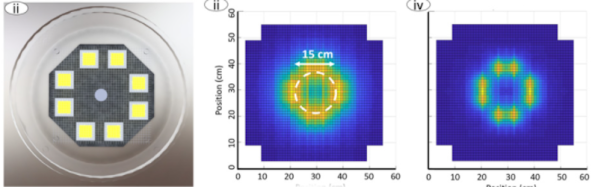
The Mylar disks were 500 nanometers thick and had a 300 nanometer layer of carbon nanotubes beneath. The nanotubes absorb light, make the disks more rigid, and improve the Mylar’s surface-gas characteristics. The light source had a strong center beam and an even stronger ring around the center beam that causes the disk to remain over the center beam. The LED system used eight arrays, each consuming 100 watts of input power.

Preparing the disk might be difficult, but the LED power isn’t that hard. Even if you do like the researchers did and use water cooling.

Winding Your Own Small Coils

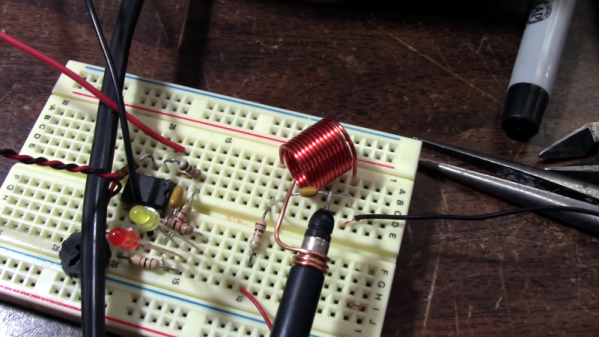
Depending on what you build, you may or may not run into a lot of inductors. If you need small value coils, it is easy to make good-looking coils, and [JohnAudioTech] shows you how. Of course, doing the winding itself isn’t that hard, but you do need to know how to estimate the number of turns you need and how to validate the coil by measurement.

[John] uses a variety of techniques to estimate and measure his coils ranging from math to using an oscilloscope. He even uses an old-fashioned nomogram from a Radio Shack databook circa 1972.

Continue reading “Winding Your Own Small Coils” →

How Big Is The Moon? Figure It Out Yourself

We have to confess that we occasionally send friends a link to “let me Google that for you” when they ask us something that they could have easily found online. Naturally, if someone asked us how big the moon is, we’d ask Google or another search engine. But not [Prof Matt Strassler]. He’d tell you to figure it out yourself and he would then show you how to do it.

This isn’t a new question. People have been wondering about the moon since the dawn of human civilization. The ancient Greeks not only asked the question, but they worked out a pretty good answer. They knew approximately how big the Earth was and they knew the moon was far away because it is seen over a very wide area. They also knew the sun was even further away because the moon sometimes blocks the sun’s light in an eclipse. Using complex geometry and proto-trigonometry they were able to work out an approximate size of the moon. [Matt’s] method is similar but easier and relies on the moon occluding distant stars and planets.

Continue reading “How Big Is The Moon? Figure It Out Yourself” →

AI Maybe Revives Dead Languages

While Star Trek’s transporter is hard to imagine — perfect matter movement across vast distances with no equipment on one end — it may not be the most far-fetched piece of tech on the Enterprise. While there are several contenders, I strongly suspect the universal translator is the most unlikely MacGuffin. After all, how would you decipher a totally unknown language in real-time? Of course, no one wants to watch 30 episodes of TV about how we finally figured out what Klingons call clouds, so pretty much every science fiction movie has some hand-waving explanation for speaking the viewer’s language. Farscape had microbes, some aliens have telepathy that works with alien brains of any kind, and still others study English from afar for decades off camera. Babelfish anyone?

I was thinking about this because of an article I read by [Alizeh Kohari] about [Jiaming Luo’s] work using AI to decode dead languages. While this might seem to be similar to Spock’s translator, it really isn’t. Human languages change over time and distance. You only have to watch the BBC or read something written by Thomas Jefferson to see that. But there is still a lot in common, at least within certain domains.

Continue reading “AI Maybe Revives Dead Languages” →