No Privacy: Cloning The AirTag

You’ve probably heard of the infamous rule 34, but we’d like to propose a new rule — call it rule 35: Anything that can be used for nefarious purposes will be, even if you can’t think of how at the moment. Case in point: apparently there has been an uptick in people using AirTags to do bad things. People have used them to stalk people or to tag cars so they can be found later and stolen. According to [Fabian Bräunlein], Apple’s responses to this don’t consider cases where clones or modified AirTags are in play. To prove the point, he built a clone that bypasses the current protection features and used it to track a willing experimental subject for 5 days with no notifications.

According to the post, Apple says that AirTags have serial numbers and beep when they have not been around their host Apple device for a certain period. [Fabian] points out that clone tags don’t have serial numbers and may also not have speakers. There is apparently a thriving market, too, for genuine tags that have been modified to remove their speakers. [Fabian’s] clone uses an ESP32 with no speaker and no serial number.

The other protection, according to Apple, is that if they note an AirTag moving with you over some period of time without the owner, you get a notification. In other words, if your iPhone sees your own tag repeatedly, that’s fine. It also doesn’t mind seeing someone else’s tags if they are near you. But if your phone sees a tag many times and the owner isn’t around, you get a notification. That way, you can help identify random tags, but you’ll know if someone is trying to track you. [Fabian] gets around that by cycling between 2,000 pre-loaded public keys so that the tracked person’s device doesn’t realize that it is seeing the same tag over and over. Even Apple’s Android app that scans for trackers is vulnerable to this strategy.

Even for folks who aren’t particularly privacy minded, it’s pretty clear a worldwide network of mass-market devices that allow almost anyone to be tracked is a problem. But what’s the solution? Even the better strategies employed by AirGuard won’t catch everything, as [Fabian] explains.

This isn’t the first time we’ve had a look at privacy concerns around AirTags. Of course, it is always possible to build a tracker. But it is hard to get the worldwide network of Bluetooth listeners that Apple has.
3D Printing Livers

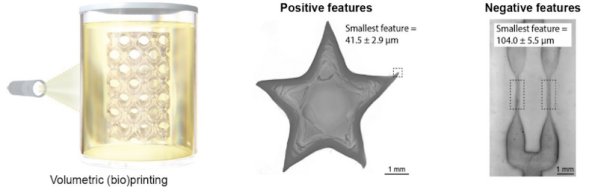
The University of Utrecht has a team that is successfully bioprinting “liver units” that are able to do some of the functions of a human liver and may open the door to new medical treatments. This isn’t simply printing a fake liver in a jar though, instead the technique uses optical tomography to rapidly create small structures of about 1 cc of volume in less than 20 seconds.

Apparently, one problem with printing hydrogels full of biological structures is that passing them through a nozzle tends to disturb the delicate structures.  This technique uses no nozzle or layers, which makes it useful in this situation.

Continue reading “3D Printing Livers” →

Hello (Many Quantum) World(s)

Historically, the first program you write for a new computer language is “Hello World,” or, if you are in Texas, “Howdy World.” But with quantum computing on the horizon, you need something better. Like “Hello Many Worlds.” [IonQ] proposes what that looks like and then writes it in seven different quantum languages in a post you should check out.

Here’s the description of the simple program:

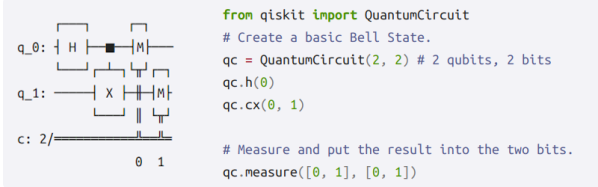
The basic quantum program we’ll write is simple. It creates a fully-entangled state between two qubits, and then measures this state. This state is sometimes called a Bell State, or Bell Pair, after physicist John Stewart Bell.

The measurement results for this program should give us 0 for both qubits or 1 for both qubits, in equal amounts. When running these, we’ll be able to tell that we’re running on real hardware because that’s not always what we get! These errors are what currently limit quantum computers, but the first steps to overcome this with quantum error correction have already begun.

Continue reading “Hello (Many Quantum) World(s)” →

High-Power Laser Salvaged From Headlights

[DiodeGoneWild]’s latest video lives up to the name. He takes apart a laser headlight to recover a pretty powerful blue laser. You can see the video, below.

The headlights work with blue laser diodes that excite phosphor to produce white light. Removing the outside trappings revealed a three-pin laser diode (the case is the third pin). There’s also a substantial heatsink. Removing the diode from the assembly is difficult, but it is easy enough to leave it in the heatsink and use the existing connector.

Of course, the phosphor and a filter have to go. Some destructive work with a screwdriver and pliers broke out the optics from a diode he’d destroyed trying to remove it. Then he replaced the optics on the remaining diode with the modified housing.

With a low-current test, the diode didn’t lase but did act as a regular LED. More current did the trick, though. The laser without the optics made a line rather than a spot but still had enough power to melt some plastic and light matches. To get a parallel beam, the internal lens needs to move closer to the diode, and a drill bit allowed that to happen, which reduced the beam’s divergence quite a bit, but didn’t create the best result.

With the proliferation of cheap laser modules, it is really worth scrapping a headlight? Maybe. But it is an interesting look inside of a modern headlight, either way. We’ve peeked inside these headlights before. Maybe you can turn those old headlights into an oven.

Continue reading “High-Power Laser Salvaged From Headlights” →

Linux Fu: Fusing Hackaday

Unix and, by extension, Linux, has a mantra to make everything possible look like a file. Files, of course, look like files. But also devices, network sockets, and even system information show up as things that appear to be files. There are plenty of advantages to doing that since you can use all the nice tools like grep and find to work with files. However, making your own programs expose a filesystem can be hard. Filesystem code traditionally works at the kernel module level, where mistakes can wipe out lots of things and debugging is difficult. However, there is FUSE — the file system in user space library — that allows you to write more or less ordinary code and expose anything you want as a file system. You’ve probably seen FUSE used to mount, say, remote drives via ssh or Dropbox. We’ve even looked at FUSE before, even for Windows.

What’s missing, naturally, is the Hackaday RSS feed, mountable as a normal file. And that’s what we’re building today.

Writing a FUSE filesystem isn’t that hard, but there are a lot of tedious jobs. You essentially have to provide callbacks that FUSE uses to do things when the operating system asks for them. Open a file, read a file, list a directory, etc. The problem is that for some simple projects, you don’t care about half of these things, but you still have to provide them.

Luckily, there are libraries that can make it a lot easier. I’m going to show you a simple C++ program that can mount your favorite RSS feed (assuming your favorite one is Hackaday, of course) as a file system. Granted, that’s not amazing, but it is kind of neat to be able to grep through the front page stories from the command line or view the last few articles using Dolphin. Continue reading “Linux Fu: Fusing Hackaday” →

A Hombrew Retro Laptop

We feel bad when we see a retrocomputer project and think, “Hey! That’s not that old.” But, usually, when we think about it, it really is. Take the Penkesu. It looks like one of the little organizer computers that were popular — ok — a long time ago.

Inside is a Raspberry Pi Zero 2W, a 7.9 inch 400×1280 screen and a 48-key mechanical keyboard. Unsurprisingly, the case is mostly 3D printed, but it does use Gameboy Advance SP hinges.

Continue reading “A Hombrew Retro Laptop” →

Printing Magnets

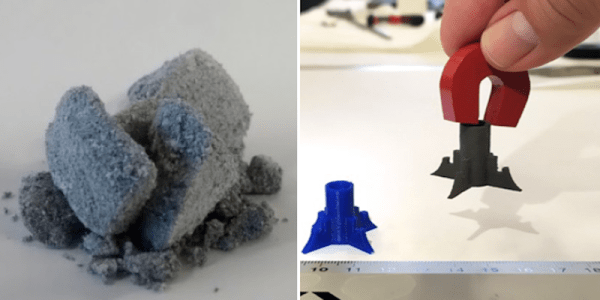
A research center in Spain has been working on ways to solve recent supply chain issues. One of these issues is a shortage of materials to make magnets. Their answer? Recycle ferrite residue by treating it and mixing it with ABS for 3D printing.

The mixing of ferrite with a polymer isn’t the key though, instead the trick is in the processing. The team collected strontium ferrite waste and ground it to a powder. Heating to the point of calcination (about 1000C) creates a superior material with a 350% increase in coercitivity and a 25% increase in remanence over the original waste material.

Continue reading “Printing Magnets” →