Linux Fu: Walk, Chew Gum

If you ever think about it, computers are exceedingly stupid. Even the most powerful CPU can’t do very much. However, it can do what it does very rapidly and repeatably. Computers are so fast, they can appear to do a lot of things at once, too and modern computers have multiple CPUs to further enhance their multitasking abilities. However, we often don’t write programs or shell scripts to take advantage of this. However, there’s no reason for this, as you’ll see.

Bash Support

It is surprisingly easy to get multiple processes running under Bash. For one thing, processes on either side of a pipe run together, and that’s probably the most common way shell scripts using multiprogramming. In other words, think about what happens if you write ls | more.

Under the old MSDOS system, the first program would run to completion, spooling its output to a temporary file. Then the second program will run, reading input from the same file. With Linux and most other modern operating systems, both programs will run together with the input of the second program connected to the first program’s output. Continue reading “Linux Fu: Walk, Chew Gum”
3D Printed Fabric Stiffens On Demand

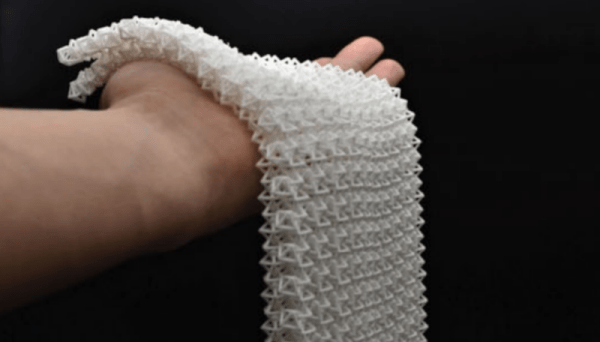
Researchers in Singapore and at CalTech have developed a 3D printed fabric with an interesting property: it is generally flexible but can stiffen on demand. You can see a video about the new fabric, below.

The material consists of nylon octahedrons interlocked. The cloth is enclosed in a plastic envelope and vacuum-packed. Once in a vacuum, the sheet becomes much stiffer and can hold many times its own weight.

Continue reading “3D Printed Fabric Stiffens On Demand”

Making Ferroelectric Solar Cells Better

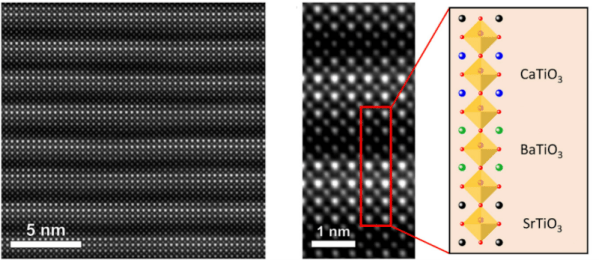
Researchers claim that using several very thin layers of ferroelectric crystals can lead to significantly better ferroelectric solar cell efficiency. But don’t pull the panels off your roof yet. Conventional cells are still much more efficient than ferroelectric devices — at least, for now.

Unlike conventional silicon-based solar cells, ferroelectric cells don’t depend on a PN junction and — in theory — can be cheaper and easier to produce. However, they typically don’t absorb as much sunlight as other materials.

Continue reading “Making Ferroelectric Solar Cells Better”

Google’s Periodic Table

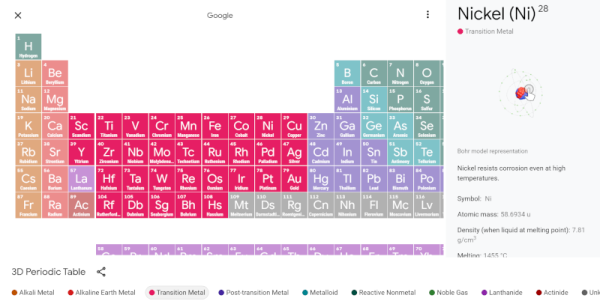
One of the nice things about the Internet is that you don’t need huge reference books anymore. You really don’t need big wall charts, either. A case in point: what science classroom didn’t have a periodic table of the elements? Now you can just look up an interactive one from Google. They say it is 3D and we suppose that’s the animations of the Bohr model for each atom. You can debate if it is a good idea to show people Bohr models or not, but it is what most of us learned, after all.

While the website is probably aimed more at students, it is a handy way to look up element properties and it is visually attractive, too. You probably remember, the columns are no accident in a periodic table, so the actual format doesn’t vary from one instance of it to another. However, we liked the col coding and the information panel that appears when you click on an element.

Continue reading “Google’s Periodic Table”

Audio Cassette Tape Data Retrospective

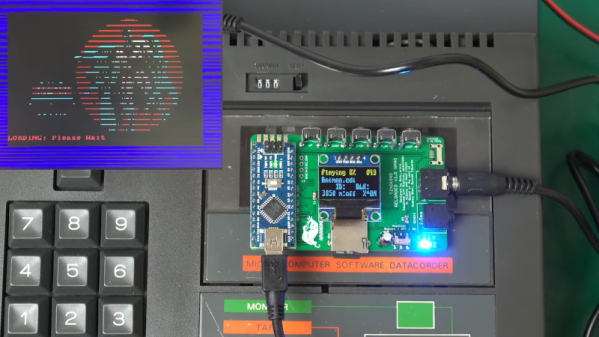
It has been a long time since we stored software and computer data on audiotape. But it used to be the de facto standard for hobby computers and [Noel] has a great video about the Amstrad’s system (embedded below) which was pretty typical and how the process could be sped up since today, you have perfect audio reproduction, especially compared to consumer-grade audiotape.

The cassette tapes suffered from several problems. The tape had an inherently low bandwidth, there was quite a bit of noise present from the analog circuitry and heads, and the transport speed wasn’t necessarily constant. However, you can easily digitally synthesize relatively noise-free sound at high fidelity and rock-solid frequency. So basically a microcontroller, like an Arduino, can look like an extremely high-quality tape drive.

Continue reading “Audio Cassette Tape Data Retrospective”

3D Prints Of Steel — Um — PLA, Rather

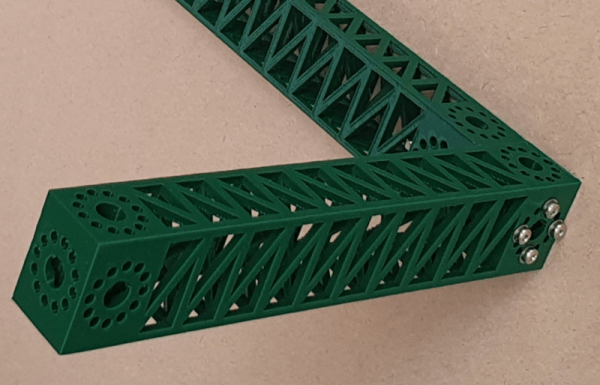
Need a steel beam? You can 3D print PLA beams that are as strong as a steel beam of equivalent weight according to [RepRap]. The Python code for FreeCAD generates a repeating structure especially well suited for belt printers that can print a beam of any length. Keep in mind, of course, given two things that weigh the same, if one is made of steel and the other PLA, the steel one will be physically smaller.

The beams are repeating tetrahedrons which are quite strong with a lot of material on the outer faces to resist bending. Each beam end has a neat block with a wiring hole and a ring of small holes that allow you to mount the beams to things or each other with 30 degree increments of rotation.

Continue reading “3D Prints Of Steel — Um — PLA, Rather”

Charles Lindbergh The Famous… Inventor?

Most people remember Charles Lindbergh for his non-stop solo flight across the Atlantic which made him an international celebrity. If you are a student of history, you might also know he was at the center of a very controversial trial surrounding the kidnapping of his child or even that he had a dance named after him. But did you know he was also the co-inventor of a very important medical device? Turns out, medicine can thank Lindbergh for the creation of the perfusion pump.

Continue reading “Charles Lindbergh The Famous… Inventor?”