Inside A DEC Hard Drive

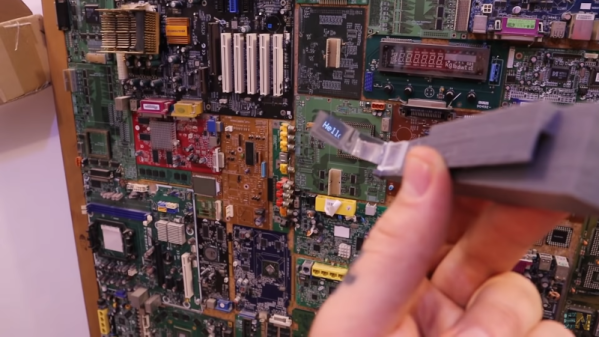
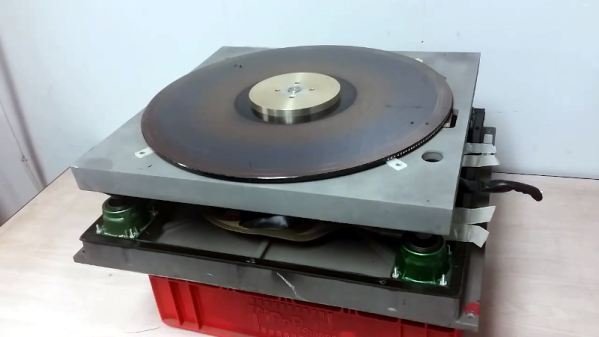
A lot of technology from the not-so-distant past doesn’t resemble modern versions very much. For a case in point, look at the DEC RS08 disk drive meant to pair with a circa 1970 PDP-8. Paired with an RF08 controller, this was state of the art, holding 262K 12-bit words with a blistering access speed of almost 63K/second unless you were plugged into 50Hz AC when it was closer to 50K/second. [Uniservo] had the disk unit, but not the controller. Someone else had a controller, but no disk drive. So [Uniservo] is shipping the disk to its new owner in a move worthy of a Reeses’ Peanutbutter Cup. The problem? The disk is super fragile and shipping is risky, so he decided to remove the platter for separate packing. Good thing for us, because we get a peek inside.

The nickel-cobalt platter looks like a thick LP record with heads underneath. As you might guess from the data transfer specification, the motor was just a common AC motor that rotated the platter against the head.
Continue reading “Inside A DEC Hard Drive”

Power Supply Uses Thin Form Factor

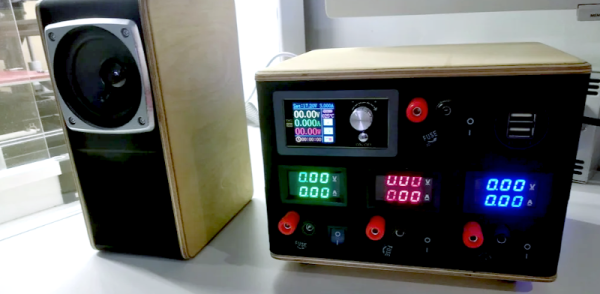
We’ve seen lots of power supply projects that start with an ATX PC power supply. Why not? They are cheap and readily available. Generally, they perform well and have a good deal of possible output. [Maco2229’s] design, though, looks a lot different. First, it is in a handsome 3D-printed enclosure. But besides that, it uses a TFX power supply — the kind of supply made for very small PCs as you’d find in a point of sale terminal or a set-top box.

Like normal PC supplies, these are inexpensive and plentiful. Unlike a regular supply, though, they are long and skinny. A typical supply will be about 85x65x175mm, although the depth (175mm) will often be a little shorter. Compare this to a standard ATX supply at  150x86x140mm, although many are shorter in depth. Volume-wise, that’s nearly 967 cubic centimeters versus over 1,800. That allows the project to be more compact than a similar one based on ATX.

Continue reading “Power Supply Uses Thin Form Factor”

Exploring Op Amp Loading

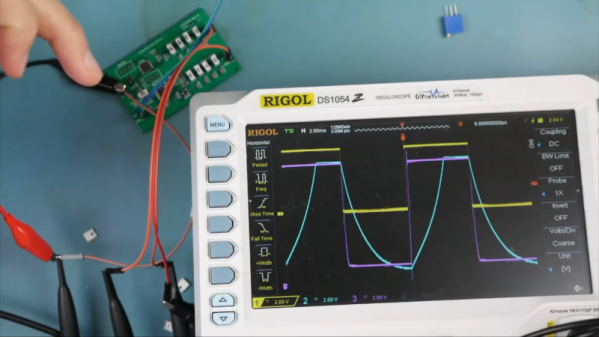
Op amps are generally pretty easy to apply, but there are some practical nonideal behaviors you have to keep in mind. [EEforEveryone] takes a test board with some 2X amplifiers on it and — after some fiddling around with the scope probes — demonstrates the effect of capacitive loading on the output of an op amp. (Video, embedded below.)

The op amp in question is the OP07. In fact, there are two identical opamps looking at the single input. The output of one op amp feeds directly to the scope probes. The second one passes through a bipolar transistor buffer consisting of an NPN and PNP transistor. Both outputs have optional capacitors that can be jumpered in or out of the circuit.

Continue reading “Exploring Op Amp Loading”

Heads Up: Smart Glass Multimeter

Sometimes it is hard to probe a circuit and then look over at the meter. [Electronoobs] decided to fix that problem by making a Google Glass-like multimeter using an OLED screen and Bluetooth module.

The custom PCB doesn’t have many surprises. A small board has a controller, a battery charger, a display, and a Bluetooth module. One thing he did forget is a switch, though, so the board is always on unless you arrange an external switch.

Continue reading “Heads Up: Smart Glass Multimeter”

The Imperfect Bipolar Transistor

We like to pretend that our circuit elements are perfect because, honestly, it makes life easier and it often doesn’t matter much in practice. For a normal design, the fact that a foot of wire has a tiny bit of resistance or that our capacitor value might be off by 10% doesn’t make much difference. One place that we really bury our heads in the sand, though, is when we use bipolar transistors as switches. A perfect switch would have 0 volts across it when it is actuated. A real switch won’t quite get there, but it will be doggone close. But a bipolar transistor in saturation won’t be really all the way on. [The Offset Volt] looks at how a bipolar transistor switches and why the voltage across it at saturation is a few tenths of a volt. You can see the video below.

To understand it, you’ll need a little bit of math and some understanding of the construction of transistors. The idea of using a transistor as a switch is that the transistor is saturated — that is, increasing base current doesn’t make much change in the collector current. While it isn’t perfect, it is good enough to switch a relay or do other common switching tasks.

Continue reading “The Imperfect Bipolar Transistor”

3D Animation For All Thanks To Google AI

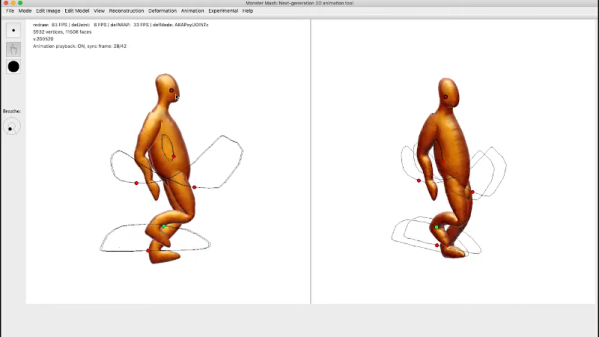
Google rarely fails to impress with technology demos. Their latest — Monster Mash — is aimed at using artificial intelligence to allow the creation of simple 3D animations without a lot of training or trouble. We’ll warn you: we aren’t artists so we didn’t get the results the demos were showing, but then again, if you are even a little artistic, you’ll probably have better luck than we did. You might want to start watching the video, below.

There’s also a research paper if you are more interested in the technology. The idea is to make simple line drawings in 2D. Then you inflate the object to 3D. The final step is to trace out animation paths.

Continue reading “3D Animation For All Thanks To Google AI”

Queen Victoria’s Secret (Teletype And COSMAC Elf)

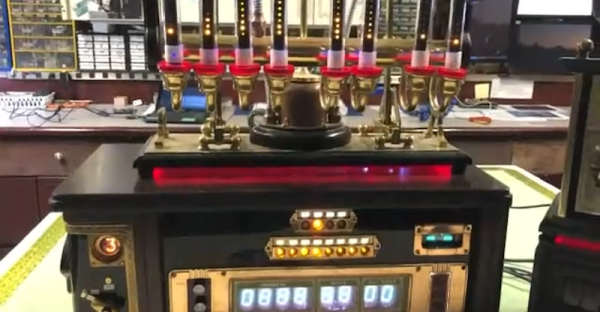
We don’t really think anyone in the Victorian era had a COSMAC Elf — the homebrew computer based around the RCA 1802 CPU. But if they did, it might have looked like [Daniel Ross’] steampunk recreation of the system that includes an appropriate-looking teletype device. You can see the thing in a series of videos, below. There are actually quite a few videos showing different parts of the system, along with several blog postings stretching back a few months.

A magic eye tube doesn’t look out of place in this build. We especially liked the glass tube displays and the speaker, although we thought the USS Enterprise looked out of place with the technology based on stone knives and bearskins, to paraphrase Mr. Spock. On the plus side, the VFD displays have the right glowing look, although a Nixie would have been pretty good there, too.

The videos don’t have much detail, but the blog posts do if you wanted to attempt something similar. Honestly, 1802 system design is pretty easy thanks to the its on-chip DMA that allows you to load memory from switches with no actual software like a monitor. The teletype started out life as a Remington #7 from around 1900, although another newer machine donated parts to get everything working. It is a testament to how well things were built then that it took as much abuse as it did and still has working parts.

We have a soft spot for the 1802 — it was a very good design for its time. We’ve even gone as far as to simulate it.

Continue reading “Queen Victoria’s Secret (Teletype And COSMAC Elf)”