Spy Tech: Tiny Spy Plane Becomes Cold War Prize

What looks like something famous, is much smaller, and is embroiled in a web of cold war cloak-and-dagger intrigue? It sounds like the answer could be Mini-Me from the Austin Powers movies, but we were actually thinking of the D-21 supersonic spy drone. Never heard of it? It didn’t have a very long service life, but it was a tiny little unmanned SR-71 and is part of a spy story that would fit right in with James Bond, if not Austin Powers.

The little plane had a wingspan of only 19 feet — compared to the SR-71’s 56 foot span — and was 42 feet long. It could fly at about Mach 3.3 at 95,000 feet and had a range of around 3,500 miles. It shared many characteristics with its big brother including the use of titanium and a design to present a low RADAR cross-section.

The Spy Who Photographed Me

With today’s global economy and increased international cooperation, it is hard to remember just how tense the late 1960s were. Governments wanted to see what other governments were up to. Satellite technology would eventually fill that role, but even though spy satellites first appeared in 1959, they used film that had to be retrieved by an airplane as it fell from the sky and then processed. Not exactly real time. More effective satellites would have to wait for better imaging technology — see the video below for just how bad those old satellite images were. That left spy planes to do the bulk of the work.

Continue reading “Spy Tech: Tiny Spy Plane Becomes Cold War Prize”
Abusing A CPU’s Adders To Optimize Bit Counting

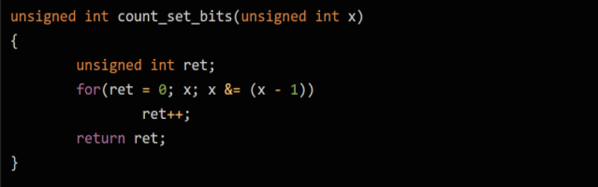
If you like nitpicking around C code and generated assembly language — and we’ll admit that we do — you shouldn’t miss [Scaramanga’s] analysis of what’s known as Kernighan’s trick. If you haven’t heard of the trick, it’s a pretty efficient way of counting bits.

Like the Wheatstone bridge and a lot of other things, the Kernighan trick is misnamed. Brian Kernighan made it famous, but it was actually first published in 1960 and again in 1964 before he wrote about it in 1988. The naive way to count bits would be to scan through each bit position noting how many one bits you encounter, but the problem is, that takes a loop for each bit. A 64-bit word, then, takes 64 loops no matter what it contains. You can do slightly better by removing each bit you find and stopping when the word goes to zero, but that still could take 64 cycles if the last bit you test is set.

Continue reading “Abusing A CPU’s Adders To Optimize Bit Counting”

Adobe Neural Net Detects Photoshop Shenanigans

Photoshop can take a bad picture and make it look better. But it can also take a picture of you smiling and make it into a picture of your frowning. Altering images and video can of course be benign, but it can also have nefarious purposes. Adobe teamed up with researchers at Berkeley to see if they could teach a computer to detect a very specific type of photo manipulation. As it turns out, they could.

Using a Photoshop feature called face-aware liquify, slightly more than half of the people tested could tell which picture was the original and which was retouched to alter the facial expression. However, after sufficient training, Adobe’s neural network could solve the puzzle correctly 99% of the time.

Continue reading “Adobe Neural Net Detects Photoshop Shenanigans”

Morse Code Catches Google Swiping Lyrics

We think of Morse code in terms of dots and dashes, but really it’s a kind of binary code. Those symbols might as well be 0s and 1s or any other pair of characters. That attribute is exactly what led to a sting operation a music lyric site called Genius.com pulled on Google. At issue was a case of song lyrics that had allegedly been stolen by the search giant.

Song lyric sites — just like Google — depend on page views to make revenue. The problem is that in a Google search the lyrics appear on the search page, so there is no longer much incentive to continue to the song lyric site. That’s free enterprise for you, right? It is, but there was a problem. It appears that Google — or, according to Google, one of their partners — was simply copying Genius.com’s lyrics. How does Genius know the song lyrics were copied? According to news reports in the Wall Street Journal and other sources, they used Morse code.

Continue reading “Morse Code Catches Google Swiping Lyrics”

Before Computers: Notched Card Databases

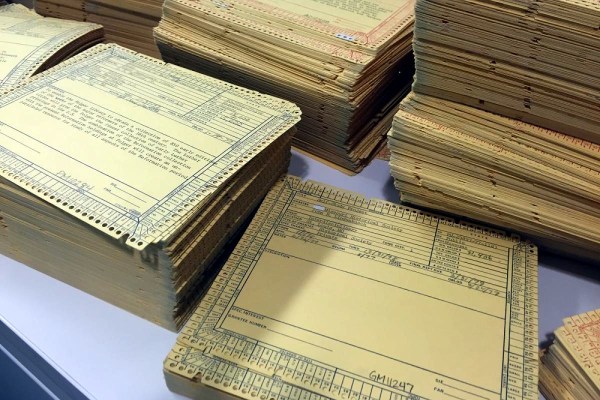
It is hard to remember that practical computers haven’t been around for even a century, yet. Modern computers have been around an even shorter period. Yet somehow people computed tables, kept ledgers, and even wrote books without any help from computers at all. Sometimes they just used brute force but sometimes they used little tricks that we’ve almost forgotten. For example, only a few of us remember how to use slide rules, but they helped send people to the moon. But what did database management look like in, say, 1925? You might think it was nothing but a filing cabinet and someone who knew how to find things in it. But there was actually a better system that had fairly wide use.

Continue reading “Before Computers: Notched Card Databases”

Game Builder Lets Kids — Even Old Kids — Build Games

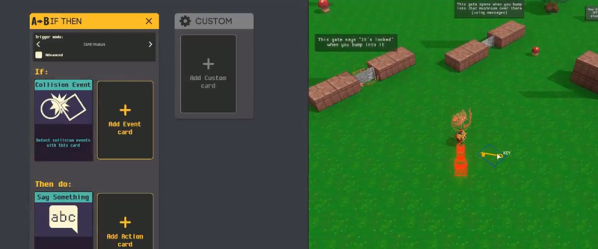
One rite of passage back in the good old days of owning a TRS-80, Commodore 64, or similar vintage computer was writing your own game. It probably wouldn’t be very good, but it wouldn’t be much worse than most of the stuff that was out there, either. Today, trying to get a kid interested in “hunt the wumpus” is probably not going to fly and having them create a modern-looking game is out of the question. Or is it? Disguised as a game itself, Game Builder offers an interactive way to create interesting games without having to get too detailed into programming. On the other hand, it supports JavaScript, so you can get to programming if you need to or want to. We could easily see a kid — or even an adult — easing into programming using this game which is free, from Google.

In the old days, hardware was a limiting factor and Basic made it pretty easy to whip out some text or crude graphics. Our favorite was a high low game that guesses your number. But everyone had some little game they’d create so they said they could. Today’s games, though, have good graphics and music and 3D shapes and a host of other things you didn’t have to contend with back then. Game Builder, though, makes it pretty simple. You can work on a game by yourself, or with friends, or with the general public. Everyone involved can play the game, but they can also edit the game. The tool runs under Steam so even though it is marked for PC or Mac, it will also run on Linux if you have Steam installed properly.

Continue reading “Game Builder Lets Kids — Even Old Kids — Build Games”

Play Dough Simplifies Interferometer Build

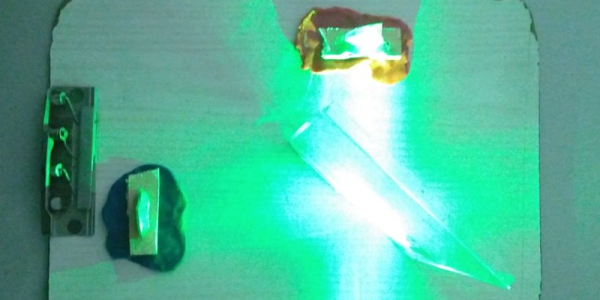
An interferometer sounds like something complicated, and in a way, it is. But it is also pretty easy to build one with some common materials. [Let’s Innovate] has instructions for how to make an interferometer using a green laser pointer, some mirrors, and a CD case. one of the most mundane parts, though, might be the most important: Play Dough.

The very sensitive device needs very precise alignment of the mirrors that reflect the beam. Using Play Dough it is easy to adjust the mirrors to the spot that is just right and then have it stay there.

For the best result, the mirrors really need to be first surface mirrors and not the more common kind with the reflective part on the back. Apparently, a green laser gives better results than a red one, too. If you don’t want to hack up a CD jewel case, a DVD player may give up a beam splitter.

So what do you use it for? Well, most of us use it to see the pretty patterns. But the instrument actually has wide-ranging applications to measure very small distances in fields as diverse as astronomy, optics, and photomicroscopy. To do anything really practical, you might need to add a detector of some sort.

If you want a more robust build, this one is similar. If you have a well-stocked test bench, you might be able to get by with even less.