A Tale Of Two Phases And Tech Inertia

What kind of power service is in the United States? You probably answered 120-volt service. If you thought a little harder, you might remember that you have some 240-volt outlets and that some industrial service is three phase. There used to be DC service, but that was a long time ago. That’s about it, right? Turns out, no. There are a very few parts of the United States that have two-phase power. In addition, DC didn’t die as quickly as you might think. Why? It all boils down to history and technological inertia.

Split Phase Power by Charles Esson CC-BY-SA 3.0

You probably have quite a few 120-volt power jacks in sight. It is pretty hard to find a residence or commercial building these days that doesn’t have these outlets. If you have a heavy duty electric appliance, you may have a 240-volt plug, too. For home service, the power company supplies 240 V from a center tapped transformer. Your 120V outlets go from one side to the center, while your 240V outlets go to both sides. This is split phase service.

Industrial customers, on the other hand, are likely to get three-phase service. With three-phase, there are three wires, each carrying the line voltage but out of phase with each other. This allows smaller conductors to carry more power and simplifies motor designs. So why are there still a few pockets of two-phase?

Continue reading “A Tale Of Two Phases And Tech Inertia”

Incremental Sheet Forming With A CNC Machine

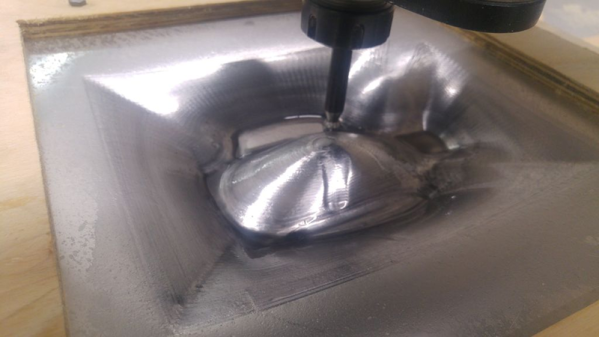
If you want to form a piece of sheet metal into a shape, you’ll probably think about using a die. That’s certainly a great way to do it, but it presupposes you can create or purchase the die, which may be a showstopper for small projects. [Dardy-7] has worked out how to use a lesser-used technique — incremental sheet forming — to get similar results with a CNC machine. The idea is to trace out the form on the sheet metal with a round blunt tool.

He got good results using an inexpensive dapping tool, although he’s seen other use heated titanium ball bearings. In addition, he’s worked out how to adapt existing tool paths, like the ones you might download from the Internet, to use with this technique. You can see a video of the workflow below.

Continue reading “Incremental Sheet Forming With A CNC Machine”

Up AlphaGoer Five

AlphaGo is the deep learning program that can beat humans at the game Go. You can read Google’s highly technical paper on it, but you’ll have to wade through some very academic language. [Aman Agarwal] has done us a favor. He took the original paper and dissected the important parts of in in plain English. If the title doesn’t make sense to you, you need to read more XKCD.

[Aman] says his treatment will be useful for anyone who doesn’t want to become an expert on neural networks but still wants to understand this important breakthrough. He also thinks people who don’t have English as a first language may find his analysis useful. By the way, the actual Go matches where AlphaGo beat [Sedol] were streamed and you can watch all the replays on YouTube (the first match appears below).

Continue reading “Up AlphaGoer Five”

Hacked 3D TV Glasses May Cure Lazy Eye

Lazy eye (technically Amblyopia) is a sight disorder that affects about 3% of the population where one eye is stronger than the other. Historically, treatment is via an eyepatch or special drops, but research shows that it may be better not to cover up the strong eye for long periods. It suggests that occluding the eye for short periods using a liquid crystal panel can yield better results. To that end, [Raninn] decided to hack some LCD glasses meant for 3D TV viewing to make a low-cost lazy eye treatment device.

This is his second version of [Raninn’s] glasses. The first one took two batteries and didn’t generate enough voltage for the LCD panels. The newer design uses a Dickson charge pump to generate a higher voltage from the battery and surface mount MOSFETs to switch voltages to the panels.

The write up is very complete with details about how to create even the PC board. He didn’t get into a lot of details about hacking the glasses. We assume that’s because your glasses may be different from his. These shutter glasses aren’t too complicated, you’ll just need to find the connections to the panel.

One of our favorite shutter glasses hacks came from [Dino] who built a set of automatic sunglasses for himself. Many of us wear glasses and for those with bifocals we keep waiting for an eyeglasses hack that makes automatic mult-focals a reality.

3D Printed Transmission Invented Again; This Time Continuously Variable

We shouldn’t laugh, but we know the feeling very well. [Gear Down for What] invented a revolutionary transmission and fabricated it from scrap material when he was 16. Except he later found out the same design was the subject of a patent filed 14 years earlier. Dismayed he destroyed his prototype, but fast forward to today and he’s made a 3D model of a ratcheting continuously variable transmission. You can see a video of him explaining how it works below and put your own spin on the idea by grabbing the model from Thingiverse.

The model is just for demonstration purposes. We doubt it would wear well enough to use in practice but it’s great to get your hands on for a really intuitive understanding of the mechanism. Some modern automobiles use a continuously variable transmissions (CVT) and many recreational vehicles and motorcycles use them. Like any transmission, their job is to match the motor’s rotation to needed output torque and speed by offering different gearing ratios. Whereas a normal transmission provides a few fixed gears, a CVT changes seamlessly through a range of ratios.

Some of the design of the transmission is pretty tricky, like the cam adjustment. The video shows the rationale for how the design works and how it relates to tank steering (tank as in an Army tank; not like a gas tank). The model isn’t just plastic. It uses some screws and BBs, as well. However, if you have a 3D printer and wanted a good classroom demonstration, this is the ticket.

We’ve seen other geared variable transmissions for robots before. The planetary gears in the cam adjustment of this design are well understood. If you want to brush up your planetary knowledge, there’s no time like the present.

Continue reading “3D Printed Transmission Invented Again; This Time Continuously Variable”

IoT Potty Training

If you have not had children, stop reading now, we implore you. Because before you’ve had kids, you can’t know how supremely important it is that they take care of going to the bathroom by themselves. [David Gouldin] knows how it is. But unlike most of us, he resorted to using an Amazon IoT button and Twilio. No, we are not kidding.

The problem he was trying to solve is when his younger child would need to use the potty in the middle of the night, calling out for assistance would wake the older child. [David] said it best himself:

Behind the smiling emoji facade is an Amazon IoT button, a variant of Amazon’s dash button. When my kid presses this button, it triggers an AWS Lambda function that uses Twilio’s Python Helper Library to call my iPhone from a Twilio number. The Twilio number is stored in my contacts with “emergency bypass” turned on, so even when it’s 2am and I’m on “do not disturb” I still get the call.

Continue reading “IoT Potty Training”

You Don’t Need To Be Tony Stark To Afford This Hand Controller

Proving that duct tape really can do anything, [StudentBuilds] uses it to make a workable controller out of a glove. To be fair, there are a few more bits too, including paper coated with pencil graphite and tin foil, which forms a variable resistor you can read with an Arduino analog input. You can see the entire thing in the video below.

The source code is simple at this point — eventually, he plans to control a robotic hand with the controller, but that’s later. However, there’s no promised link to the code in the description, so you’ll have to freeze frame and type. However, it is pretty simple — just read the analog pin values to determine the specific values for each finger.

Continue reading “You Don’t Need To Be Tony Stark To Afford This Hand Controller”