Morse Code: Paris In The Mint Box

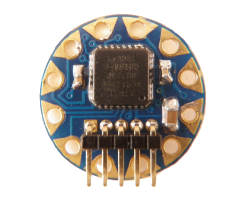
TinyLilyThumbnail[Rob Bailey] likes to build things and he likes ham radio. We are guessing he likes mints too since he’s been known to jam things into Altoids tins. He had been thinking about building a code practice oscillator in a Altoids Smalls tin, but wasn’t sure he could squeeze an Arduino Pro Mini in there too. Then he found the TinyLily Mini. The rest is history, as they say, and 1CPO was born.

The TinyLily Mini is a circular-shaped Arduino (see right) about the size of a US dime. most of the pads are arranged around the circle and there is a small header that takes a USB programmer. A small rechargeable battery can run the device for a long time.

Continue reading “Morse Code: Paris In The Mint Box” →

Kids! Don’t Try This At Home! Robot Destroys Mankind

From the Forbin Project, to HAL 9000, to War Games, movies are replete with smart computers that decide to put humans in their place. If you study literature, you’ll find that science fiction isn’t usually about the future, it is about the present disguised as the future, and smart computers usually represent something like robots taking your job, or nuclear weapons destroying your town.

Lately, I’ve been seeing something disturbing, though. [Elon Musk], [Bill Gates], [Steve Wozniak], and [Stephen Hawking] have all gone on record warning us that artificial intelligence is dangerous. I’ll grant you, all of those people must be smarter than I am. I’ll even stipulate that my knowledge of AI techniques is a little behind the times. But, what? Unless I’ve been asleep at the keyboard for too long, we are nowhere near having the kind of AI that any reasonable person would worry about being actually dangerous in the ways they are imagining.

Smart Guys Posturing

Keep in mind, I’m interpreting their comments as saying (essentially): “Soon machines will think and then they will out-think us and be impossible to control.” It is easy to imagine something like a complex AI making a bad decision while driving a car or an airplane, sure. But the computer that parallel parks your car isn’t going to suddenly take over your neighborhood and put brain implants in your dogs and cats. Anyone who thinks that is simply not thinking about how these things work. The current state of computer programming makes that as likely as saying, “Perhaps my car will start flying and we can go to Paris.” Ain’t happening.

Continue reading “Kids! Don’t Try This At Home! Robot Destroys Mankind” →

Cable Butchering For Logic-Level Serial

Early PCs and other computers had serial ports, sometimes as their main interfaces for peripherals. Serial ports still survive, but these days they are more likely to have a USB connection into the main computer. However, when you are working with a microcontroller, you probably don’t want a proper RS232 port with its plus and minus 12 volt signals.

You can get converters that specifically output logic-level signals but you probably can’t pick one up at the local office supply store. They might, though, have a normal USB to serial cable. [Aaron] had the same problem so he hacked into a cable to pull out the logic level signals.

On the one hand, hacks like this are a good inspiration for when you have a similar problem. On the other hand, you probably won’t wind up with the same cable as [Aaron]. He got lucky since the board inside his cable was clearly marked. Just to be sure, he shorted the transmit and receive lines to see that he did get an echo back from a terminal program.

Unsurprisingly, you can also repurpose an ESP8266 to perform this same task. Or, you can use a cable as an I/O device.

Radio Shack Returns

In February 2015, Radio Shack–an icon in American malls and towns–filed for bankruptcy. You could say a lot of critical things about Radio Shack, but in many parts of the country, it was the only place you were going to go find electronic components on short notice. A lot of people of a certain age got their exposure to electronics via Radio Shack kits and parts.

Radio Shack did close a lot of stores. In fact, from 4,000 stores they are down to about 1,700. A New York hedge fund named Standard General bought all the Radio Shack assets and formed a new company (also called, oddly enough, Radio Shack). They just named [Dene Rogers] as CEO. He’s a veteran at retail sales, having been with Target in Australia and Sears in Canada.

Continue reading “Radio Shack Returns” →

Raspberry Pi Levels With You

It is easy to imagine how early man started using rocks and then eventually developed better and better tools until they created the hammer. Some simple tools took a little longer to invent. The spirit level, for example, didn’t exist until sometime in the last half of the 1600’s.

The idea is simple. A clear tube holds a liquid and a bubble. When the bubble is in the center of the tube, the device is level in the direction of the tube. [Mark Williams] has a slightly more involved approach. He took an internal measurement unit (IMU) and a Raspberry Pi to create a modern take on the spirit level.

Continue reading “Raspberry Pi Levels With You” →

FriendlyARM: A Different Flavor Of Raspberry

A lot of old science fiction movies show people wearing the same–or nearly the same–clothes. We’re left guessing if this is because there is a single centralized plant mass-producing skin-tight jumpsuits, or if everyone is under orders to dress the same. Now that we live in the past’s future, it looks like science fiction was a poor predictor of fashion. People want variety.

Which calls to mind development boards. How many different ones do we need? Need doesn’t matter, because we have plenty of them. There may be strong leaders: in the 8-bit world, you think of the Arduino, and on the Linux side, maybe the Raspberry Pi. But there are options.

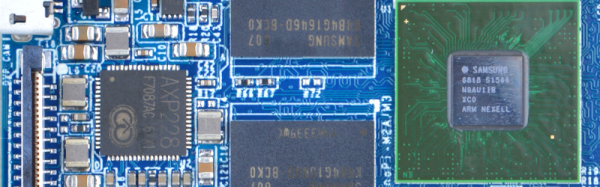
[Eric Brown] recently compared several inexpensive development boards from FriendlyARM including the NanoPi M3, the NanoPi M1, and the NanoPC-T3. These range from about $11 to $60 with the M3 costing $35. You can see an M1 booting on an HDMI screen in the video below.

Continue reading “FriendlyARM: A Different Flavor Of Raspberry” →

Waste Not, No Lights

Alchemists tried in vain to transmute lead into gold. What if you could turn waste products into energy? That’s what [chemicum] did in a recent video–he and some friends built microbial fuel cells that convert excrement into electricity (you can see the video, below).

The video doesn’t give you all the details of the build, but it seems easy enough. You need some stainless steel mesh, some activated charcoal, some epoxy, plastic containers, and some assorted metal plates and hardware. Of course, you also need excrement and–if the video is any indication–some clothespins to clamp your nose shut as you work.

Continue reading “Waste Not, No Lights” →