3D Printed RC Servo To Linear Actuator Conversion

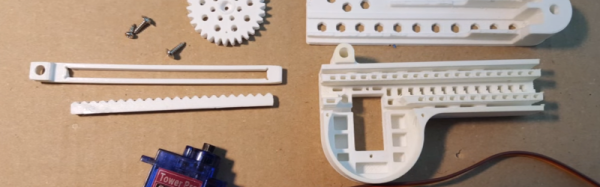
RC servos are handy when you need to rotate something. You can even modify them to rotate continuously if that’s what you need. However, [Roger Rabbit] needed linear motion, but wanted the simple control afforded by an RC servo. The solution? A 3D printed housing that converts a servo’s rotation into linear motion.

The actuator uses five different parts, a few screws, and a common RC servo. The video shows the actuator pushing and pulling a 200g load with a 6V supply. There’s some room for adjustment, so different servos should work.

Continue reading “3D Printed RC Servo To Linear Actuator Conversion”
Electrolytic Capacitor Repair

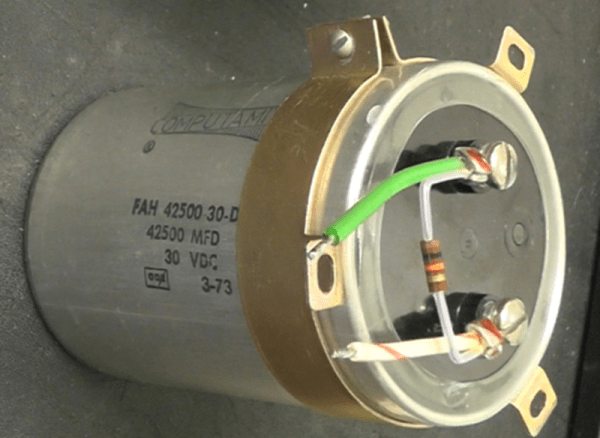
If you’ve ever worked on old gear, you probably know that electrolytic capacitors are prone to failure. [Dexter] undertook a repair of some four-decade-old capacitors in a power supply. He didn’t replace them. He fixed the actual capacitors.

The reason these units are prone to fail is the flip side of what people like about electrolytics: high capacitance in a small package. In a classic parallel plate capacitor, the capacity goes up as the distance between the plates shrinks. In an electrolytic, one plate is a rolled up spiral. The other plate is conductive fluid. The insulator between (the dielectric) is a very thin layer of oxide that forms on the spiral. Over time, the oxide degrades, but this degradation repairs itself when using the capacitor. If the capacitor isn’t powered up for an extended period, the oxide will degrade beyond the point of self-repair.

Continue reading “Electrolytic Capacitor Repair”

Polarizing 3D Scanner Gives Amazing Results

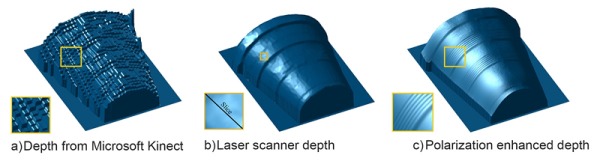
What if you could take a cheap 3D sensor like a Kinect and increase its effectiveness by three orders of magnitude? The Kinect is great, of course, but it does have a limited resolution. To augment this, MIT researchers are using polarized measurements to deduce 3D forms.

The Fresnel equations describe how the shape of an object changes reflected light polarization, and the researchers use the received polarization to infer the shape. The polarizing sensor is nothing more than a DSLR camera and a polarizing filter, and scanning resolution is down to 300 microns.

The problem with the Fresnel equations is that there is an ambiguity so that a single measurement of polarization doesn’t uniquely identify the shape, and the novel work here is to use information from depth sensors like Kinect to select from the alternatives.

Continue reading “Polarizing 3D Scanner Gives Amazing Results”

Before Google There Was The Chemical Rubber Company

Quick. What’s the difference in conductivity between silver and copper? Today, that’s easy to find out. You just ask Google (maybe even out loud if you have a phone handy). But it wasn’t that long ago that you needed another option. Before the Internet age, a big part of being “that guy” (or gal) was knowing where to go to find things. You had to be a master of the library’s reference section, know what might be in an encyclopedia or an almanac.

However if you were a hardcore math, science, or engineering geek you probably had, at least, one edition of CRC handbooks. Today, we usually think of CRC as cyclic redundancy check, but back then it was the Chemical Rubber Company.

The Chemical Rubber Company dates back to 1903 when brothers Arthur, Leo, and Emanuel Friedman were selling rubber lab aprons in Cleveland, Ohio (Arthur, apparently, had been in a similar business from 1900). In 1913, the brothers offered a short (116-page) booklet called the Rubber Handbook free with the purchase of a dozen aprons.

Continue reading “Before Google There Was The Chemical Rubber Company”

Let’s Blow Up An Explosive Lightning Arrestor

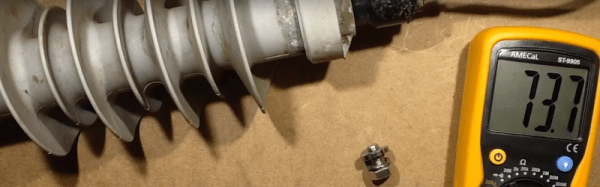
Lightning is some nasty stuff. Luckily, it doesn’t have a very long lifespan. [BigClive] decided to tear down an 11KV lighting arrestor used in power distribution systems. The fiberglass core has silicone rubber water-shedding disks that make the unit look sort of floppy, but inside is some serious hardware.

To protect the circuit, metal oxide varistors shunt high voltage from a lightning strike to ground as you’d expect. The interesting part is how the device deals with failure. It would be a disaster if the device shorted the 11KV power line to ground for any length of time due to a fault. To prevent that problem, a resistor heats up when struck by lightning and triggers an explosive charge that disconnects the ground wire and releases a flag to indicate the failure.

[BigClive] triggered the charge in the video below. So if you like to see things explode in a bucket of water, you’ll enjoy the video.

Continue reading “Let’s Blow Up An Explosive Lightning Arrestor”

$20 Sip-and-Puff Mouse From E-Cig And 3D Printing

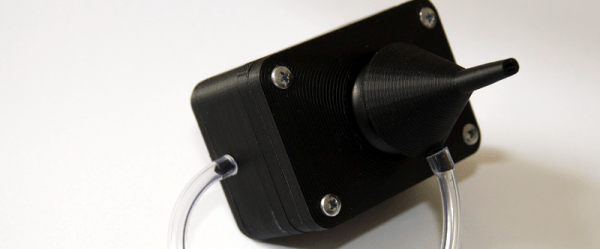
At Hackaday, we think the highest form of hacking is hacking for good. Sure, it’s fun to build robots and gadgets, and universal remotes. But it is even better to create things that make people’s lives better. In that spirit, we enjoyed seeing the Assistive Tech Challenge over on Thingiverse that ended last month. The winner was [0_o] who used 3D printing and an Arduino to produce a mouth-operated mouse for under $20.

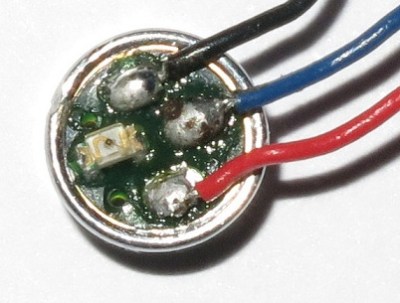
sip-sensor-from-ecigInstructions on Thingiverse can be spotty, but [0_o] did an excellent job of laying out what you need to buy and how to assemble it. One of the most interesting parts of the build is the blow sensor. [0_o] tore apart a $5 electronic cigarette and used the sensor within. The mouthpiece is moved like a joystick to actuate the cursor, and the user blows into it for the mouse clicks. Perhaps not a true sip-and-puff system but it made us wonder what other uses you might find for these sensors.


You can see a video about the mouse after the break. These kinds of projects have the power to make someone’s life better and what could be better than that?

Continue reading “$20 Sip-and-Puff Mouse From E-Cig And 3D Printing”

Reverse Engineering The ARM ALU

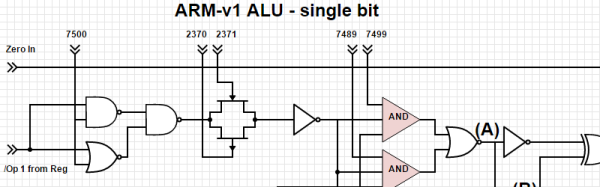
[Dave] wanted to learn more about the ARM architecture, so he started with an image of the ARMV1 die. If you’ve had some experience looking at CPU die, you can make some pretty good guesses at what parts of the chip have certain functions. [Dave], however, went further. He reverse engineered the entire ALU–about 2,200 transistors worth.

Continue reading “Reverse Engineering The ARM ALU”