Start Gaming Early With IKEA High (Score) Chair

If you want your kid to be really great at something, you have to start them out early. [Phil Tucker] must want his kid to be a video gamer pretty badly. [Phil’s] build starts with a $20 IKEA high chair. He likes these chairs because at that price point, tearing into them isn’t a big risk. What’s more is you can buy extra trays so you can use it as a modular project with different trays serving different purposes.

The chair has two joysticks and two buttons, looking suspiciously like a video game controller. The current incarnation (see video, below) uses an Arduino Uno to trigger an Akai MPC1000 synthesizer via the MIDI interface.

Continue reading “Start Gaming Early With IKEA High (Score) Chair”

The Internet Of Reflow Ovens

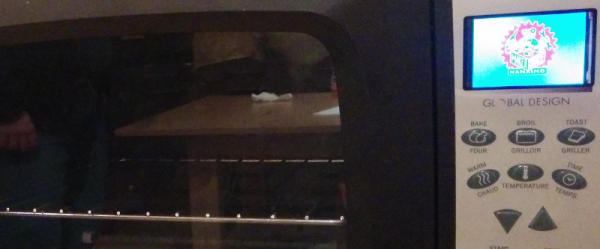
Using a toaster oven to reflow solder isn’t a new idea. But [Sukasa] wanted something that had more features and improved appearace. So he married a Netduino, a toaster oven, and some solid state relays to made a clean-looking reflow oven. His goal was to have nothing look like an overt modification to a casual observer. Inside, however, the oven now has a network connection for system status via a Web browser or JSON.

The new brains of the oven are a Netduino Plus 2 and an I2C port expander that connects to a few extra I/O devices. The challenging I/O, though, is the heaters. When cold, the oven can draw over 16 amps, so a pair of 12A solid state relays in parallel handle that load. There are also two fans: one to keep the electronics cool and another on software control. An IGBT allows the controller to pulse width modulate the fan’s output. A pair of MAX31855s read the thermocouples that report the temperature.

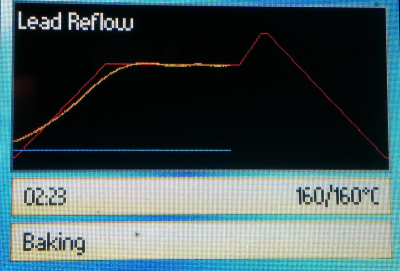
lcdThe controller was a mashup of the existing oven’s keypad and an add-on LCD display (see right). One thing we didn’t see was a schematic. Of course, you can read the code and figure out how it is all connected and (unless you use the exact same oven) you are probably going to need to modify things to suit your particular setup, anyway.
We’ve seen other good looking reflow oven and controller builds in the past, including one with a touchscreen. It is also worth noting that you can find reflow ovens at relatively low prices now if you don’t feel like rolling your own.

Hack A Cake

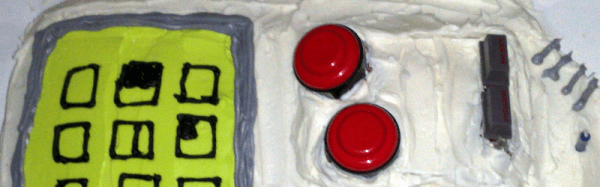
What’s a hacker going to do with an oven? Reflow solder? Dry out 3D printing filament? If you are [Alicia Gibb] you’d be baking a cake. While complaining that projects aren’t a hack seems to be a favorite past time for Hackaday commentators, we think [Alicia] will be in the clear. Why? Because these cakes have Arduinos, LEDs, and motorized candles among other gizmos.

The Game Boy cake is undeniably cool, although we have to admit the cake that screams when cut got our attention (see video below), even if it would unnerve guests.

As you might expect, you can’t bake the electronics directly into the cake. [Alicia] uses Tupperware or parchment paper to create cavities for the electronics. Connections and other solder joints get professional grade Saran wrap to keep the lead and other awful chemicals out of the cake.

Continue reading “Hack A Cake”

Laser Cut Mechanical Logic Gates

When you create logic circuits using ICs or FPGAs, you can’t easily visualize their operation without special tools. But if you’ve ever seen a mechanical computer (like the Computer History Museum’s Babbage engine) operate, you know you don’t have that problem. Just like it is fascinating to watch a 3D printer or CNC machine, watching mechanical logic gates work can be addictive.

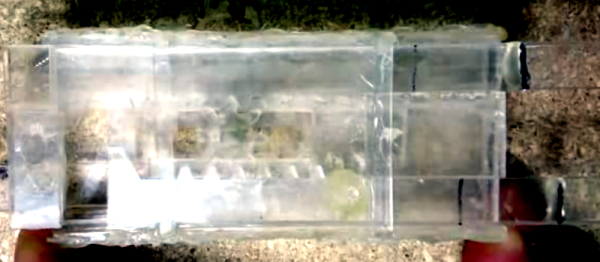
[Anthony] wanted to build some mechanical logic gates and set out designing them using Inkscape. Unlike some common mechanical gate schemes, [Anthony’s] gates use gears to implement the logic operations. He sent the designs off to a laser cutter service and got back parts cut from 3mm acrylic.

Continue reading “Laser Cut Mechanical Logic Gates”

Easier PCB Vias With Drill Trick And Conductive Ink

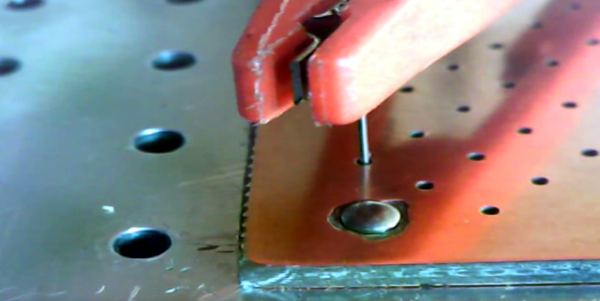
If you’ve ever made double-sided PCBs without professional equipment, you had to deal with connecting one side of the board to the other. You have a few obvious choices: 1) Rely on component leads to connect both sides (and solder both sides); 2) Create vias and solder wire to both sides of the board; or 3) Use through hole rivets. [Diyouware] had a different idea: use conductive ink. After a few false starts, they found a technique that seemed to work well.

This isn’t the first time we’ve heard of people trying conductive ink with varying degrees of success. The biggest problem, usually, is that the ink wants to run out of the hole. [Diyouware] has an interesting solution for this problem: Don’t drill the hole all the way thorough.

Continue reading “Easier PCB Vias With Drill Trick And Conductive Ink”

New Magnetic Semiconductor

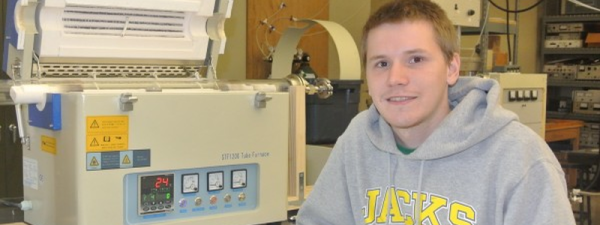
When you think of South Dakota you generally think of Mount Rushmore and, maybe, nuclear missiles. However, [Simeon Gilbert] will make you think of semiconductors. [Simeon], a student at South Dakota State University, won first place at the annual Sigma Xi national conference because of his work on a novel magnetic semiconductor.

The material, developed in collaboration with researchers from the nano-magnetic group at the University of Nebraska-Lincoln, is a mix of cobalt, iron, chromium, and aluminum. However, some of the aluminum is replaced with silicon. Before the replacement, the material maintained its magnetic properties at temperatures up to 450F. With the silicon standing in for some of the aluminum atoms, the working temperature is nearly 1,000F.

Continue reading “New Magnetic Semiconductor”

Swans, Pigs, And The CIA: An Unlikely Radio Story

Shortwave radio is boring, right? Maybe not. You never know what intrigue and excitement you might intercept. We recently covered secret number stations, and while no one knows for sure exactly what their purpose is, it is almost surely involving cloaks and daggers. However, there’s been some more obvious espionage radio, like Radio Swan.

The swan didn’t refer to the animal, but rather an island just off of Honduras that, until 1972, was disputed between Honduras and the United States. The island got its name–reportedly–because it was used as a base for a pirate named Swan in the 17th century. This island also had a long history of use by the United States government. The Department of Agriculture used it to quarantine imported beef and a variety of government departments had weather stations there.

You might wonder why the United States claimed a tiny island so far away from its shores. It turns out, it was all about guano. The Guano Islands Act of 1856 allowed the president to designate otherwise unclaimed territory as part of the United States for the purpose of collecting guano which, in addition to being bird excrement, is also important because it contains phosphates used in fertilizer and gunpowder. (Honestly, you couldn’t make this stuff up if you tried.)

However, the most famous occupant of Swan Island was Radio Swan which broadcast on the AM radio band and shortwave. The station was owned by the Gibraltar Steamship Company with offices on Fifth Avenue in New York. Oddly, though, the company didn’t actually have any steamships. What it did have was some radio transmitters that had been used by Radio Free Europe and brought to the island by the United States Navy. Did I mention that the Gibraltar Steamship Company was actually a front for the Central Intelligence Agency (CIA)?

Continue reading “Swans, Pigs, And The CIA: An Unlikely Radio Story”