You have an old PC with a nonstandard RGB video out and you need to bring it to a modern PAL TV set. That’s the problem [svofski] had, so he decided to use an Altera-based DE1 board to do the conversion. Normally, you’d expect reading an RGB video signal would take an analog to digital converter, which is not typically present on an FPGA. Instead of adding an external device, [svofski] used a trick to hijack the FPGA’s LVDS receivers and use them as comparators.
Author: Al Williams4514 Articles
Pulse Density Modulation
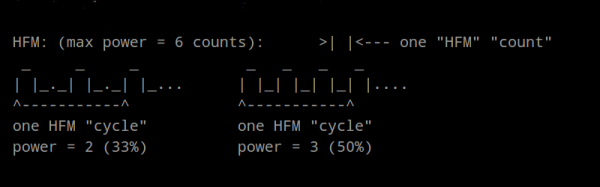
[esot.eric] was trying to drive a motor and naturally thought of using pulse width modulation (PWM) to control the motor speed. However, he found that even with a large capacitor, his underpowered power supply would droop before the PWM cycles were complete. So instead of PWM he decided to experiment with pulse density modulation.
The idea is to use smaller pulses over a longer period of time and make the average power equal to the percentage motor speed desired. With a PWM system, for example, if the time period is T, a 50% PWM drive would have the drive high for T/2 and low for the other half of the cycle. With pulse density, each pulse might be T/10 (as an example) and then the output would be on for 1/10, off for 1/10, on for 1/10 and so on, until by time T you’d still get to 50%. The advantage is the output capacitor gets a kick more often and has less opportunity to droop.
Understanding Surface Mount
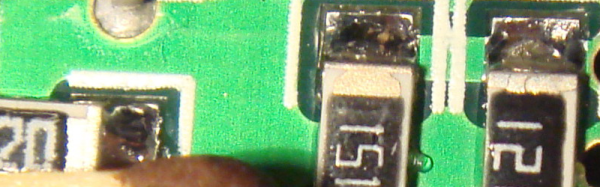
Do you know what a MELF is (and, yes, it is safe for work to Google it)? What’s the difference between a QFP, and LCC, and a PLCC package? Do you need a 0603 resistor or a 1206 resistor?
If you are an old hand at surface mount devices (SMDs) you probably know the answers to most of these questions. But if you’ve done most of your work with through hole, it is a confusing mess of acronyms and numbers. Sure, you can Google and find out that at 0603 resistor is .06 inches by .03 inches. [TopLine] has a great booklet that pulls many common definitions in one place available for download that can help you make sense of different SMD nomenclature.
Managing An Unmanaged Switch
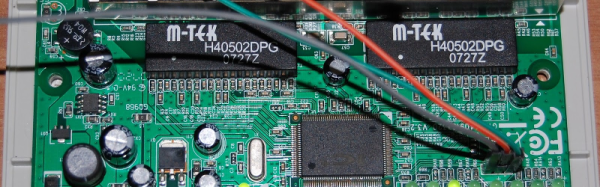
Network switches come in two different flavors: managed, where you have some interface to configure and monitor the equipment, and unmanaged where the device just does what it is supposed to do and you can’t really control it. [Tiziano Bacocco] wanted to manage his cheap unmanaged switch, so he did what any good hacker would do: he opened it up.
Inside the Digicom 10/100 switch he found an IP178CH controller IC and a quick search turned up a data sheet. [Tiziano] noticed there were three ways to configure the switch: Some hardware pins could control very basic functions; an EEPROM (absent on the PCB) could configure the device; or the chip would accept commands via a synchronous serial port.
Since the datasheet covered the protocol required, [Tiziano] commandeered an Arduino Pro Mini and used it to send commands to configure the switch. A few resistors and some quick code allowed him to control VLAN and other functions on the switch via the USB port. Of course, he mentioned you could use a Raspberry Pi if you wanted a network interface–or maybe that’s a good excuse to use one of those Ethernet shields you got on clearance at Radio Shack.
Using LTSpice To Measure Total Harmonic Distortion
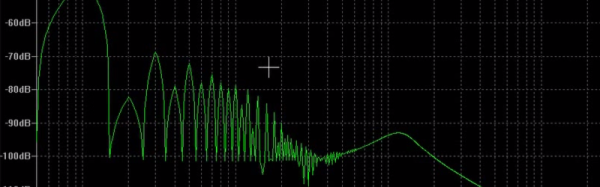
Audiophiles spend a lot of time and effort worrying about audio specs like Total Harmonic Distortion (THD). Makes sense, because THD affects the quality of audio reproduction. However, THD can also affect interference from radio signals and even losses in power transfer systems. A simplified definition is the THD is the ratio of the sum of the power of all harmonic frequencies to the power of the fundamental frequency.
If a circuit produced a perfect sine wave, there would be no harmonics. There are many ways to measure THD in practice, but [Michael Jackson] has an interesting video showing how he easily visualizes THD using LTSpice. Assuming you already have the system in question in LTSpice (or you could use another simulation tool, if you prefer) it is fairly straightforward.
Continue reading “Using LTSpice To Measure Total Harmonic Distortion”
Hams Talk Digital
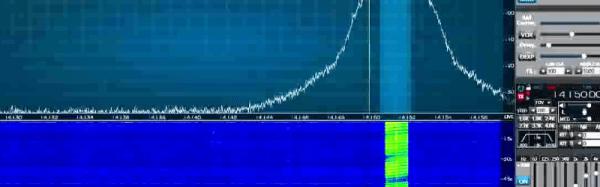
Morse code qualifies as a digital mode, although organic brains are somewhat better at copying it than electronic ones. Ham radio operators that did “phone” (ham-talk for voice) started out with AM modulation. Sometime after World War II, there was widespread adoption of single side band or SSB. SSB takes up less bandwidth and is more reliable than AM modulation. On the digital side, hams turned to different and more sophisticated digital transmission types with computers pushing bandwidth down and reliability up. However, a recent trend has been to encode voice over ham radio–sort of VoIP with radio instead of Ethernet–using an open source program called freedv.
[AA6E] made a very informative video where he carries on a QSO (a conversation) with a distant station using freedv. What makes it interesting, is towards the end when the two stations switch to regular SSB. The difference is dramatic and really points out how even with less bandwidth (roughly 3 kHz for SSB vs 1.25 kHz), the digital mode is superior. The freedv software (available for Windows or Linux) compresses audio to 700-1600 bits per second and spreads it over 16 QPSK signals.
Crystal Radio: It’s A Match!
A crystal radio is often a kid’s first introduction to building something electronic. [Billy Cheung] is a crystal radio builder who wants to “make crystal radios as easy to use as regular radios.” He’s built many sets, but his latest is one that not only fits in a matchbox, but uses the matchbox as a variable tuning inductor.
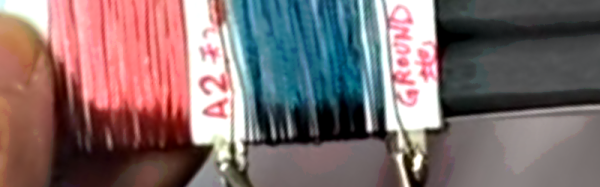
There’s no oatmeal box in this design and just a few components. The matchbox contains some ferrite rods and two different windings. By moving the inner part of the matchbox, you can tune different stations. Although the design calls for two fixed capacitors [Billy] found he had enough self resonance (presumably from stray capacitance) that omitting them didn’t hurt his reception of strong signals.