Everything You Wanted To Know About Early Macintosh Floppies

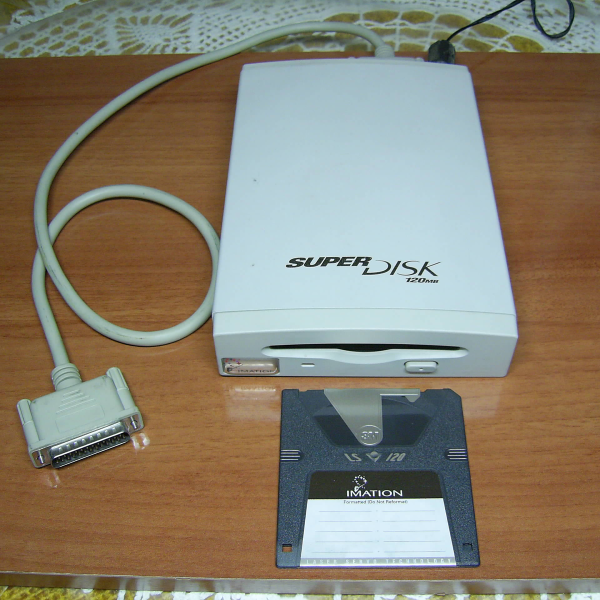
Using a disk drive today is trivial. But back “in the day,” it was fairly complex both because the drives were simple and the CPUs were not powerful by today’s standards. [Thomas] has been working on a 68000 Mac emulator and found that low-level floppy information was scattered in different places. So he’s gathered it all for us in one place.

Low-level disk access has a lot of subtle details. For example, the Mac calibrates its speed control on boot. If your emulated drive just sets the correct speed and doesn’t respond to changes during calibration, the system will detect that as an error. Other details about spinning disks include the fact that inner tracks are shorter than outer track and may require denser recordings. Laying out sectors can also be tricky since you will lose performance if you, for example, read sector one and then miss sector two and have to wait for it to come back around. Disk sectors are often staggered for this reason.

Adding to the complexity is the controller — the IWM or Integrated Woz Machine — which has an odd scheme for memory mapping I/O. You should only access the odd bytes of the memory-mapped I/O. The details are all in the post.

In a way, we don’t miss these days, but in other ways, we do. It wasn’t that long ago that floppies were king. Now it is a race to preserve the data on them while you still can.

V-Slot Wheels Or Linear Rails?

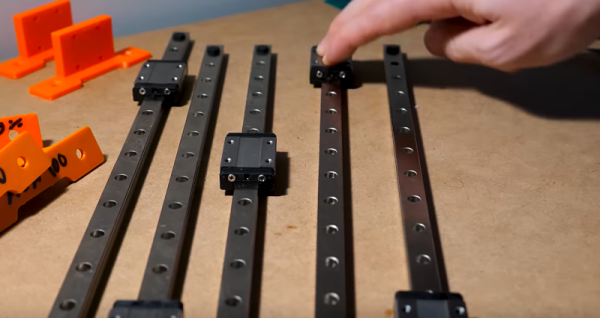
In the early days of 3D printers, most builds used smooth rods and bearings that rode on them. But these days, printers are shipping with either V-slot extrusions with Delrin wheels or linear rails. Which is best? Everyone seems to have an opinion, but [Spencer] decided to compare them using some well-defined experiments, and he shares his results in the video below.

Common wisdom is that linear rails create a better print quality, but [Spencer] didn’t really find that much difference. He does admit, however, that he isn’t an expert on setting up linear rails, so perhaps there’s something he could have done better. He did note that the rails were quieter but that, for both cases, the noise generated by the moving rails was only a small fraction of the total noise generated by the printer. The rails were also more stable in terms of resonance. Input shaping can help overcome that, though, so it probably isn’t that important in a modern printer.

What do you think? Are linear rail upgrades worth it? Let us know in the comments. We’ve been 3D printing long enough that we are hard-pressed to complain much about any of the prints we produce today on printers that cost a fraction of what we spent on our first ones.

Of course, you could go with string. Putting rails together with or without slots is its own art form.

Continue reading “V-Slot Wheels Or Linear Rails?”

Simulating Air Flow For 3D Printing

You’ve probably heard that a 3D printer is capable of producing its own replacement parts. Sometimes, that even includes upgraded or improved versions of the parts it was originally built with. But sometimes, it’s hard to figure out what improved really means. Think about air ducts that cool the part after printing. In theory, it should be easy to design a new duct. But how does it perform? Empirical testing can be difficult, but [Mike] shows how you can simulate the airflow so you can test design changes and validate assumptions before you print the actual part.

Of course, this wouldn’t only apply to printer ducts. You might also get some tips if you want to model airflow for PC cooling, hot air soldering, or other air-related projects. The free version of the software has some limitations, but it was surprisingly capable.

We also enjoyed how [Mike] used fluid to visualize the actual patterns and compared it to the simulation. The trick is using a compound from a kid’s science project kit, and it seems to work very well. Of course, you could just grab your smartphone. This might be worth thinking about if you are building a laser cutter air assist, too.

Continue reading “Simulating Air Flow For 3D Printing”

Tech In Plain Sight: Speedometers

In a modern car, your speedometer might look analog, but it is almost certainly digital and driven by the computer that has to monitor all sorts of things anyway. But how did they work before your car was a rolling computer complex? The electronic speedometer has been around for well over a century and, when you think about it, qualifies as a technlogical marvel.

If you already know how they work, this isn’t a fair question. But if you don’t, think about this. Your dashboard has a cable running into it. The inner part of the cable spins at some rate, which is related to either the car’s transmission or a wheel sensor. How do you make a needle deflect based on the speed?

Continue reading “Tech In Plain Sight: Speedometers”

Farewell Magnetic Stripe

For decades, the magnetic stripe has been ubiquitous on everything from credit cards to tickets to ID badges. But the BBC reports — unsurprisingly — that the mag stripe’s days are numbered. Between smartphones, QR codes, and RFID, there’s just less demand for the venerable technology.

IBM invented the stripe back in the early 1960s. The engineer responsible, [Forrest Parry], was also involved in developing the UPC code. While working on a secure ID for the CIA, his wife suggested using an iron to melt a strip of magnetic tape onto the card. The rest is history.

Continue reading “Farewell Magnetic Stripe”

Ask Hackaday: How Can We Leverage Tech For Education?

If you’re like us, you’ve studied the mathematician [Euler], but all you really remember is that you pronounce his name like “oiler” and not much else. [Welch Labs], on the other hand, not only remembers what he learned about logarithms and imaginary numbers but also has a beautiful video with helpful 3D graphics to explain the concepts.

This post, however, isn’t about that video. If you are interested in math, definitely watch it. It’s great. But it also got us thinking. What would it be like to be a high school math student today? In our day, we were lucky to have some simple 2D graph to explain concepts. Then it hit us: it probably is exactly the same.

Continue reading “Ask Hackaday: How Can We Leverage Tech For Education?”

Pulling Apart A Premium WebCam

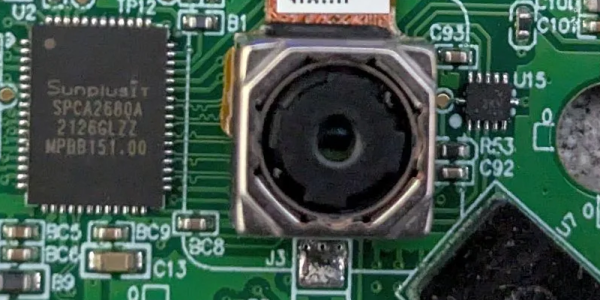
Over at EDN, [Brian Dipert] has been tearing down web cameras. A few months ago, he broke into a bargain basement camera. This time, he’s looking into a premium unit. Although we have to admit from some of what he reports, we are a little surprised at some of the corners cut. For example, it’s a 4K camera that doesn’t quite provide a 4K image. Despite a Sony CMOS sensor, [Brian] found the low-light performance to be poor. However, it does carry a much larger price tag than the previous camera examined.

The interesting part is about half way down the page when he tries to open the unit up. It seems like it is getting harder and harder to get into things and this camera was no exception. The device finally gives up. Inside is a relatively unremarkable board with a host of unknown ICs. One interesting item is a gyro chip that determines if the camera is upside down.

[Brian] managed to get the camera back together with no harm. It is interesting to compare it to the $15 camera he took apart earlier.

If you want maximum cred, do your video calls with a Game Boy camera. Or, at least, add your own lens to a webcam.