Print Yourself Penrose Wave Tiles As An Excellent Conversation Starter

Ah, tiles. You can get square ones, and do a grid, or you can get fancier shapes and do something altogether more complex. By and large though, whatever pattern you choose, it will normally end up repeating on some scale or other. That is, unless you go with something like a Penrose Wave Tile. Discovered by mathematician Roger Penrose, they never exactly repeat, no matter how you lay them out.

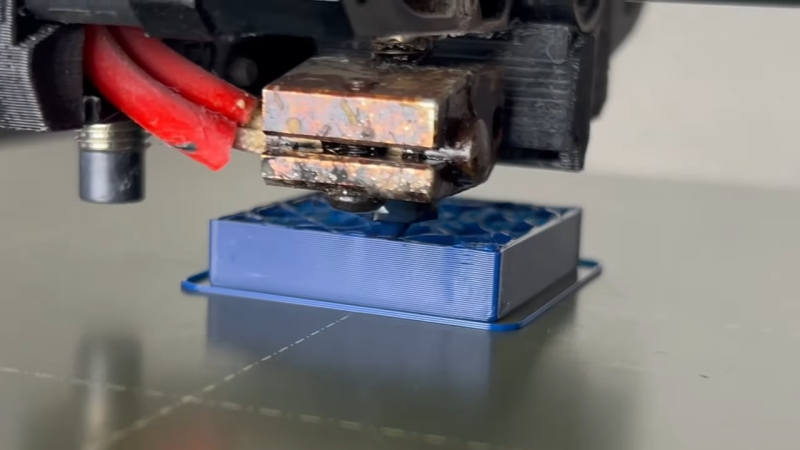
[carterhoefling14] decided to try and create Penrose tiles at home—with a 3D printer being the perfect route to do it. Creating the tiles was simple—the first step was to find a Penrose pattern image online, which could then be used as the basis to design the 3D part in Fusion 360. From there, the parts were also given an inner wave structure to add further visual interest. The tiles were then printed to create a real-world Penrose tile form.

You could certainly use these Penrose tiles as decor, though we’d make some recommendations if you’re going that path. For one, you’ll want to print them in a way that optimizes for surface quality, as post-processing is time consuming and laborious. If you’re printing in plastic, probably don’t bother using these as floor tiles, as they won’t hold up. Wall tiles, though? Go nuts, just not as a splashback or anything. Keep it decorative only.

You can learn plenty more about Penrose tiling if you please. We do love a bit of maths around these parts, too. If you’ve been making your own topological creation, don’t hesitate to drop us a line. 

Very Tiny Cube Has 384 RGB LEDs

When it comes to making things that glow, there are two ways to stand out from the crowd. You can make something very big, or something very small. [DIY GUY Chris] has done the latter, producing a tiny LED cube that he says is the world’s smallest.

As is so often the way, the build relies on tiny WS2812B-compatible LEDs in a 1 mm x 1 mm form factor. They’re mounted on a series of teeny interlocking PCBs that come together to build a cube that’s just 8 cubic centimeters in volume. Power is courtesy of a small lithium-ion cell that lives inside the cube. Data and power signals flow around the cube via solder connections along the edges of the faces of the cube.  Running the show is an ATmega328P, the same microcontroller you’d find in an Arduino Uno. It’s responsible for sending out commands to the LEDs to create various animations.

We can’t speak to [Chris’s] claim about being the world’s smallest, but it is small. We’ve seen other builds in a similar vein, like this barely-larger D20 with a full 2400 LEDs, though. Video after the break.

Continue reading “Very Tiny Cube Has 384 RGB LEDs”

Doing 1080p Video, Sort Of, On The STM32 Microcontroller

When you think 1080p video, you probably don’t think STM32 microcontroller. And yet! [Gabriel Cséfalvay] has pulled off just that through the creative use of on-chip peripherals. Sort of.

The build is based around the STM32L4P5—far from the hottest chip in the world. Depending on the exact part you pick, it offers 512 KB or 1 Mbyte of flash memory, 320 KB of SRAM, and runs at 120 MHz. Not bad, but not stellar.

Still, [Gabriel] was able to push 1080p at a sort of half resolution. Basically, the chip is generating a 1080p widescreen RGB VGA signal. However, to get around the limited RAM of the chip, [Gabriel] had to implement a hack—basically, every pixel is RAM rendered as 2×2 pixels to make up the full-sized display. At this stage, true 1080p looks achievable, but it’ll be a further challenge to properly fit it into memory.

Output hardware is minimal. One pin puts out the HSYNC signal, another handles VSYNC. The same pixel data is clocked out over R, G, and B signals, making all the pixels either white or black. Clocking out the data is handled by a nifty combination of the onboard DMA functionality and the OCTOSPI hardware. This enables the chip to hit the necessary data rate to generate such a high-resolution display.

There’s more work to be done, but it’s neat to see [Gabriel] get even this far with such limited hardware. We’ve seen others theorize similar feats on chips like the RP2040 in the Pi Pico, too. Video after the break.

Continue reading “Doing 1080p Video, Sort Of, On The STM32 Microcontroller”

Supercon 2023 – Going Into Deep Logic Waters With The Pico’s PIO And The Pi’s SMI

The Raspberry Pi has been around for over a decade now in various forms, and we’ve become plenty familiar with the Pi Pico in the last three years as well. Still, these devices have a great deal of potential if you know where to look. If you wade beyond the official datasheets, you might even find more than you expected.

Kumar is presently a software engineer with Google, having previously worked for Analog Devices earlier in his career. But more than that, Kumar has been doing a deep dive into maxing out the capabilities of the Raspberry Pi and the Pi Pico, and shared some great findings in an excellent talk at the 2023 Hackaday Supercon.

Continue reading “Supercon 2023 – Going Into Deep Logic Waters With The Pico’s PIO And The Pi’s SMI”

Static Electricity And The Machines That Make It

Static electricity often just seems like an everyday annoyance when a wool sweater crackles as you pull it off, or when a doorknob delivers an unexpected zap. Regardless, the phenomenon is much more fascinating and complex than these simple examples suggest. In fact, static electricity is direct observable evidence of the actions of subatomic particles and the charges they carry.

While zaps from a fuzzy carpet or playground slide are funny, humanity has learned how to harness this naturally occurring force in far more deliberate and intriguing ways. In this article, we’ll dive into some of the most iconic machines that generate static electricity and explore how they work.

Continue reading “Static Electricity And The Machines That Make It”

Supercon 2023: The Road To Writing Great Step-by-Step Instructions

IKEA is known as a purveyor of build-it-yourself flatpack furniture. LEGO is known as a purveyor of build-it-yourself toys. Both are known for their instructions. The latter’s are considered incredibly clear and useful, while the former’s are often derided as arcane and confusing—though the major difference between the two is color printing.

These two companies are great examples of why instructions are important. Indeed, Sonya Vasquez has learned this lesson well, and came down to Supercon 2023 to tell us all about it. Prepare to learn all about how to write great step-by-step instructions that enable greatness and never frustrate the end user.

Continue reading “Supercon 2023: The Road To Writing Great Step-by-Step Instructions”

Pulling Apart An Old Satellite Truck Tracker

Sometimes there’s nothing more rewarding than pulling apart an old piece of hardware of mysterious origin. [saveitforparts] does just that, and recently came across a curious satellite system from a surplus store. What else could he do, other than tear it down and try to get it humming? 

The device appeared to be satellite communication device for a tracking unit of some sort, complete with a long, thick proprietary cable. That led to a junction box with a serial port and an RJ45 port, along with some other interfaces. Disassembly of the unit revealed it contained a great deal of smarts onboard, including some kind of single-board computer. Comms-wise, it featured a cellular GPRS interface as well as an Orbcomm satellite modem. It also packed in GPS, WiFi, Xbee, Ethernet, and serial interfaces. It ultimately turned out to be a Digi ConnectPort X5 device, used as a satellite tracking system for commercial trucks.

What’s cool is that the video doesn’t just cover pulling it apart. It also dives into communicating with the unit. [saveitforparts] was able to power it up and, using the manufacturer’s software, actually talk to the device. He even found the web interface and tested the satellite modem.

Ultimately, this is the kind of obscure industry hardware that most of us would never come into contact with during our regular lives. It’s neat when these things show up on the secondary market so hackers can pull them apart and see what makes them tick. Video after the break.

Continue reading “Pulling Apart An Old Satellite Truck Tracker”