Smashed Laptop Becomes Stylish All-In-One

Many of us will have broken a laptop at one point or another, destroying the screen or smashing the case. It can be frustrating, as there’s a perfectly usable computer in there, trapped inside a broken husk of a body. [Matthew] saw this not as a problem, but an opportunity – and built a beautiful all-in-one desktop PC. (Video, embedded below.)

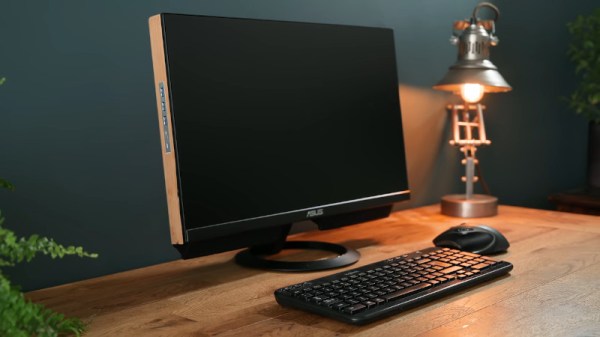
With a badly damaged Thinkpad laptop to hand, an ASUS monitor was sourced with a thin body and flat back, perfect for mounting hardware. An MDF base was created, on to which the laptop motherboard was mounted. A USB hub and audio amplifier were then added, along with a USB power isolator and soundcard to avoid problems with groundloops from the onboard headphone output. Speakers were Harman Kardon units salvaged from an old television, providing great quality sound for the build.

There’s plenty of great ideas in the video, from using epoxy for a strong permanent assembly, to a nifty hack to make the power button work. It has us contemplating a build for our own broken laptops in the junkpile. We’ve seen other creative all-in-one builds too, like this one inside a printer.

Continue reading “Smashed Laptop Becomes Stylish All-In-One” →

Using Voice Commands To Start A Jeep

If you’ve got a car built in the last 5 years or so, it’s quite likely it’s started by the push of a button when in the presence of a keyfob. Older vehicles make do with the twist of a key. Of course, starting a car by voice command would be cool, and that’s what [John Forsyth] set out to do.

The build uses a Macbook to handle voice recognition, using its Dictation feature. With a hefty download, it’s capable of doing the task offline, making things easier. The dictated words are passed to a Python script, which searches for words like “start” and “go” as a trigger. When an appropriate command is received, the Python script sends a signal over a USB-serial connection to an attached Arduino. The Arduino then toggles a relay connected to the Jeep’s external starter solenoid, starting the vehicle.

As a fan of recent popular films, [John] programmed the system to respond to the command “Jarvis, let’s get things going!”, causing the vehicle to spring into life. There’s room for future improvement, too – the system could benefit from being a little more compact, and there’s a long delay between finishing the sentence and the vehicle starting. A Raspberry Pi and faster dictation software could likely help in this regard.

We’ve seen voice commands used for everything from chess to finding electronic components. Video after the break.

Continue reading “Using Voice Commands To Start A Jeep” →

Procedurally Generating Marble Runs

Marble runs are somehow incredibly soothing to play with and watch, with the gentle clack of the marbles and the smooth, predictable motion. Sadly for some, they never quite got enough time to enjoy them in school. Luckily, [Fernando Jerez] is here with a way to procedurally generate marble runs you can actually play with!

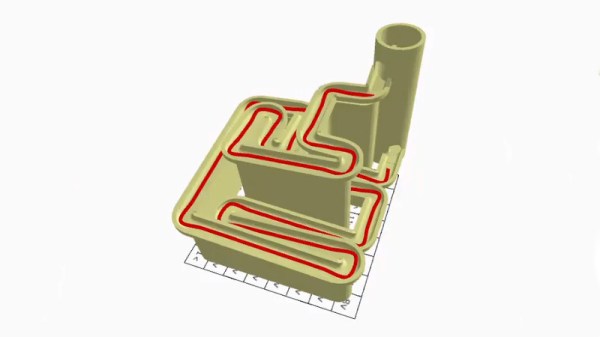
[Fernando] does a great job of explaining the mathematical process of generating the marble runs, using the method of random space filling curves. A maze is drawn on a grid, with points on the grid acting as walls. Each grid cell is then given a value based on points on its corners, and these values then translate into directions of travel. This creates a path through the maze. Scaling this path along the Z-axis, and then replacing the path with a marble track creates the run. It’s then a simple matter of adding a shaft to the loop with a screw to drive marbles back to the top of the run, and you’re all set!

With both animated explanations and actual 3D printed marble runs, [Fernando] demonstrates the concept well. We’d love to print a few runs of our own, and we can’t help but think there’s other great applications for the mathematics behind this concept. If you’re wise to it, drop it in the comments. Otherwise, check out these exquisite creations we’ve featured before!

Building Cameras For The Immersive Future

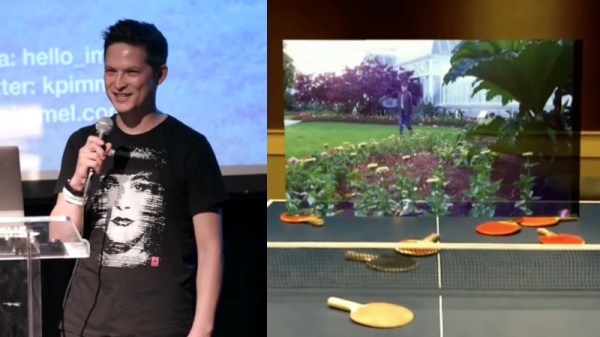
Thus far, the vast majority of human photographic output has been two-dimensional. 3D displays have come and gone in various forms over the years, but as technology progresses, we’re beginning to see more and more immersive display technologies. Of course, to use these displays requires content, and capturing that content in three dimensions requires special tools and techniques. Kim Pimmel came down to Hackaday Superconference to give us a talk on the current state of the art in advanced AR and VR camera technologies.

[Kim]’s interest in light painting techniques explored volumetric as well as 2D concepts.
Kim has plenty of experience with advanced displays, with an impressive resume in the field. Having worked on Microsoft’s Holo Lens, he now leads Adobe’s Aero project, an AR app aimed at creatives. Kim’s journey began at a young age, first experimenting with his family’s Yashica 35mm camera, where he discovered a love for capturing images. Over the years, he experimented with a wide variety of gear, receiving a Canon DSLR from his wife as a gift, and later tinkering with the Stereorealist 35mm 3D camera. The latter led to Kim’s growing obsession with three-dimensional capture techniques.

Through his work in the field of AR and VR displays, Kim became familiar with the combination of the Ricoh Theta S 360 degree camera and the Oculus Rift headset. This allowed users to essentially sit inside a photo sphere, and see the image around them in three dimensions. While this was compelling, [Kim] noted that a lot of 360 degree content has issues with framing. There’s no way to guide the observer towards the part of the image you want them to see.

Continue reading “Building Cameras For The Immersive Future” →

Developing Retro Games For Conference Badges With Kate Morris

PCB badges have exploded in popularity in recent years. Starting out as a fun token of entry to a conference, they’re now being developed by all manner of independent groups, with DEFCON serving as the heart of the #badgelife movement. After DEFCON 26, Kate Morris and associates decided to undertake the development of their own badge, to celebrate the 50th anniversary of the Apollo landing. Kate’s talk at the 2019 Hackaday Superconference serves to tell the tale of creating a retro game to run on a badge platform.

Continue reading “Developing Retro Games For Conference Badges With Kate Morris” →

A Rope Maker You Can 3D Print At Home

Ropes are one of those things that, while possible to make by hand, having a little mechanical help goes a long way in their manufacture. [b33ma247] wanted just such a rig, so set about building one from scratch.

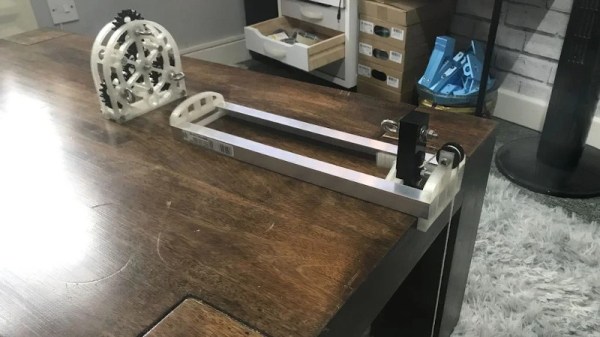
It’s a simple device, but one that makes the task much easier. A series of gears are printed, which assemble on to a frame to form the winding mechanism that weaves the rope. There’s also a slide, a rope separator, and a weight carriage to ensure proper tension is kept on the string during the weaving process. The mechanism is driven by a power drill, though this could be easily replaced with a hand crank if full manual operation was desired.

It’s a project which shows if you have a 3D printer, you can make a lot of other useful tools for your workshop too. We see similar approaches taken when it comes time to wind coils, too. Video after the break.

Continue reading “A Rope Maker You Can 3D Print At Home” →

Gesture Control The Easy Way

Gesture control is a technology that has floated around for quite a while, but never quite reached mainstream acceptance. Wii Bowling was fun for a while, but we’re not regularly using gestures to open doors or order pizza just yet. Doing it yourself can be quite easy, however, as [RC Lover san] found with a barebones, hacky build.

Typically, when we think of gesture control, we envisage object tracking cameras or MEMS accelerometers. Instead, this build uses simple tilt switches, as you might find in a pinball machine from days of yore. Four of these are placed on a wrist-mounted device, allowing the user to tilt their arm to move an RC car in different directions. The tilt switches are easy to hack into the controller for a toy RC car, as they simply replace the existing buttons on the PCB.

It’s a project that goes to show that not everything has to be done with advanced sensors and complex algorithms. Sometimes, it can all be done with a handful of cheap switches and some ingenuity. Plus, using arm movements to scoot BB-8 around on the floor looks like great fun. We’ve seen other attempts to build simple gesture controls with pots, too. Video after the break.

Continue reading “Gesture Control The Easy Way” →