Design And Construction With Copper Pipe

Copper is a material with many applications; typically, it’s used for electrical wiring or in applications where good heat conductivity is a requirement. However, it can also make for an attractive material in furnishings, which [Andrei Erdei] decided to explore.

A render of the coffee table design, exported from OpenSCAD into Fusion360.

[Andrei]’s work began in OpenSCAD, where he wrote scripts to enable the quick and easy assembly of various designs. The modular nature of commercially-available copper pipe and fittings allows complex structures to be assembled, particularly if you’re a fan of 90-degree bends. The final renders of some of these designs are impressive, with the coffee table design a particular highlight. Staying conceptual wasn’t enough, however, so [Andrei] set out to build one of his designs. Constructing a table lamp shroud out of copper parts was successful, though the real components have flanges and other features that aren’t represented in the rendering.

It’s a project that shows the value of tools such as OpenSCAD to aid the design process before committing to cutting real-world materials. While the designs on screen aren’t perfect representations of what’s possible in reality, it still proves to be a useful guide.

We’re a fan of the aesthetic, and would love to see more done with copper pipe as a construction kit. Global ore prices may limit experimentation, however. Alternatively, you can always harvest the metal from scrap!

Getting 1000 FPS Out Of The Raspberry Pi Camera

The Raspberry Pi camera has become a de facto standard for many maker projects, making things like object recognition and remote streaming a breeze. However, the Sony IMX219 camera module used is capable of much more, and [Gaurav Singh] set out to unlock its capabilities.

After investigating the IMX219 datasheet, it became clear that it could work at higher bandwidths when configured to use all four of its MIPI CSI lanes. In the Raspberry Pi module, only two MIPI lanes are used, limiting the camera’s framerate. Instead, [Gaurav] developed a custom IMX219 breakout module allowing the camera to be connected to an FPGA using all four lanes for greater throughput.

With this in place, it became possible to use the camera at framerates up to 1,000 fps. This was achieved by wiring the IMX219 direct to an FPGA and then to a USB 3.0 interface to a host computer, rather than using the original Raspberry Pi interface. While 1,000 fps is only available at a low resolution of 640 x 80, it’s also possible to shoot at 60 fps at 1080p, and even 15 fps at 3280 x 2464.

While it’s probably outside the realm of performance required for the average user, [Gaurav] ably demonstrates that there’s often capability left on the table if you really need it. Resources are available on Github for those eager to delve deeper. We’ve seen others use advanced techniques to up the frame rate of the IMX219, too. Video after the break.

Continue reading “Getting 1000 FPS Out Of The Raspberry Pi Camera” →

Open-Source Collaboration Tackles COVID-19 Testing

When you think of open source, your mind likely jumps to projects such as Linux, Firefox, and other now-mainstream software. The ideals of the movement are applicable to other areas, too, however – and a group have come together to pool resources to tackle the COVID-19 pandemic.

The group has formed around Just One Giant Lab, a non-profit organisation operating out of Paris, France. They aim to create an open platform for scientific collaboration on a broad range of issues facing humanity. The current project aims to create an open-source method for safely testing for COVID-19 infection, in an attempt to help better manage cases popping up around the world.

Thus far, the group has collected a variety of resources and begun to host conference calls discussing best practices for testing for the virus. There’s discussion of various PCR assays and virus sequences that are all useful in detecting the virus, along with data from WHO reports in China. The current state of play has been boiled down in the lab notebook the group has prepared, available online.

It’s inspiring to see open-source ideals put to work in new arenas outside computer software. Time will tell if this is the new way forward, but it certainly can’t hurt to have more minds tackling the problems of today and tomorrow.

A Stylish Coffee Table Featuring Conway’s Game Of Life

Coffee tables are a great place to put your hot beverages, but most don’t offer a lot beyond that. For most people this is perfectly acceptable, but hackers often desire a little more. [Andrei Erdei] is one such person, who built Conway’s Game of Life into this handsome piece of furniture.

The build began with an existing coffee table, chosen for its glass top. Unfortunately, the top was painted black on one side, and was completely opaque, negating its use as a diffuser for LEDs. Instead, this was replaced with smoked glass, with frosted window film applied to make the final piece darker. This attention to detail allowed [Andrei] to install the WS2812B LED strips underneath such that they’re invisible when switched off. The LEDs themselves are run by a WEMOS D1 mini, based on the ESP8266. This microcontroller has plenty of grunt, which makes running the LEDs and the Game of Life code a cinch.

If you want to make something attractive and blinky, it’s hard to go wrong with Conway’s Game of Life. You can even use it to make a clock or a synthesizer; or build an entire game of Tetris within it. Video after the break.

Continue reading “A Stylish Coffee Table Featuring Conway’s Game Of Life” →

How To Get Into Cars: Handling Mods

As a budding automotive enthusiast, you finally took the plunge and scored yourself a sweet project car. After going through it from top to toe, you’ve done your basic maintenance and it’s now running like a top. Now you’re getting comfortable, you’ve set your sights on turning your humble ride into a corner carving machine. Here’s a guide to get yourself started.

It’s All About Grip

When it comes to creating a handling monster, the aim is to create a car that sticks to the road like glue, and is controllable when it does break loose. Having a car that handles predictably at the limit is a big help when you’re pushing hard on track, particularly for an inexperienced driver. And, whether you’re hitting the canyons on the weekend or trying to slash your laptimes, it’s always nice to have more grip. Through selecting the right parts and getting the set up right, it’s possible to hone your car’s cornering ability to make it a rewarding experience to drive fast and hard. Continue reading “How To Get Into Cars: Handling Mods” →

A Reminder Not To Touch Your Face

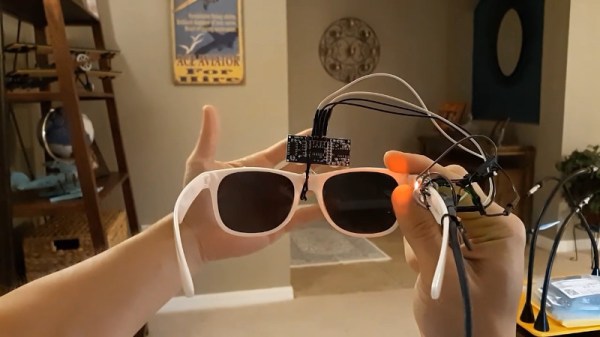
In 2020, the world is focused on the rampant spread of a new virus by the name of COVID-19. Like many infectious diseases, transmission can be reduced by good hygiene practices. To help in the fight, [Nick Bild] threw together a device he calls Sentinel.

The concept is simple. Reduce the user touching their own face by shining a warning light when such behaviour is detected. This is achieved through the use of an Arduino, which controls an LED through feedback from an ultrasonic proximity sensor. The LED is placed in the user’s peripheral vision, glowing when the sensor detects hands (or other objects) approaching the face.

While it’s unlikely to be rolled out en-masse, it’s a project that nevertheless reminds us to practice good self-care routines. And, as the adage goes, prevention is better than cure. As governments and industry grapple with the ongoing problem, consider how your supply chain may be exposed to the crisis. Video after the break.

Continue reading “A Reminder Not To Touch Your Face” →

Homebuilt Onewheel Uses Hoverboard Parts

Since Back To The Future II first screened back in 1989, people have been waiting for hoverboards to become reality. Instead, we got a dangerous two-wheeled contraption going by the same name. Wanting something a little cooler, [Bartek Plonek] decided to convert his to a one-wheel design. (Video, embedded below.)

The hack starts by machining the hub motors of the hoverboard. They’re bolted together, and used as the hub of a single larger wheel. Care is necessary to avoid cracking the motor housing during this process, as [Bartek] found during his first attempt. The wheel is then fitted to the centre of a steel frame, upon which two halves of a skateboard are attached to act as a footplate. The original hoverboard controller is still used; we’d love to know if firmware modification was required to work with the new motor configuration.

It’s a classic garage hack that results in a viable personal electric vehicle. Plus, cornering is far easier, with the DIY onewheel capable of carving back and forth quite well. We’ve seen others aim to commute using similar builds.

Continue reading “Homebuilt Onewheel Uses Hoverboard Parts” →