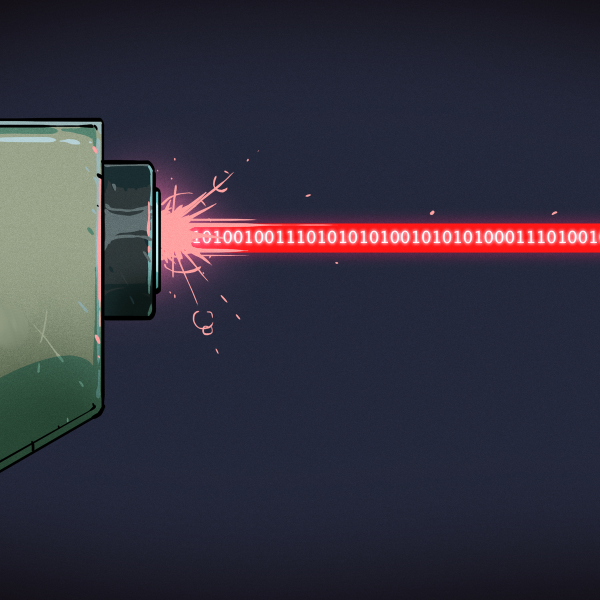
USB Hub-A-Dub-Dub: Weird Edge Cases Are My Ruin

The Universal Serial Bus. The one bus to rule them all.  It brought peace and stability to the world of computer peripherals. No more would Apple and PC users have to buy their own special keyboards, mice, and printers. No more would computers sprout different ports for different types of hardware. USB was fast enough and good enough for just about everything you’d ever want to plug in to a computer.

We mostly think of USB devices as being plug-and-play; that you can just hook them up and they’ll work as intended. Fiddle around around with some edge cases, though, and you might quickly learn that’s not the case. That’s just what I found when I started running complicated livestreams from a laptop…

Continue reading “USB Hub-A-Dub-Dub: Weird Edge Cases Are My Ruin”

Tiny RC Four-Wheeler Gets Chassis Upgrade For More Traction

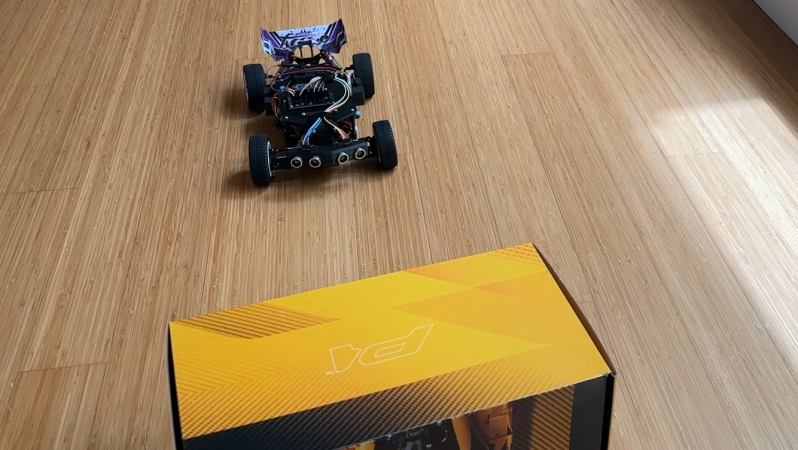
[Azpaca] purchased a fun little toy car from Tamiya, only… there was a problem. The little off-roader wasn’t up to scratch—despite its four-wheel-drive, it couldn’t get over rough ground to save its life. Thus, it was time to 3D-print a better chassis that could actually get through it!

The problem was quite obvious. With no suspension and a rigid chassis, the vehicle would tend to end up with one or more wheels on the air on rough surfaces. To rectify this, [Azpaca] created a twisting chassis which would allow the wheels to better remain in contact with the ground. The design is relatively straightforward, and reuses much of the original drivetrain, including the simple brushed motor. However, with a pivot right behind the front wheels, it has much more traction on rocks and gravel, and can traverse these terrains much more easily.

Tamiya’s motorized toys aren’t particularly well known in the West, but it’s neat to see the community that exists around modifying them around the world. Design files are available for the curious. If you’re not down with mods, perhaps you’d prefer to print your own cars from scratch. Video after the break.

Continue reading “Tiny RC Four-Wheeler Gets Chassis Upgrade For More Traction”

Could Non-Planar Infill Improve The Strength Of Your 3D Prints?

When you’re spitting out G-Code for a 3D print, you can pick all kinds of infill settings. You can choose the pattern, and the percentage… but the vast majority of slicers all have one thing in common. They all print layer by layer, infill and all. What if there was another way?

There’s been a lot of chatter in the 3D printing world about the potential of non-planar prints. Following this theme, [TenTech] has developed a system for non-planar infill. This is where the infill design is modulated with sinusoidal waves in the Z axis, such that it forms a somewhat continuous bond between what would otherwise be totally seperate layers of the print. This is intended to create a part that is stronger in the Z direction—historically a weakness of layer-by-layer FDM parts.

Files are on Github for the curious, and currently, it only works with Prusaslicer. Ultimately, it’s interesting work, and we can’t wait to see where it goes next. What we really need is a comprehensive and scientific test regime on the tensile strength of parts printed using this technique. We’ve featured some other neat work in this space before, too. Video after the break.

Continue reading “Could Non-Planar Infill Improve The Strength Of Your 3D Prints?”

RedBox In The 80s: Meet The VHS Vending Behemoth

Redbox was a company with a moderately interesting business model—it let you rent DVDs from automated kiosks. It’s an idea so simple it’s almost surprising it didn’t appear sooner. Only, it did—all the way back in the VHS age!

Meet the Video Vendor. YouTuber [SpaceTime Junction] was able to track down one of these rare machines, which apparently formerly served an Ohio rental outlet called Kohnen’s. It’s a monstrous thing that stands taller and about three times wider than traditional vending machines, and it could hold up to 320 tapes in its robotic magazine. It’s got lashings of woodgrain, a green-on-black CRT, and the beautiful kind of clicky keys that went away after the 1980s.

[SpaceTime Junction] has a bunch of videos up on the machine, and you even get to see it powered up.  It’s a little difficult to see what’s going on, because the machine is something like nine feet wide and it’s all shot in vertical video. There isn’t a whole lot of content on these obscurities out there, so this is a great place to start. Apparently, there were recently a hundred or more of these found living in a Texas warehouse according to Reddit, so we might see more of these popping up online soon. [SpaceTime Junction] has toured that facility, too.

You can read more about the fall of Redbox, or the cleanup afterwards, in our prior coverage.

Continue reading “RedBox In The 80s: Meet The VHS Vending Behemoth”

Antique-Style GPS Looks Like Steampunky Fun

These days, turn-by-turn GPS navigation isn’t considered special anymore. It’s in every smartphone and most cheap rental cars, and thus everybody expects you to figure out where you’re going. If you want a simpler and less robust navigation experience, you might like to try the rather fancy RadioScout.

The RadioScout is a build from [hardlyhumanfx]—a group of engineers and artists that collaborate on fun and whimsical projects. It looks like some kind of steampunk compass, and it kind of is—but at heart, it’s powered by GPS.

You program the RadioScout using the buttons on the front panel and a rotary phone dial to enter the latitude and longitude of your destination. It then uses an internal GPS receiver to compare that with your current location, and calculates a direct bearing to where you want to go. This bearing is displayed with a large compass-like needle run by a stepper motor, and you you can use it to guide yourself onwards.

It’s an attractive build that uses lots of neat parts. The team interfaced a microcontroller with a GPS receiver, a rotary dial, and 7-segment LEDs for the latitude and longitude display. The very real bell is neat, too. The whole thing is wrapped up in a brass and wooden case that would make you a star at just about any sci-fi convention. The build video is a little vague on the finer details, but experienced makers will be able to figure out how it all works.

You can actually buy a RadioScout if it’s something you must have, but one suspects the Hackaday set would probably prefer the homebrew route.

Continue reading “Antique-Style GPS Looks Like Steampunky Fun”

A New Case And Keyboard For The Timex Sinclair 1000

The Timex Sinclair 1000 was a sleek and compact machine, and the US counterpart to the more well-known Spectrum ZX-81. Timex may not have come to dominate the computer market, but the machine still has its fans today, with [skidlz] being one of them. That inspired them to craft a new case and keyboard for their beloved machine, putting a slimline twist on the old classic.

The new case finds some economies of size by eliminating the bulky RF modulator in favor of hacking in a cleaner composite out feed. In turn, this enabled the elimination of the channel switch that freed up more room. [skidlz] then designed a simple case using 2D laser-cut parts and dovetail joints, using superglue to assemble the individual pieces into a cohesive whole.

Meanwhile, the keyboard swap is obvious to anyone that ever used one of these things. The original was particularly unpleasant. In order to upgrade, [skidlz] decided to look to the compact Redragon K603 as an inspiration, giving the new build a longer travel and a nicer mechanical feel under one’s fingers.

The final result look great, and files are on Github for the curious. We’ve seen great work from [skidlz] before, too, in the form of this microcassette storage project. Meanwhile, if you’ve been cooking up your own retrocomputing projects, don’t hesitate to let us know!

Automating The Process Of Drawing With Chalk

Chalk is fun to draw with, and some people even get really good at using it to make art on the sidewalk. If you don’t like tediously developing such skills, though, you could go another route. [MrDadVs] built a robot to scrawl chalk pictures for him, and the results speak for themselves.

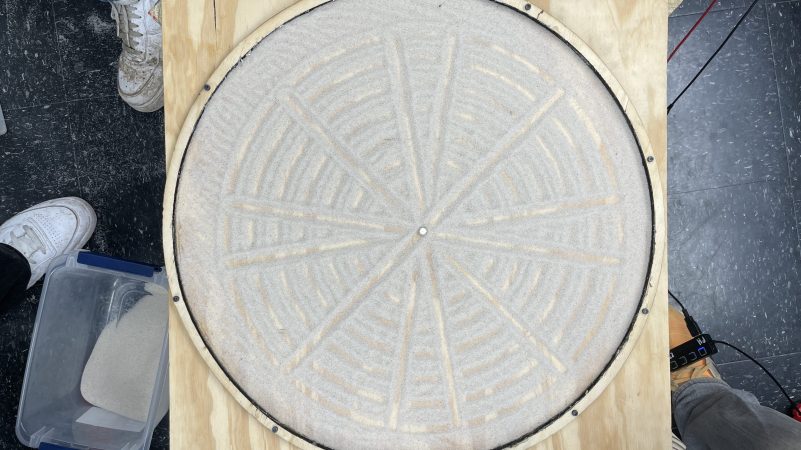
The robot is known as AP for reasons you’ll have to watch the video to understand. You might be imagining a little rover that crawls around on wheels dotting at the pavement with a stick of chalk, but the actual design is quite different. Instead, [MrDadVs] effectively built a polar-coordinate plotter to make chalk pictures on the ground. AP has a arm loaded with a custom liquid chalk delivery system for marking the pavement. It’s rotated by a stepper motor with the aid of a 3D-printed geartrain that helps give it enough torque. It’s controlled by an ESP32 running the FluidNC software which is a flexible open-source CNC firmware. [MrDadVs] does a great job of explaining how everything works together, from converting cartesian coordinates into a polar format, to getting the machine to work wirelessly.

Building a capable sidewalk chalk robot seems like a great way to spend six months. Particularly when it can draw this well. Video after the break.

Continue reading “Automating The Process Of Drawing With Chalk”