Blinds Automated With Offline Voice Recognition

Blinds are great for keeping light out or letting light in on demand, but few of us appreciate having to walk over and wind them open and shut on the regular. [DIY Builder] resented this very task, so set about creating an automated system to do the job for him.

The blinds in question use a ball chain to open and close, which made them relatively easy to interface with mechanically. [DIY Builder] set up a NEMA 17 stepper motor with an appropriate 3D-printed gear to interface with the chain, allowing it to move the blinds accurately. The motor is controlled via an Arduino Nano and an A4988 stepper motor driver.

However, that only covered the mechanical side of things. [DIY Builder] wanted to take the build a step further by making the blinds voice activated. To achieve this, the Arduino Nano was kitted out with a DFRobot Gravity voice recognition module. It’s a super simple way to do voice recognition—it’s an entirely offline solution with no cloud computing or internet connection required. You just set it up to respond to simple commands and it does the rest.

The result is a voice activated blind that works reliably whether your internet is up or not. We’ve seen some other great projects in this space, too. Video after the break.

Continue reading “Blinds Automated With Offline Voice Recognition”

Tiny Mouse Ring Uses Prox Sensors

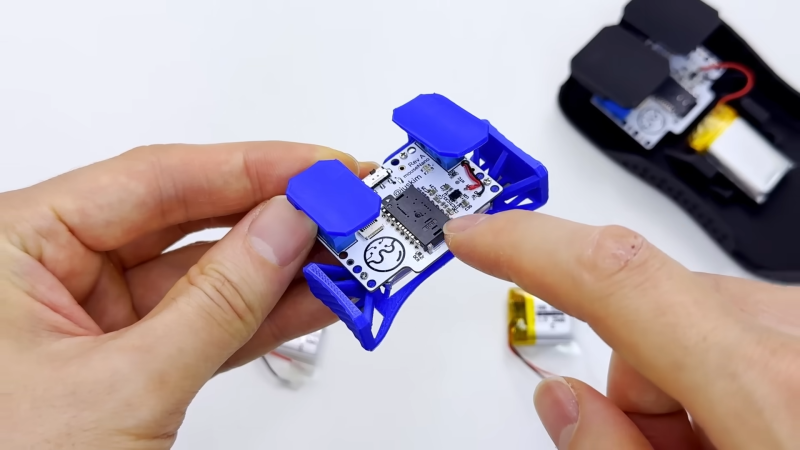
A traditional computer mouse typically fits in the palm of your hand. However, with modern technology, there’s no need for mice to be so large, as demonstrated by [juskim]’s neat little mouse ring. Check it out in the video below.

The concept is simple—it’s a tiny mouse that sits neatly on the end of one of your fingers. You then get the slightly surreal experience of pointing on your computer just by moving a single finger instead of your whole hand.

The project uses a typical optical mouse sensor for movement, as you might expect. However, there are no conventional switches for the left and right mouse buttons. Instead, [juskim] realized a more compact design was possible by using proximity sensors instead. The sensors detect the presence of his fingers on either side of the ring mouse. When one of the fingers is lifted, the absence of the finger triggers a mouse click, either left or right, depending on the finger.

The build started with junk box parts, but hooking up an Arduino Pro Micro dev board and other modules proved too cumbersome to use effectively. Instead, the build relies on an ATTO board, a tiny PCB featuring the same ATmega32U4 microcontroller. Similarly, the build relies on tiny proximity sensors from STM to fit in the “ring” form factor. It’s all wrapped up in a 3D-printed enclosure that fits snugly on the user’s finger.

We’ve seen some other neat mouse rings before, too. Or, if you want something really different, grab some keychains and make a 6DOF mouse.

Continue reading “Tiny Mouse Ring Uses Prox Sensors”

How Magnetic Fonts Twisted Up Numbers And Saved Banking Forever

If you’ve ever looked at the bottom of a bank check, you probably glanced over some strangely formed numbers? If you’re a fan of science fiction or retro computers, you’ve probably spotted the same figures on any number of books from the 1980s. They’re mostly readable, but they’re chunky and thin in places you don’t expect.

Those oddball numerals didn’t come from just anywhere—they were a very carefully crafted invention to speed processing in the banking system. These special fonts were created to be readable both by humans and machines—us with our eyes, and the computers with magnetic sensors. Let’s explore the enigmatic characters built for Magnetic Ink Character Recognition (MICR). Continue reading “How Magnetic Fonts Twisted Up Numbers And Saved Banking Forever”

Flip Flops Make Great Soft Switches

Mechanical switches are pretty easy to understand—the contacts touch, the current flows, and Bob is, presumably, your uncle. But what about soft switches? Well, they’re not that difficult to understand either, as explained by [EDN].

You can build a touch switch quite easily with old-school chips.

The traditional softswitch takes input from a momentary single-pole pushbutton and lets you press to toggle power on and off. This operation is easy to achieve with a simple flip-flop constructed with old-school logic to create a “bistable” circuit. That means it will happily remain stable in one of two states unless you do something to make it switch.

Continue reading “Flip Flops Make Great Soft Switches”

Powerful Flashlight Gets Active Air Cooling

LEDs were once little more than weedy little indicators with low light output. Today, they’re absolute powerhouses, efficiently turning a flow of electrons into a searing beam of light. Despite their efficiency, they can still put out a fair whack of heat. Thus, if you’re building a powerful flashlight like [CrazyScience], you might wanna throw some active cooling on there just to keep things happy. Check out the video below.

The build will not be unfamiliar to any casual observer of the modern DIY flashlight scene. It uses a flatpack LED module of great brightness and a wad of 18650 lithium-ion cells to provide the juice to run it. The LED itself is mounted in a 3D-printed frame, which leaves its rear exposed, and a small PC fan is mounted for air cooling. It’s not the most optimized design, as airflow out of the fan is somewhat restricted by the 3D-printed housing, but it’s a lot better than simple passive cooling. It allows the torch to be more compact without requiring a huge heatsink to keep the LED at an acceptable temperature.

The final torch doesn’t have the most ergonomic form factor, but it does work. However, as a learning project for a new maker, it’s a start, and the learning value of building something functional can’t be understated. If your desire for flashlights swerves to the more powerful, we’ve covered those, too. Just be careful out there.

Continue reading “Powerful Flashlight Gets Active Air Cooling”

How Do We Deal With Microplastics In The Ocean?

Like the lead paint and asbestos of decades past, microplastics are the new awful contaminant that we really ought to do something about. They’re particularly abundant in the aquatic environment, and that’s not a good thing. While we’ve all seen heartbreaking photos of beaches strewn with water bottles and fishing nets, it’s the invisible threat that keeps environmentalists up at night. We’re talking about microplastics – those tiny fragments that are quietly infiltrating every corner of our oceans.

We’ve dumped billions of tons of plastic waste into our environment, and all that waste breaks down into increasingly smaller particles that never truly disappear. Now, scientists are turning to an unexpected solution to clean up this pollution with the aid of seashells and plants.

Continue reading “How Do We Deal With Microplastics In The Ocean?”

What Happens If You Die In Space?

There are no two ways about it—space will kill you if you give it half a chance. More than land, sea, or air, the space environment is entirely hostile to human existence. Precision-engineered craft are the bare minimum just to ensure human survival. Even still, between the vacuum, radiation, micrometeorites, and equipment failures, there are plenty of ways for things to go catastrophically wrong beyond Earth’s atmosphere.

Despite the hazards, most spacefaring humans have completed their missions without injury. However, as we look to return to the Moon, tread on Mars, and beyond, it’s increasingly likely that future astronauts could pass away during longer missions. When that inevitably happens, the question is simple—how do you deal with death in space?

Continue reading “What Happens If You Die In Space?”