Squeezing Every Bit From An ATMega

While the ATMega328 is “mega” for a microcontroller, it’s still a fairly limited platform. It has plenty of I/O and working memory for most tasks, but this Battleship game that [thorlancaster328] has put together really stretches the capabilities of this tiny chip. Normally a Battleship game wouldn’t be that complicated, but this one has audio, an LED display, and can also play a fine rendition of Nyan Cat to boot, which really puts the Atmel chip through its paces.

The audio is played through a 512-byte buffer and an interrupt triggers the microcontroller when to fill the buffer while it works on the other processes. The 12×12 LED display is also fed through a shift register triggered by the same interrupt as the audio, and since the build uses so many shift registers the microcontroller can actually output four separate displays (two players, each with a dispaly for shots and one for ships). It will also eventually support a player-vs-computer mode for the battleship game, and also has a mode where it plays Nyan cat just to demonstrate its own capabilities.

We’re pretty impressed with the amount of work this small microcontroller is doing, largely thanks to code optimization from its creator [thorlancaster328]. If there’s enough interest he also says he will provide the source code too. Until then, be sure to check out this other way of pushing a small microcontroller to its limits.

Thanks to [Thinkerer] for the tip!

Fox Hunting With Software-Defined Radio

Fox hunting, or direction finding, is a favorite pastime in the ham radio community where radio operators attempt to triangulate the position of a radio transmission. While it may have required a large amount of expensive equipment in the past, like most ham radio operations the advent of software-defined radio (SDR) has helped revolutionize this aspect of the hobby as well. [Aaron] shows us how to make use of SDR for direction finding using his custom SDR-based Linux distribution called DragonOS.

We have mentioned DragonOS before, but every iteration seems to add new features. This time it includes implementation of a software package called DF-Aggregator. The software (from [ckoval7]), along with the rest of DragonOS, is loaded onto a set of (typically at least three) networked Raspberry Pis. The networked computers can communicate information about the radio waves they receive, and make direction finding another capable feature found in this distribution.

[Aaron] has a few videos showing the process of setting this up and using it, and all of the software is available for attempting something like this on your own. While the future of ham radio as a hobby does remain in doubt, projects like this which bring classic ham activities to the SDR realm really go a long way to reviving it.

Continue reading “Fox Hunting With Software-Defined Radio”

Indoor Antennas Worthy Of 007

Many ham radio operators now live where installing an outdoor antenna is all but impossible. It seems that homeowner’s associations are on the lookout for the non-conformity of the dreaded ham radio antenna. [Peter] can sympathize, and has a solution based on lessons of spycraft from the cold war.

[Peter] points out that spies like the [Krogers] needed to report British Navy secrets like the plans for a nuclear boomer sub to Russia but didn’t want to attract the attention of their neighbors. In this case, the transmitter itself was so well-hidden that it took MI5 nine days to find the first of them. Clearly, then, there wasn’t a giant antenna on the roof. If there had been, the authorities could simply follow the feedline to find the radio. A concealed spy antenna might be just the ticket for a deed-restricted ham radio station.

The antenna the [Kroger’s] used was a 22-meter wire in the attic of their home. Keep in mind, the old tube transmitters were less finicky about SWR and by adjusting the loading circuits, you could transmit into almost anything. Paradoxically, older houses work better with indoor antennas because they lack things like solar cell panels, radiant barriers, and metallic insulation.

Like many people, [Peter] likes loop antennas for indoor use. He also shows other types of indoor antennas. They probably won’t do as much good as a proper outdoor antenna, but you can make quite a few contacts with some skill, some luck, and good propagation. [Peter] has some period spy radios, which are always interesting to see. By today’s standards, they aren’t especially small, but for their day they are positively tiny. Video after the break.

Continue reading “Indoor Antennas Worthy Of 007”

Legged Robots Put On Wheels And Skate Away

We don’t know how much time passed between the invention of the wheel and someone putting wheels on their feet, but we expect that was a great moment of discovery: combining the ability to roll off at speed and our leg’s ability to quickly adapt to changing terrain. Now that we have a wide assortment of recreational wheeled footwear, what’s next? How about teaching robots to skate, too? An IEEE Spectrum interview with [Marko Bjelonic] of ETH Zürich describes progress by one of many research teams working on the problem.

For many of us, the first robot we saw rolling on powered wheels at the end of actively articulated legs was when footage of the Boston Dynamics ‘Handle’ project surfaced a few years ago. Rolling up and down a wide variety of terrain and performing an occasional jump, its athleticism caused quite a stir in robotics circles. But when Handle was introduced as a commercial product, its job was… stacking boxes in a warehouse? That was disappointing. Warehouse floors are quite flat, leaving Handle’s agility under-utilized.

Boston Dynamic has typically been pretty tight-lipped on details of their robotics development, so we may never know the full story behind Handle. But what they have definitely accomplished is getting a lot more people thinking about the control problems involved. Even for humans, we face a nontrivial learning curve paved with bruised and occasionally broken body parts, and that’s even before we start applying power to the wheels. So there are plenty of problems to solve, generating a steady stream of research papers describing how robots might master this mode of locomotion.

Adding to the excitement is the fact this is becoming an area where reality is catching up to fiction, as wheeled-legged robots have been imagined in forms like Tachikoma of Ghost in the Shell. While those fictional robots have inspired projects ranging from LEGO creations to 28-servo beasts, their wheel and leg motions have not been autonomously coordinated as they are in this generation of research robots.

As control algorithms mature in robot research labs around the world, we’re confident we’ll see wheeled-legged robots finding applications in other fields. This concept is far too cool to be left stacking boxes in a warehouse.

Continue reading “Legged Robots Put On Wheels And Skate Away”

Casting Skateboard Wheels With A 3D Printed Mold

We’ll admit that most of the Hackaday staff wouldn’t get too far on a skateboard, but that doesn’t mean we can’t appreciate the impressive DIY wheels that [Chris McCann] has managed to cast using 3D printed molds. From unique color combinations to experimental materials, the process certainly opens up some interesting possibilities for those looking to truly customize their rides. Though it’s worth noting there’s a certain element of risk involved; should a set of homemade wheels fail at speed, it could go rather poorly for the rider.

Both the STL and STEP files for the mold have been released under the Creative Commons Attribution 4.0 license, meaning anyone with a 3D printer can follow along at home. Unfortunately, it’s not quite as simple as clicking print and coming back to a usable mold. Because of the layer lines inherent to FDM 3D printing, the inside of the mold needs to be thoroughly sanded and polished. [Chris] mentions that printing the mold in ABS and using vapor smoothing might be a workable alternative to elbow grease and PLA, but he hasn’t personally tried it yet.

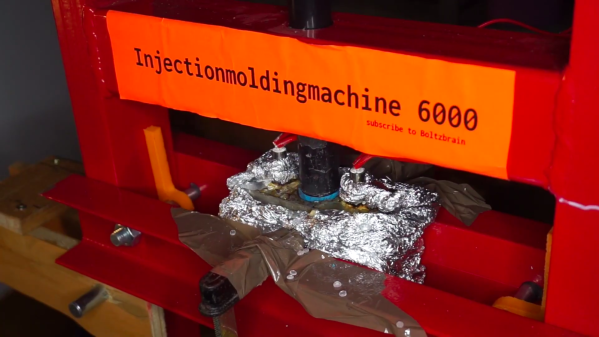
Once you’ve got the three part mold printed, smoothed, and coated with an appropriate release agent like petroleum jelly, it’s time to make some wheels. The core of each wheel is actually 3D printed from PETG, which should give it pretty reasonable impact resistance. If you have access to a lathe, producing aluminum cores shouldn’t be too difficult either. With the core loaded into the mold, urethane resin is poured in through the top until all the empty space is filled.

But you’re not done yet. All those little air bubbles in the resin need to be dealt with before it cures. [Chris] puts his filled molds into a pressure chamber, though he mentions that vacuum degassing might also be a possibility depending on the urethane mixture used. After everything is solidified, the mold can easily be taken apart to reveal the newly cast wheel.

While there’s often some trial and error involved, 3D printing and resin casting are an undeniably powerful combination. If you can master the techniques involved, you can produce some very impressive parts that otherwise would be exceptionally difficult to produce on a hacker’s budget. Especially when you’re ready to start casting molten metal.

Continue reading “Casting Skateboard Wheels With A 3D Printed Mold”

No Doorknobs Needed For This Nitrogen Laser Build

Sometimes the decision to tackle a project or not can boil down to sourcing parts. Not everything is as close as a Digi-Key or Mouser order, and relying on the availability of surplus parts from eBay or other such markets can be difficult. Knowing if and when a substitute will work for an exotic part can sometimes be a project all on its own.

Building lasers is a great example of this, and [Les Wright] recently looked at substitutes for hard-to-find “doorknob” capacitors for his transversely excited atmospheric lasers. We took at his homebrew TEA lasers recently, which rely on a high voltage supply and very rapid switching to get nitrogen gas to lase. His design uses surplus doorknob caps, big chunky parts rated for very high voltages but also with very low parasitic inductance, which makes them perfect for the triggering circuit.

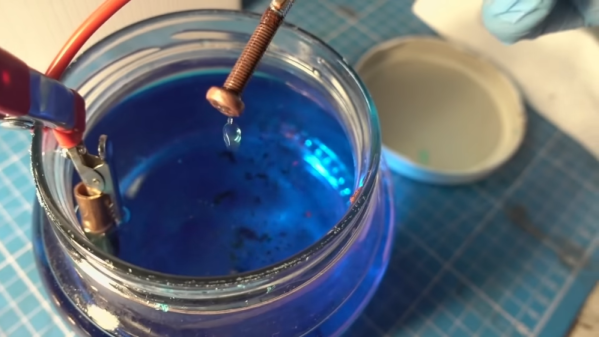
[Les] tried to substitute cheaper and easier-to-find ceramic power caps with radial wire leads rather than threaded lugs. With a nominal 40-kV rating, one would expect these chunky blue caps to tolerate the 17-kV power supply, but as he suspected, the distance between the leads was short enough to result in flashover arcing. Turning down the pressure in the spark gap chamber helped reduce the flashover and prove that these caps won’t spoil the carefully engineered inductive properties of the trigger. Check out the video below for more details.

Thanks to [Les] for following up on this and making sure everyone can replicate his designs. That’s one of the things we love about this community — true hackers always try to find a way around problems, even when it’s just finding alternates for unobtanium parts.

Continue reading “No Doorknobs Needed For This Nitrogen Laser Build”

Webcam Heart Rate Monitor Brings Photoplethysmography To Your PC

It seems like within the last ten years, every other gadget to be released has some sort of heart rate monitoring capability. Most modern smartwatches can report your BPMs, and we’ve even seen some headphones with the same ability hitting the market. Most of these devices use an optical measurement method in which skin is illuminated (usually by an LED) and a sensor records changes in skin color and light absorption. This method is called Photoplethysmography (PPG), and has even been implemented (in a simple form) in smartphone apps in which the data is generated by video of your finger covering the phone camera.

The basic theory of operation here has its roots in an experiment you probably undertook as a child. Did you ever hold a flashlight up to your hand to see the light, filtered red by your blood, shine through? That’s exactly what’s happening here. One key detail that is hard to perceive when a flashlight is illuminating your entire hand, however, is that deoxygenated blood is darker in color than oxygenated blood. By observing the frequency of the light-dark color change, we can back out the heart rate.

This is exactly how [Andy Kong] approached two methods of measuring heart rate from a webcam.

Method 1: The Cover-Up

The first detection scheme [Andy] tried is what he refers to as the “phone flashlight trick”. Essentially, you cover the webcam lens entirely with your finger. Ambient light shines through your skin and produces a video stream that looks like a dark red rectangle. Though it may be imperceptible to us, the color changes ever-so-slightly as your heart beats. An FFT of the raw data gives us a heart rate that’s surprisingly accurate. [Andy] even has a live demo up that you can try for yourself (just remember to clean the smudges off your webcam afterwards).

Method 2: Remote Sensing

Now things are getting a bit more advanced. What if you don’t want to clean your webcam after each time you measure your heart rate? Well thankfully there’s a remote sensing option as well.

For this method, [Andy] is actually using OpenCV to measure the cyclical swelling and shrinking of blood vessels in your skin by measuring the color change in your face. It’s absolutely mind-blowing that this works, considering the resolution of a standard webcam. He found the most success by focusing on fleshy patches of skin right below the eyes, though he says others recommend taking a look at the forehead.

Every now and then we see something that works even though it really seems like it shouldn’t. How is a webcam sensitive enough to measure these minute changes in facial color? Why isn’t the signal uselessly noisy? This project is in good company with other neat heart rate measurement tricks we’ve seen. It’s amazing that this works at all, and even more incredible that it works so well.