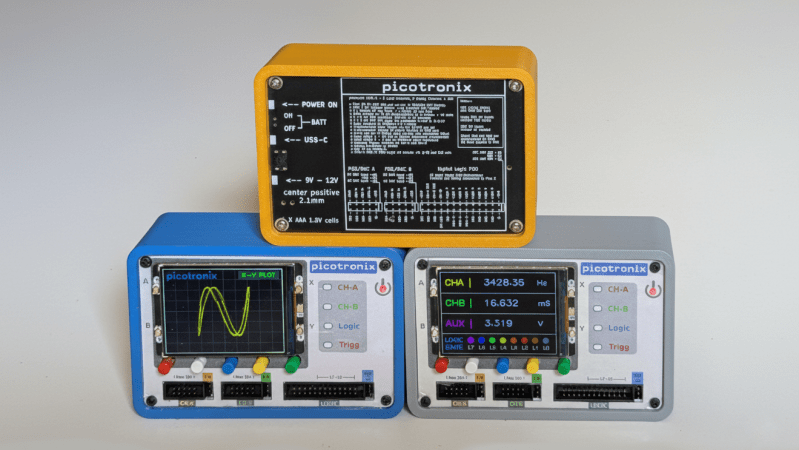
A set of three stacked oscilloscopes is shown. The lower two oscilloscopes have screens and input pins visible, and the top oscilloscope is reversed, with a printed back plate visible.

A Higher-End Pico-Based Oscilloscope

Hackers have been building their own basic oscilloscopes out of inexpensive MCUs and cheap LCD screens for some years now, but microcontrollers have recently become fast enough to actually make such ‘scopes useful. [NJJ], for example, used a pair of Raspberry Pi Picos to build Picotronix, an extensible combined oscilloscope and logic analyzer.

This isn’t an open-source project, but it is quite well-documented, and the general design logic and workings of the device are freely available. The main board holds two Picos, one for data sampling and one to handle control, display, and external communication. The control unit is made out of stacked PCBs surrounded by a 3D-printed housing; the pinout diagrams printed on the back panel are a helpful touch. One interesting technique was to use a trimmed length of clear 3D printer filament as a light pipe for an indicator LED.

Even the protocol used to communicate between the Picos is documented; the datagrams are rather reminiscent of Ethernet frames, and can originate either from one of the Picos or from a host computer. This lets the control board operate as an automatic testing station reporting data over a wireless or USB-connected network. The display module is therefore optional hardware, and a variety of other boards (called picoPods) can be connected to the Picotronix control board. These include a faster ADC, adapters for various analog input spans, a differential analog input probe, a 12-bit logic state analyzer, and a DAC for signal generation.

If this project inspired you to make your own, we’ve also seen other Pico-based oscilloscopes before, including one that used a phone for the display.
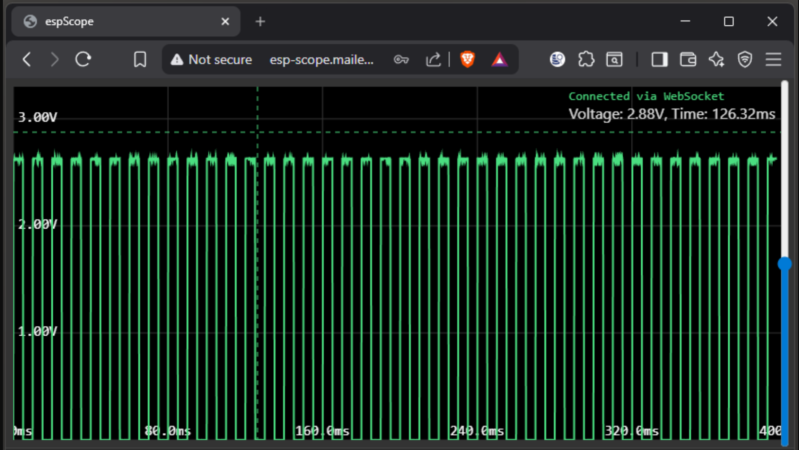
A browser window is shown, in which a web page is displaying a green trace of a square wave.

A Compact, Browser-Based ESP32 Oscilloscope

An oscilloscope is usually the most sensitive, and arguably most versatile, tool on a hacker’s workbench, often taking billions of samples per second to produce an accurate and informative representation of a signal. This vast processing power, however, often goes well beyond the needs of the signals in question, at which point it makes sense to use a less powerful and expensive device, such as [MatAtBread]’s ESP32 oscilloscope.

Continue reading “A Compact, Browser-Based ESP32 Oscilloscope”

“Simplest” Oscilloscope Is A Cunning Vector Display

Superlatives are tricky things. [mircemk]’s guide “How to make Simplest ever Oscilloscope Clock” falls into that category. It’s that word, simplest. Certainly, this is an oscilloscope clock, and a nice one. But is it simple?

There’s a nice oscilloscope circuit with a cute 2″ 5LO38I CRT and EF80 tubes for horizontal and vertical deflection that we’d say is pretty simple. (It’s based on an earlier DIY oscilloscope project [mircemk] did.) The bill of materials is remarkably sparse– but it’s modules that do it. One entry is a DC-DC step up supply to get the needed HV. Another is a LM317 to get 6.3 V to heat the tubes. The modules make for a very simple BOM, but on another level, there’s quite a bit of complex engineering in those little modules.

When we get to the “clock” part of the oscilloscope clock, that quandary goes into overdrive. There’s only one line on the BOM, so that’s very simple. On the other hand, it’s an ESP32. Depending on your perspective, that’s not simple at all. It’s a microcomputer, or at least something that can play at emulating one.

Oh, in the ways that matter to a maker — parts count, time, and effort, this oscilloscope clock is very simple. The fact that its actually a vector display for a powerful little micro just adds to the versatility of the build. We absolutely love it, to be honest. Still, the idea that you can have millions of transistors in a simple project — never mind the “simplest ever” — well, it just seems weird on some level when you think about it.

It all comes back to what counts as “simple”. If we’re taking lines on a BOM, arguably this would be even simpler if you used an existing oscilloscope. 

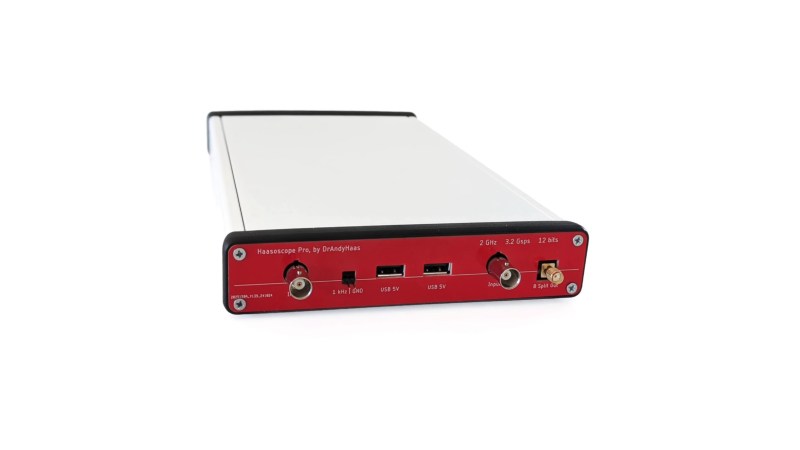
Photo of the Haasoscope Pro

Haasoscope Pro: Open-Everything 2 GHz USB Oscilloscope

Our hacker [haas] is at it again with the Haasoscope Pro, a full redesign of the original Haasoscope, which was a successful Crowd Supply campaign back in 2018.

This new Pro version was funded on Crowd Supply in April this year and increases the bandwidth from 60 MHz to 2 GHz, the vertical resolution from 8 to 12 bits, and the sample rate from 125 MS/s to 3.2 GS/s. Selling for $999 it claims to be the first open-everything, affordable, high-bandwidth, real-time sampling USB oscilloscope.

The firmware and software are under active development and a new version was released yesterday.

Continue reading “Haasoscope Pro: Open-Everything 2 GHz USB Oscilloscope”

The Oscilloscope From 1943

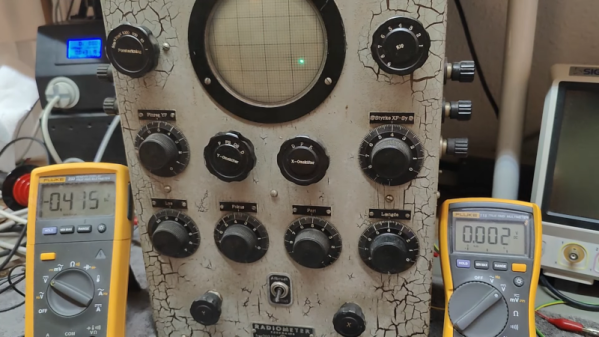
[Thomas] comes up with some unusual gear. In his latest teardown and repair video, he has a vintage 1943 Danish oscilloscope,  a Radiometer OSG32 on the bench. It isn’t lightweight, and it certainly looks its age with a vintage cracked finish on the case. You can check out the tubes and high-voltage circuitry in the video below.

If you’ve only seen the inside of a modern scope, you’ll want to check this out with giant condensers (capacitors) and a slew of tubes. We love seeing the workmanship on these old chassis.

Continue reading “The Oscilloscope From 1943”

Two Bits, Four Bits, A Twelve-bit Oscilloscope

Until recently, hobby-grade digital oscilloscopes were mostly, at most, 8-bit sampling. However, newer devices offer 12-bit conversion. Does it matter? Depends. [Kiss Analog] shows where a 12-bit scope may outperform an 8-bit one.

It may seem obvious, of course. When you store data in 8-bit resolution and zoom in on it, you simply have less resolution. However, seeing the difference on real data is enlightening.

Continue reading “Two Bits, Four Bits, A Twelve-bit Oscilloscope”

Supercon 2024: Using An Oscilloscope To Peek Below The Noise Floor

When you’re hunting for a signal with your oscilloscope, the stronger it is, the better. If it’s weak, you might struggle to tease it out from other interference, or even from the noise floor itself. You might wish that you were looking for something more obvious rather than the electromagnetic equivalent of a needle in a haystack.

Finding hidden signals below the noise floor may be a challenge, but it needn’t be an insurmountable one. James Rowley and Mark Omo came to the 2024 Hackaday Superconference to tell us how to achieve this with the magic of lock-in amplifiers.

Continue reading “Supercon 2024: Using An Oscilloscope To Peek Below The Noise Floor”