2023 Halloween Hackfest: A Spooky Muscle-Brain Interface

What could be better than a Halloween decoration? Something more perennial, or even something that could also be found in a classroom or lab. Something like [Markus Bindhammer]’s spooky muscle-brain interface. It was inspired by a series called “Tales From the Loop” in which a character’s muscle electrical activity is measured in preparation to adjust his prosthetic hand.

Essentially, it does what you think it does: attach the sensors to your muscles, move them around, and watch the brain light up. [Markus] started with a children’s learning kit that involves molding the brain and discs out of red rubbery goop, the vertebrae out of plaster, and then assembling the whole thing.

Instead, [Markus] molded the brain and vertebrae in two-part silicone for durability, and used two-component colored epoxy for the discs.

As the inspiring series is set in the 80s (we assume the brown, dingy 80s and not the fun, neon 80s), [Markus] gave the enclosure/stand an appropriate color scheme. Inside that box there’s an Arduino Pro Micro, a Grove EMG detector, and a mini step-up converter module. And of course, under the brain, there’s a NeoPixel ring. Don’t miss the build and demo video after the break.

There are a ton of things you can do with blinkenlights for Halloween. How about a light-up candy slide, or a bucket that seems them coming?

Continue reading “2023 Halloween Hackfest: A Spooky Muscle-Brain Interface”

2023 Halloween Hackfest: Candy Basket Sees You Coming

On Halloween, some people can’t or don’t want to open the door for various reasons. Maybe they have a cat that likes to escape every chance it gets, or maybe their favorite TV show is on during prime trick-or-treating time. Whatever the case, we think it’s perfectly acceptable to leave a bowl of candy outside the door, especially if there are electronics involved.

In this case, the bowl detects trick-or-treaters and candy eaters using an LD2410 60 GHz radar sensor and an RP2040. A light pipe shows orange when a person is detected, and switches over to green as they come closer, as if to say you may have candy now.

Nothing happens after that, but now that we think about it, it would be cool to add an MP3 decoder and a speaker to play a little witch cackle or something once they’ve had a chance to stick their hand in the bucket.

[Mike Kushnerik] actually designed the PCB a few months ago for non-Halloween purposes: some home automation projects. But then they were trying to think of something for Halloween, and this delightful light-up bucket came to mind. In addition to the RP2040 chip, there’s a 128 MB flash chip, a WS2812 LED, and a header for communicating with the radar sensor over UART. Be sure to check out the brief demo video after the break.

If you’d like to stand outside and give out candy, at least send it down a light-up slide or something.

Continue reading “2023 Halloween Hackfest: Candy Basket Sees You Coming”

2023 Halloween Hackfest: Musical Jack-o-Lanterns Harmonize For Halloween

Halloween is many things to many people. For some, it’s a chance to dress up and let loose. For others, it’s a chance to give everyone in the neighborhood a jump scare. For [Aaron], it’s the perfect time to put on a show in the yard with some musical, light-up jack-o-lanterns.

[Aaron] came across some deeply-discounted light-up jack-o-lanterns a few years ago. They all had one of those Try Me buttons that’s powered by a couple of coin cells and uses a temporary two-wire connection to the PCB, and [Aaron] figured he could remotely control them using this port of sorts.

Now the guts are made of addressable RGB LEDs that are connected through the battery compartment via weatherproofed pigtails.

On the control side, he has a Raspberry Pi 3, an amplifier, and a couple of power supplies all housed in a weatherproof box. Since it’s not possible to multiplex both the lights and the audio on a Pi 3, he added a USB sound card into the mix.

Be sure to check out the awesome demo video after the break, followed by a pumpkin conversion video.

If you’re more into scaring people, carve up an animated evil-eye pumpkin.

Continue reading “2023 Halloween Hackfest: Musical Jack-o-Lanterns Harmonize For Halloween”

2023 Halloween Hackfest: Flickering Pumpkin Pin Is Solidly Built

Now first of all, [Steph] grants that you can already take your pick of several LED pumpkin badges out there on IO. That’s not the point. The point is that this flickering pumpkin pin is nicely-built as well as being open source.

Even though it’s fully featured — it flickers, it’s wearable, and it’s lightweight — the build couldn’t be more simple. It’s fancy through-hole LEDs and a coin cell holder, plus a tack pin to stick it through your shirt. But the final result is quite elegant thanks to clever use of PCB layering.

The first version was to get all the layers right to let the light through and embellish the jack-o-lantern’s lines with manufacturer-applied silver solder, but as [Steph] points out, it looked ‘like something a disturbed child might carve into their desk in detention’. So [Steph] enlisted [Mx. Jack Nelson], who improved the artwork.

Pretty much every component does double duty here, including the tack pin — it serves as a switch because it can hold the battery in place. The battery’s edges reflect the glowing light quite nicely around the edge of the pin. And the LEDs beneath the battery prevent it from slipping out. You can see how it goes together in the video after the break.

Continue reading “2023 Halloween Hackfest: Flickering Pumpkin Pin Is Solidly Built”

2023 Halloween Hackfest: Treat Trough Of Terror Is Actually Pretty Cute

Even though it seems the worst of COVID has passed, October generally kicks off cold and flu season, so why not continue to pass out Halloween treats in a socially-distanced fashion?

That is, of course the idea behind [Gord Payne]’s Halloween Treat Trough of Terror. Lay a treat at the top of the trough and it will activate the LED strips that follow the treat down to the end, as well as some spooky sounds. The treat in question is detected by an SR-04 ultrasonic distance sensor connected to an Arduino Nano.

All in all this was a highly successful build as far as neighborhood entertainment value goes. Toddlers stared in awe at the blinkenlights, teenagers proclaimed it ‘sick’, and we can only assume that the adults were likely happy to see something aimed at kids that’s not scary.

[Gord] has a nice how-to if you want to build your own, and of course, the Arduino sketch is available. Be sure to check it out in action after the break.

Don’t have room to build a treat slide? Here’s a socially-distanced dispenser that lets them stomp a giant button.

Continue reading “2023 Halloween Hackfest: Treat Trough Of Terror Is Actually Pretty Cute”

2023 Halloween Hackfest: Ouija Robot Is Even Creepier Than The Real Thing

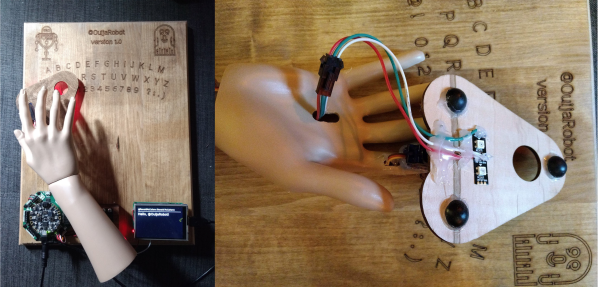
When you’re a kid, nothing says spooky like turning off the lights and bringing out the Ouija board. For decades, this mystifying oracle has purported to channel the dead by spelling out messages using a board with numbers, letters, yes/no, and a heart-shaped windowed bit of plastic called a planchette.

While the action of a standard Ouija board owes itself to something called the ideomotor phenomenon, this motorized Ouija robot by [Ronald McCollum] is powered by tweets.

That’s right, the mannequin hand uses the planchette to spell out the tweets with a rather crisp snap of the wrist. [Ronald] impressively coded all the positions by hand, with each letter being comprised of both a hand position and planchette position.

This project utilizes both an Adafruit Crickit board and a Raspberry Pi, mostly because [Ronald] wanted to use the Crickit for something, and added the Pi to spell out the tweets on the display in real time. Check it out in action after the break, and stick around for a bonus video of the numbers being laser-cut.

Speaking of creepy motion, here’s a refrigerator clock that uses those colorful alphanumeric magnets.

Continue reading “2023 Halloween Hackfest: Ouija Robot Is Even Creepier Than The Real Thing”

Hello, Halloween Hackfest!

Halloween is possibly the hackiest of holidays. Think about it: when else do you get to add animatronic eyes to everyday objects, or break out the CNC machine to cut into squashes? Labor day? Nope. Proximity-sensing jump-scare devices for Christmas? We think not. But for Halloween, you can let your imagination run wild!

Jump Scare Tombstone by [Mark]
We’re happy to announce that DigiKey and Arduino have teamed up for this year’s Hackaday Halloween Contest. Bring us your best costume, your scariest spook, your insane home decorations, your wildest pumpkin, or your most kid-pleasing feat!

We’ll be rewarding the top three with a $150 gift certificate courtesy of DigiKey, plus some Arduino Halloween treats if you use a product from the Arduino Pro line to make your hair-raising fantasy happen.

We’ve also got five honorable mention categories to inspire you to further feats of fancy.

  • Costume: Halloween is primarily about getting into outrageous costumes and scoring candy. We don’t want to see the candy.
  • Pumpkin: Pumpkin carving could be as simple as taking a knife to a gourd, but that’s not what we’re after. Show us the most insane carving method, or the pumpkin so loaded with electronics that it makes Akihabara look empty in comparison.
  • Kid-Pleaser: Because a costume that makes a kid smile is what Halloween is really all about. But games or elaborate candy dispensers, or anything else that helps the little ones have a good time is fair game here.
  • Hallowed Home: Do people come to your neighborhood just to see your haunted house? Do you spend more on light effects than on licorice? Then show us your masterpiece!
  • Spooky: If your halloween build is simply scary, it belongs here.

Head on over to Hackaday.io for the full details. And get working on your haunts, costumes, and Rube Goldberg treat dispensers today.