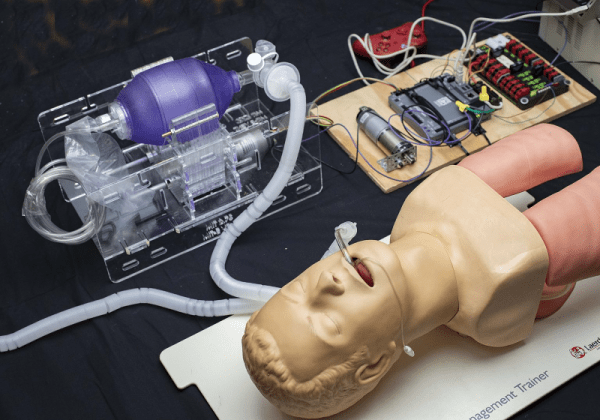
Plan Ahead: Roaming Charges Are A Killer

As the world gets more connected and computerized, it is easy to have an unintended consequence pop up and bite you. Especially because, so much of the time, today, things just work. The days of fretting over how to connect two computers, or how to store reasonable amounts of data are gone. Most of us never have to sift through assembly language programs finding three extra bytes to add a feature. Some Russian scientists recently found out about unintended consequences the hard way.

In the United States, the Eagle was long on the endangered species list, but apparently they have a similar problem in Russia. Scientists put a tracker on some migrating eagles in southern Russia and Kazakhstan. A few decades ago, this would have been a big technical challenge, but now you just use cellular technology and have the tracker text its location, right?

Continue reading “Plan Ahead: Roaming Charges Are A Killer”

Considering The Originality Question

Many Hackaday readers have an interest in older technologies, and from antique motorcycles to tube radios to retrocomputers, you own, conserve and restore them. Sometimes you do so using new parts because the originals are either unavailable or downright awful, but as you do so are you really restoring the item or creating a composite fake without the soul of the original? It’s a question the railway film and documentary maker [Chris Eden-Green] considers with respect to steam locomotives, and as a topic for debate we think it has an interest to a much wider community concerned with older tech.

Along the way the film serves as a fascinating insight for the non railway cognoscenti into the overhaul schedule for a working steam locomotive, for which the mainline railways had huge workshops but which presents a much more significant challenge to a small preserved railway. We wrote a year or two ago about the world’s first preserved railway, the Welsh Tal-y-Llyn narrow gauge line, and as an example the surprise in the video below is just how little original metal was left in its two earliest locomotives after their rebuilding in the 1950s.

The film should provoke some thought and debate among rail enthusiasts, and no doubt among Hackaday readers too. We’re inclined to agree with his conclusion that the machines were made to run rather than gather dust in a museum, and there is no harm in a majorly-restored or even replica locomotive. After all, just as a retrocomputer is as much distinguished by the software it runs, riding a steam train is far more a case of sights and smells than it is of knowing exactly which metal makes up the locomotive.

Continue reading “Considering The Originality Question”

This Radio Control Sailboat Uses 2X4s

When [PeterSripol] was a kid, he made a simple sailboat from a scrap piece of 2×4 and some napkin sails. He’s not 8 years old anymore, but he decided he wanted to make another 2X4 sailboat using the skills he’s learned since he was a kid.

You’ll have to get past storytime and mice, but the build skill is evident. There’s a RC rudder, a keel with lead shot and overall it is a good looking boat for such a simple build.

Continue reading “This Radio Control Sailboat Uses 2X4s”

We Are Bowled Over By The BouLED

We’ve seen a lot of cubic LED creations recently, but this one takes it a bit further. The BouLED is a work-in-progress icosahedric LED display, a globe-like sphere made of 20 flat triangular LED-lit faces. When combined with sensors inside the display, it will be able to stabilize the image. In other words: you can pick it up and rotate it, but the image will stay steady. It is created as part of their degree work by [Matthias Rabault], [Lucas Lebailly] and [Hichem Ghandri] who are students at the Télécom Paris school.

Continue reading “We Are Bowled Over By The BouLED”

Making A Robotic Dog Better By Adding Springiness Without Springs

Getting a legged robot to stay upright, especially a quadruped or biped, can be a challenging undertaking. To experiment with different approaches, [James Bruton] built robot dog test platform and is playing with “dynamic compliant simulated springs“, or in other words, using the motors to act as though they were springs and dampers..

When robotic legs are kept stiff, they tend to reduce the stability of the platform due to the sudden erratic movements of the robot, especially on uneven surfaces. With a back drivable joint arrangement, [James] is using limited holding current on the motor, and the position of the motor shaft is monitored using an encoder. When a leg experiences a resisting force, with will have some “give” and then the motor will return it to it’s intended position more slowly. Using a IMU on top of the robot, it can detect when it start leaning to a side, and then temporarily soften the other side to balance the robot.

This is quite a common technique in legged robots, but [James] does an excellent job of explaining just how it works. He hopes to use the lessons learned from the test platform to improve or redesign his already impressive OpenDog.

We’ve seen a number of quadruped robots on Hackaday recently. Including Boston Dynamics’ very expensive Spot as well as a low cost robot dog that giving its big brothers a run for their money, and doing some back flips in the process. Check out James’ video after the break. Continue reading “Making A Robotic Dog Better By Adding Springiness Without Springs”

Why Buy Toys When You Can Build Them Instead?

Like many creative individuals who suddenly find themselves parents, [Marta] wanted to make something special for his children to play with. Anybody can just purchase an off-the-shelf electronic toy, but if you’ve got the ability to design one on your own terms, why not do it? But even compared to the fairly high standards set by hacker parents, we have to admit that the amount of time, thought, and effort that was put into the “Marta Musik Maschine” is absolutely phenomenal.

[Marta] was inspired by the various commercial offerings which use RFID and other technologies to identify which characters the child is playing with and respond accordingly. But since he didn’t want to get locked into one particular company’s ecosystem and tinkering with the toys seemed frowned upon by their creators, he decided to just come up with his own version.

Over the course of many posts on the Musik Maschine’s dedicated website, [Marta] explains his thought process for every design consideration of the toy in absolutely exquisite detail. Each of the writeups, which have helpfully been broken down for each sub-system of the final toy, are arguably detailed and complete enough to stand as their own individual projects. Even if you’re not looking to get into the world of DIY electronic toys, there’s almost certainly an individual post here which you’ll find fascinating. From the finer points of interfacing your Python code with arcade buttons to tips for designing 3D printed enclosures, there’s really something for everyone here.

The children of hackers are often the envy of the neighborhood thanks to the one-of-a-kind playthings provided by their parents, and considering the level of commitment [Marta] has put into a toddler toy, we can’t wait to see what he comes up with next.

Continue reading “Why Buy Toys When You Can Build Them Instead?”

UECG – A Very Small Wearable ECG

[Ultimate Robotics] has been working on designing and producing an extremely small ECG that can stream data real time.

Typical electrocardiogram equipment is bulky: miniaturization doesn’t do much for a hospital where optimizations tend to lean towards, durability, longevity, and ease of use. Usually a bunch of leads are strung between a conductive pad and an analog front end and display which interprets the data; very clearly identifying the patient as a subject for measurement.

uECG puts all this in a finger sized package. It’s no surprise that this got our attention at Maker Faire Rome and that they’re one of the Hackaday Prize Finalists. The battery, micro controller, and sampling circuitry are all nearly packed onto the board. The user has the option of streaming through BLE at 125 Hz or using a radio transceiver for 1 kHz of data. Even transmitting at these sample rates and filtering the signal of unwanted noise the device draws less than 10 mA.

The files to make the device are all on their page. Though they are planning to produce the boards in a small run which should be the best way to acquire one and start experimenting with this interesting data.