3D Printed Tools For Quick Press Brake Jobs

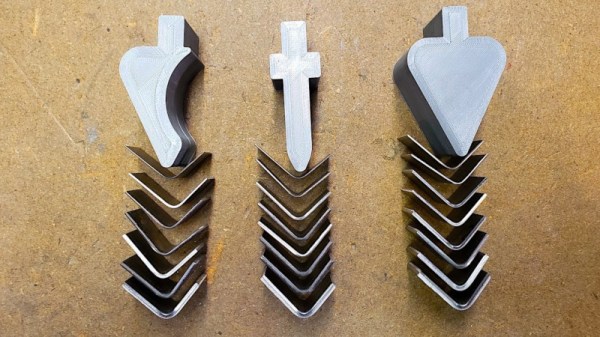
Press brakes are a workshop staple when working with sheet metal. They’re ideal for executing accurate and repeatable bends over and over again. Typically, they’re fitted with steel tooling that can hold up to thousands of press cycles. However, such tooling is expensive, and time consuming to produce. [Anthony] recently had a job come through the shop that required a unique internal radius. Rather than rush out and buy tooling, he decided to 3D print his own instead!

The press brake tools were printed on a standard Prusa i3, using regular PLA filament. There’s nothing particularly special in the process, with the prints using 12 perimeters and 20% infill. Despite being made of plastic, the tools held up surprisingly well. In testing, the parts were able to bend up to 3.4 mm steel, undergoing several cycles without major visible wear. [Anthony] also experimented with gooseneck parts, which, while less robust, make it easy to accommodate more complex sheet metal parts.

3D printing is a great way to produce custom press tooling, and can be done far more cheaply and quickly than producing traditional steel tooling. While it’s unlikely to be useful for long production runs, for short runs that need custom geometry, it’s a handy technique. We’ve even seen 3D printed punch-and-die sets, too. Video after the break.

Continue reading “3D Printed Tools For Quick Press Brake Jobs”
Spinning ESP32 Display Puts The Customer First

Most of the projects we feature on Hackaday are built for personal use; designed to meet the needs of the person creating them. If it works for somebody else, then all the better. But occasionally we may find ourselves designing hardware for a paying customer, and as this video from [Proto G] shows, that sometimes means taking the long way around.

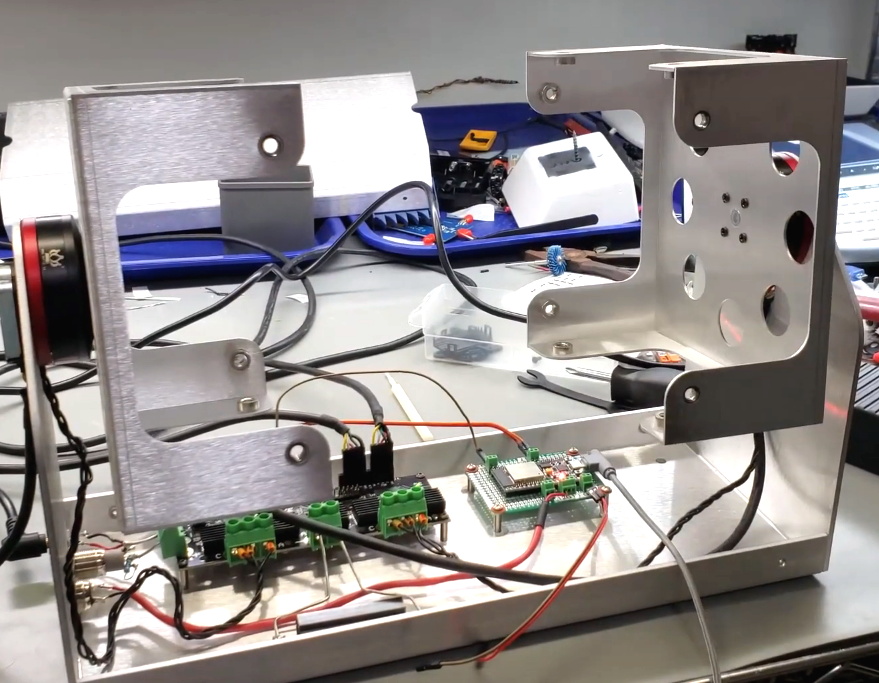
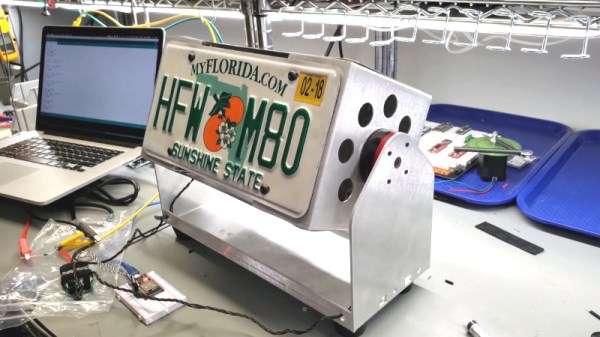
The initial task he was given seemed simple enough: build a display that could spin four license plates around, and make it so the speed could be adjusted. So [Proto G] knocked a frame out of some sheet metal, and used an ESP32 to drive two RC-style electronic speed controllers (ESCs) connected to a couple of “pancake” brushless gimbal motors. Since there was no need to accurately position the license plates, it was just a matter of writing some code that would spin the motors in an aesthetically pleasing way.

Unfortunately, the customer then altered the deal. Now they wanted a stand that could stop on each license plate and linger for a bit before moving to the next one. Unfortunately, that meant the ESCs weren’t up to the task. They got dumped in favor of an ODrive motor controller, and encoders were added to the shafts so the ESP32 could keep track of the display’s position. [Proto G] says he still had to work out some kinks, such as how to keep the two motors synchronized and reduce backlash when the spinner stopped on a particular plate, but in the end we think the results look fantastic. Now if only we had some license plates we needed rotisseried…

If [Proto G] knew he needed precise positioning control from the start, he would have approached the project differently and saved himself a lot of time. But such is life when you’re working on contract.

Continue reading “Spinning ESP32 Display Puts The Customer First”

Making Music From Cardboard

Fans of MaKey MaKey may find this project similar, but there’s a lot more to the Mini Automat than making music from fruit.

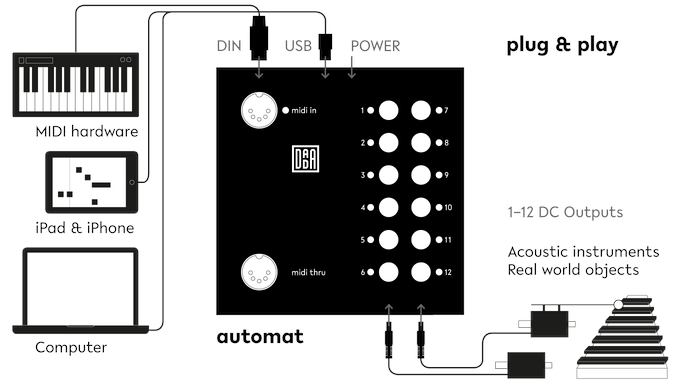
The idea for the Mini Automat (which is an off-shoot of the original Automat project by [Dada Machines]) is to make music accessible to anyone. The device functions as a plug and play MIDI-controller that connects to a computer, MIDI workstation (keyboards and sequencers), or DAW for input and triggers actuators on the output to create music.

The modifications make the originally Automat more hackable by making the board compatible with Arduino and Circuit Python, as well as adding in digital and analog pins for connecting to sensors, buttons, or light systems.

The team has released all schematics, firmware, and software, with only the board layouts unreleased to the public. From solenoids that push, pull, jiggle, smash, and bash at drums to surfaces that vibrate screws and beads, there’s a huge variety of household objects that can be used to make complex layered musical compositions, even for a one-person musician.


The Berlin-based team works on open source music tech hardware with the hopes of bringing environmentally and financially sustainable ideas to market.

Continue reading “Making Music From Cardboard”

Teardown: Quirky Egg Minder

Many of the biggest stars are hesitant to do sequels, believing that the magic captured the first time around is hard to reproduce in subsequent productions. As I’m known (at least around the former closet that now serves as my home office) as the “Meryl Streep of Teardowns”, I try to follow her example when it comes to repeat performances. But if they could get her to come back for another Mamma Mia film, I suppose I can take a look at a second Quirky product.

An elderly egg calls to inquire about euthanasia services.

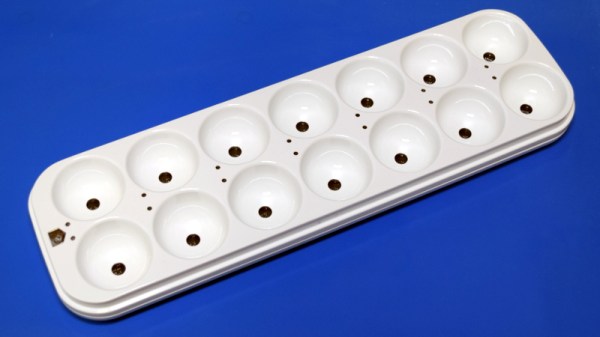
This time around we’ll be looking at the Quirky Egg Minder, a smart device advertised as being able to tell you when your eggs are getting old. Apparently, this is a problem some people have. A problem that of course is best solved via the Internet of Things, because who wouldn’t pay $80 USD for a battery-powered WiFi device that lives in their refrigerator and communicates vital egg statistics to an online service?

As it turns out, the answer to that question is “most people”. The Egg Minder, like most of its Quirky peers, quickly became a seemingly permanent fixture of retailer’s clearance shelves. This particular unit, which I was able to pick up new from Amazon, only cost me $9.99. This is still more than I would have paid under normal circumstances, but such sacrifices are part and parcel with making sure the readers of Hackaday get their regular dose of unusual gadgetry.

You may recall that our last Quirky device, the “Refuel” propane tank monitor, ended up being a fantastically engineered and built piece of hardware. The actual utility of the product was far from certain, but nobody could deny that the money had been spent in all the right places.

What will the internals of the Egg Minder reveal? Will it have the same level of glorious over-engineering that took us by surprise with the Refuel? Will that zest for form over function ultimately become the legacy of these Quirky devices, or was it just a fluke? Let’s crack this egg and find out.

Continue reading “Teardown: Quirky Egg Minder”

Celebrate Ada Lovelace Day By Catching Up On Stories Of Science And Technology

Today is Ada Lovelace Day, a day to celebrate and encourage women in the fields of science and technology.

It’s a perfect time to look back and catch up on biographies of some incredible people whose stories have been featured over the past year. You’ll find a ton of those below, but while we have your attention we wanted to make an appeal to help shine some light onto those stories we have yet to feature in our Profiles in Science series. Let us know about women whose stories you’d like to see on Hackaday in the coming year by leaving a comment below. Of course, it’s not just today, we’re always looking for suggestions and the tips line is always open.

Getting a rocket engine off of the launch pad is itself a tricky proposition, but reaching an orbital velocity is an entirely different story. During the space race, the US was on the lookout for a fuel that could do the trick, and the answers came from a chemist who grew up in a small town in North Dakota then started a college degree before for a job at Plumb Brook Ordnance Works. Mary Sherman Morgan came through with the formulation for Hydyne that powered the Redstone Rocket project.

Continue reading “Celebrate Ada Lovelace Day By Catching Up On Stories Of Science And Technology”

The Long History Of Fast Reactors And The Promise Of A Closed Fuel Cycle

The discovery of nuclear fission in the 1930s brought with it first the threat of nuclear annihilation by nuclear weapons in the 1940s, followed by the promise of clean, plentiful power in the 1950s courtesy of nuclear power plants. These would replace other types of thermal plants with one that would produce no exhaust gases, no fly ash and require only occasional refueling using uranium and other fissile fuels that can be found practically everywhere.

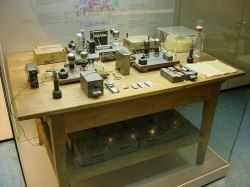
The equipment with which nuclear fission was experimentally proven in 1938.

As nuclear reactors popped up ever faster during the 1950s and 1960s, the worry about running out of uranium fuel became ever more present, which led to increased R&D in so-called fast reactors, which in the fast-breeder reactor (FBR) configuration can use uranium fuel significantly more efficiently by using fast neutrons to change (‘breed’) 238U into 239Pu, which can then be mixed with uranium fuel to create (MOX) fuel for slow-neutron reactors, allowing not 1% but up to 60% of the energy in uranium to be used in a once-through cycle.

The boom in uranium supplies discovered during the 1970s mostly put a stop to these R&D efforts, with some nations like France still going through its Rapsodie, Phénix and SuperPhénix designs until recently finally canceling the Generation IV ASTRID demonstrator design after years of trying to get the project off the ground.

This is not the end of fast reactors, however. In this article we’ll look at how these marvels of engineering work and the various fast reactor types in use and under development by nations like Russia, China and India.

Continue reading “The Long History Of Fast Reactors And The Promise Of A Closed Fuel Cycle”

Resurrecting A Recalcitrant SE/30

The Macintosh SE/30 is well regarded as the choice pick of the compact Mac line. Packing a powerful 68030 processor and with the capability to use up to 128 MB of RAM, it brought serious grunt to bear in a tight form factor. With these machines now over 30 years old, they’re often quite worse for wear. [This Does Not Compute] had his work cut out for him getting this particular example up and running. (Video embedded below.)

With the computer displaying the famous SimasiMac screen on startup, it was sadly non-functional when switched on. [This Does Not Compute] went through all the usual attempts to fix this – washing the board, recapping, checking potentially broken traces – all to no avail. After much consternation, the fix was not so hard – a fresh set of RAM helped cure what ailed the Mac.

With the Mac now showing some signs of life, there was more to do. The floppy drive refused to boot, ejecting disks and failing to read anything. A head cleaning proved helpful, but not enough. It was only when the head motor’s worm gear was relubricated, enabling it to seek properly, that the drive was successfully able to boot. The hard drive proved resistant of any attempts to get it to work, so was replaced with a SCSI2SD instead.

With the suite of repairs completed, the SE/30 was once again up and running. With a little elbow grease, the case and keyboard turned up a treat, too. [This Does Not Compute] now has one of the all-time classic Macs in excellent condition.

We’ve seen some great restorations over the past – this Commodore 64 full of dirt was a particularly compelling story. Video after the break.

Continue reading “Resurrecting A Recalcitrant SE/30”