WarWalking With The ESP8266

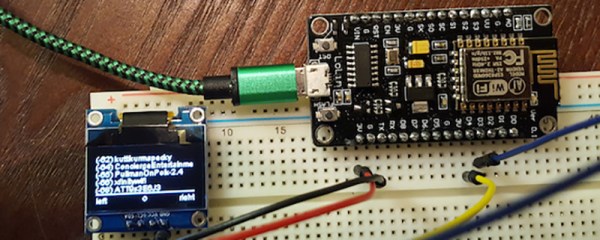
[Steve] needed a tool to diagnose and fix his friend’s and family’s WiFi. A laptop would do, but WiFi modules and tiny OLED displays are cheap now. His solution was to build a War Walker, a tiny handheld device that would listen in WiFi access points, return the signal strength, and monitor the 2.4GHz environment around him.

The War Walker didn’t appear out of a vacuum. It’s based on the WarCollar Dope Scope, a tiny, portable device consisting of an off-the-shelf Chinese OLED display, an ESP8266 module, and a PCB that can charge batteries, provide a serial port, and ties the whole thing together with jellybean glue. The Dope Scope is a capable device, but it’s marketed towards the 1337 utilikilt-wearing, The Prodigy-blasting pentesters of the world. It is, therefore, a ripoff. [Steve] can build his version for $6 in materials.

The core of the build is an ESP-based carrier board built for NodeMCU. This board is available for $3.77 in quantity one, with free shipping. A $2 SPI OLED display is the user interface, and the rest of the circuit is just some perfboard and a few wires.

The software is based on platformio, and dumps all the WiFi info you could want over the serial port or displays it right on the OLED. It’s a brilliantly simple device for War Walking, and the addition of a small LiPo makes this a much better value than the same circuit with a larger pricetag.

How To Make A Human Crossbow

Say you have a team of French engineers, a lake in the summer, a wizened old machinist, and some gigantic bungee cords. What would you build? The answer is clear, a human-launching crossbow. (Video, and making-of embedded below.)

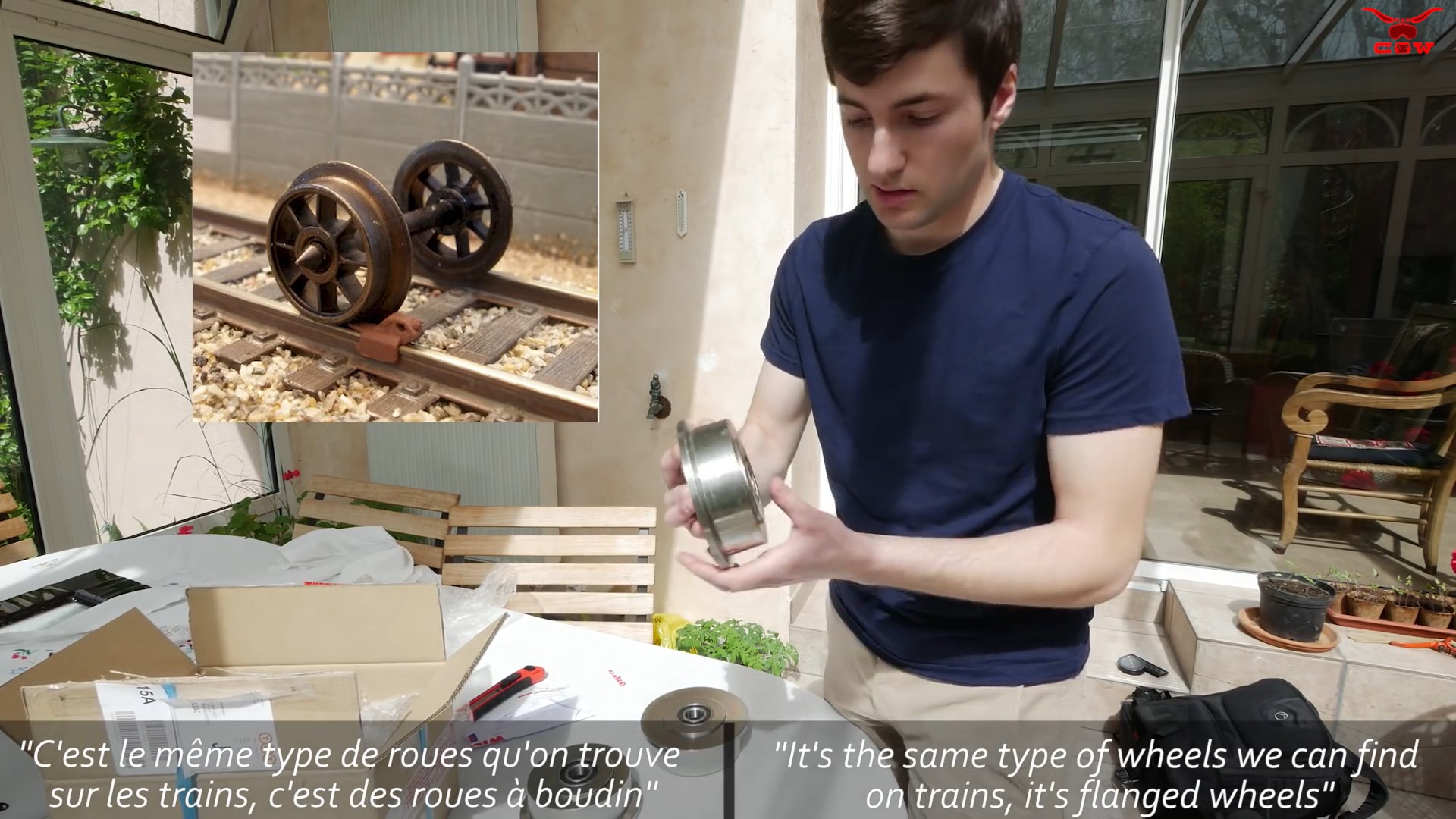
the-human-crossbow-how-we-made-it-kim41mdcizymp4-shot0001You can start out watching the promo video because it looks like a lot of fun, but don’t leave without watching the engineering video. What looks like a redneck contraption turns out to be painstakingly built, and probably not entirely a death trap. The [Rad Cow] team even went so far as to purchase metal cart wheels.

Everyone else on the Intertubes would tell you not to do this at home. We say go for it. That is, draw up reasonable plans, work with an obviously competent machinist, and make something silly. It’s not going to be more dangerous than the stuff that [Furze] pulls off.

Continue reading “How To Make A Human Crossbow”

Hackaday Prize Entry: The Fog – The Cloud At Ground Level

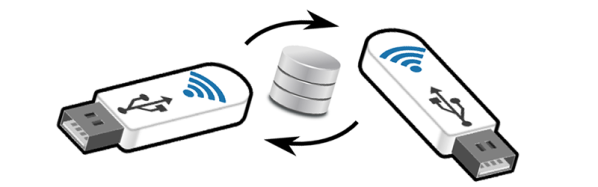
I did not coin the phrase in this article’s headline. It came, I believe, from an asinine press release I read years ago. It was a stupid phrase then, and it’s a stupid phrase now, but the idea behind it does have some merit. A collaborative Dropbox running on hardware you own isn’t a bad idea, and a physical device that does the same is a pretty good idea. That’s the idea behind the USB Borg Drive. It’s two (or more) mirrored USB thumb drives linked together by condescending condensation saying you too can have the cloud in both your pockets.

Like all good technology, the USB Borg Drive began as a joke. [heige] and his colleague were passing USB sticks back and forth to get software running on a machine without Internet. The idea of two USB sticks connected together via WiFi blossomed and the idea of the USB Borg Drive was born.

An idea is one thing, and an implementation another thing entirely. This is where [helge] is stumbling. The basic idea now is to use a Raspberry Pi Zero containing a WiFi adapter, USB set up in peripheral mode, some sort of way to power the devices, and maybe a way to set IDs between pairs of devices.

There’s still a lot of work for [heige] to do, but this is actually, honestly, not a terrible idea. Everything has a USB port on it these days, and USB mass storage is available on every platform imaginable. It’s the cloud, at ground level. A fog, if you will, but not something that sounds that stupid.

Making A Cassette Mass Storage Interface

If you are of the generation who were lucky enough to use the first 8-bit home computers in your youth, you will be familiar with their use of cassette tapes as mass storage. Serial data would be converted to a sequence of tones which could then be recorded using a standard domestic cassette recorder, this recording could then be played back into the machine’s decoder and loaded into memory as a complete piece of software. Larger programs could take a while to load, but though it was rather clunky it was a masterful piece of making the best of what was at hand.

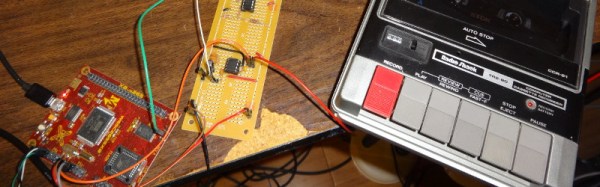
[Mike Kohn] was working with some microcontroller infra-red communication projects when he saw that the same techniques could be used to produce a tape interface like those on the home computers of old.

Over the years he has returned to the project a couple of times, and his original Atmel processor has been supplanted by a W65C265SXB development board based on the 16-bit derivative of the 6502. This made generating the tones as straightforward using his processor’s built-in tone generator, but decoding still presented a challenge. His earlier attempts used an LM2917 frequency to voltage converter to decode tones to logic levels, but on further consideration he decided to move to the LM567 tone decoder. This chip is designed specifically for an on-off logic output rather than the 2917’s analogue voltage output.

His recording device was originally a hi-fi separate cassette deck after experimenting with microcassettes, but eventually he used a data recorder designed for a Radio Shack TRS-80. All his code can be found in his GitHub repository.

It’s probably true to say that [Mike] has made a better cassette interface than the one you could have found on your home computer back in the day. We’ve featured a few data cassette hacks over the years, including this Commodore tape deck with an LED counter, and a tape deck emulator capable of holding an entire software archive.

Impressive Pi System Controls Large Office

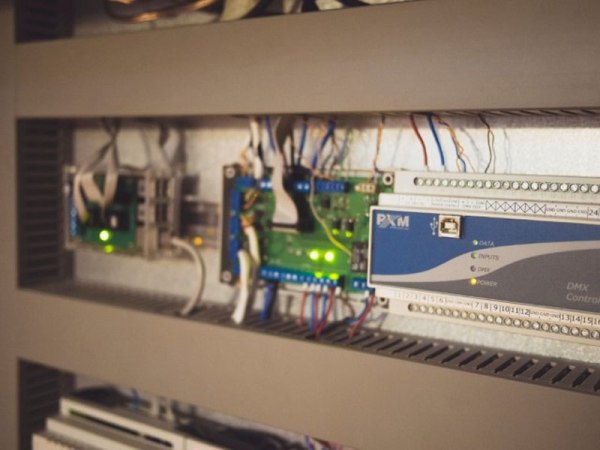
A pile of Raspberry Pis isn’t what would spring to mind for most people when building a system to control a large office, but most people aren’t [Kamil Górski]. He decided to use Pis to run the office of his company Monterail when they moved to a larger space. The system they built is one of the largest Pi installations we have seen, controlling the lights, TVs, speakers and door access. It can all be controlled through a web interface, so anyone on the network can turn the lights on or off, check if a room is occupied or send sound and video to the fancy AV system in the conference room. He even hacked a bunch of HDMI switches so that every TV can show the same image if everyone wants to watch the same event. Even the radio station that plays in the lounge is controlled remotely from an employee slack channel.

The system is run on five Pis, one of which acts as a master, while the others are connected to each of the TVs, running Chrome in console mode being remotely controlled through the Chrome Debugging Protocol.  That allows anyone on the network to control the display and send content to it. One interesting thing to note: [Kamil] freely admits that this is a bespoke system that couldn’t be easily sold as a product. Nothing wrong with that, but he decided to build in some backups: if the whole system fails, all of the lights, doors, and other devices can still be controlled through old-school switches, keys, and remote controls. Even a full system crash doesn’t render the office unusable. That’s a wide precaution that many people forget in systems like this.

Codebender Shuts Down

Codebender.cc was a cloud based IDE for Arduino development. It was made for hackers by a few fellows in Greece. Unfortunately, while they saw some serious success, they were never able to convert it all the way into a viable business.

By November 31st Codebender.cc will be completely shut down. They assure users that the site will be in read-only mode for as long as the end of the year, but longer if the traffic justifies it. Codebender made it all the way to 10,000 monthly active users, but hosting and administration overshadowed this success to the tune of 25,000 dollars a month. Not so much as far as businesses go, but without revenue it’s more than enough to shut down a site. Their business plan aimed to tailor their services for specific chip manufacturers and other companies but those deals never came together.

It’s a pity, we were excited to see if Codebender could continue to grow. They were certainly doing some really interesting stuff like remote code upload. As the comments on the site show, many users, especially educators and Chromebook users, loved Codebender — your code isn’t stuck on one computer and where there was a browser there was an IDE.

Two paid services will remain (starting at $10/month) at addresses with different TLDs. But the post does mention that the Codebender project started as Open Source. Their GitHub repo isn’t a clear path for rolling your own, but if you do manage to hack together a working Codebender implementation we’d love to hear about it.

Hackenings: Burbank And Cairo

Hi all, and welcome to the first installment of Hackenings, our review/preview of the week in global hackerspaces. If you’d like to get the news out about upcoming events at your space, get us an e-mail before Thursday to get it published on Saturday. If you’d just like to brag, any time is fine. Drop us a line at tips@hackaday.com and put [Hackenings] in the subject to make sure that we see it.

This week we’ve got two stories of hackerspaces on the move, but they couldn’t be more different. The Burbank Makerspace has upgraded to fancier new digs, while Cairo Makerspace‘s building collapsed, and now they’re taking their show on the road with a hackerspace-in-a-van.

Continue reading “Hackenings: Burbank And Cairo”