Sci-Fi Contest Roundup: Alien Autopsy And Jacking On

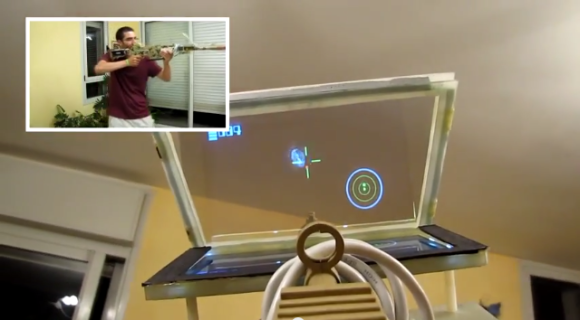
There’s still a few days left in our sci-fi contest, and unless you really pull out the stops today, it might be too late to get your entry in. Even though the contest is wrapping up, a lot of projects are wrapping things up and posting their finished projects. Here’s a few good ones.

These puns are awesome

chestbursterThe folks at the LVL1 hackerspace had the idea of making a life-sized game of Operation. This plan changed when someone at the hackerspace had the great idea of making it an alien autopsy. The game play remains the same, but this time the puns are awesome.

The play field is a life-sized alien, stuffed with metal-lined holes that set off a buzzer whenever the modified hemostat touches the side. Inside these holes are incredible puns that include, “Farscraped knee”, “Phantom Tentacle”, a “Tattoine removal”, “Jeffries Tuberculosis”, “HALatosis, “Babelfish in the Ear”, and “Grabthar’s Hammertoe”

The hackerspace took their alien autopsy game to the Louisville 2013 Mini Maker Faire where it was a huge hit. We’re thinking some of the puns were a little too obscure for the general population, but the attention to detail is impressive; there’s a 3D print of Pilot from Farscape. Awesome.

Jacking On

jackingon

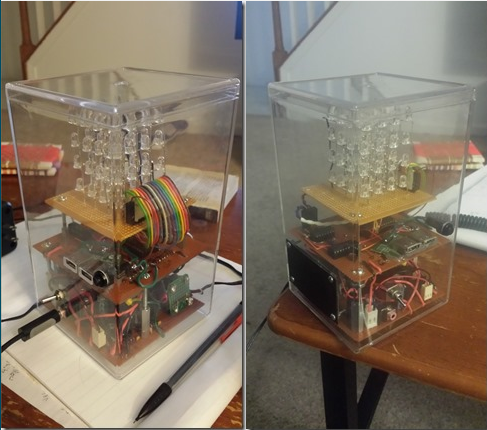
In the Futurama universe, immoral robots get their fun by “Jacking On”, or supplanting their 6502-based CPUs with a ton of electricity. This is contraindicated by Bender’s operational manual, but a robot needs his fix, right?

[RodolpheH] and [pierrep] are building one of these jack dispensers, but instead of simply supplying a whole lot of electricity through a jack, they’re creating a Raspi-powered wireless audio streaming device. Plug some speakers into the jack, connect to the Raspi, and you’ve got a very cool audio system on your hands.

The team is going all out with the design of their jack dispenser, using random bits of plastic stuff for the enclosure and a USB-powered plasma ball for the top. It impresses random strangers, and that’s the only thing that’s important, right?

Improved Thermocouples On A Microcontroller

ktype

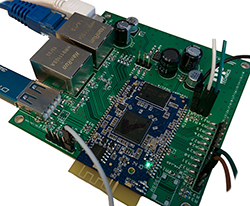
If you’re reading a thermocouple with one of those fancy schmancy SPI thermocouple amplifiers, this one isn’t for you. If, however, you’re still going through those old-school analog thermocouple amplifiers like the AD595, [miceuz] has just the thing for you. He’s come up with a library for embedded devices that reads the temperature of a k-type thermocouple with +- 0.03°C of accuracy.

As with anything dealing with natural phenomena, the voltage generate by the bimetallic junction of a thermocouple probe is decidedly non-linear. This is a problem when dealing with embedded devices, as that would mean using floating point arithmetic, greatly increasing the amount of code. [micuez] found the NIST tables for a K-type thermocouple and interpolates the actual temperature of the thermocouple probe from the NIST data. The usual way of measuring thermocouples – a polynomial unction of some sort – has an error of about 0.06°C. [miceuz]’s library has an error of less than half that, all while using less code.

The library doesn’t support temperatures below zero, but this is still a work in progress. Still, if you’re looking for a very accurate library for a forge, crock pot sous vide build, or a toaster  oven reflow controller, you can’t do better than [miceuz]’s work.

Playing Tetris On An Oscilloscope

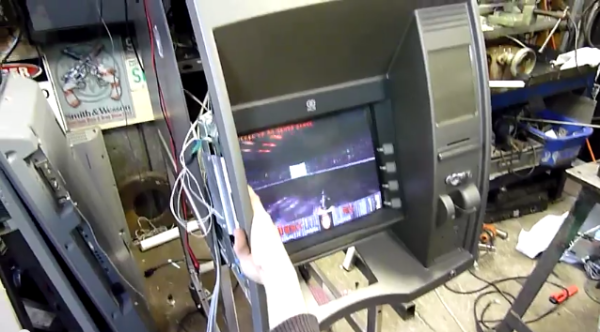
Have engineers stopped putting Easter eggs into technology lately? It’s always been a fun way to connect with your more advanced customer base (i.e. hackers) — anyway, here’s a great Easter egg you can find on the Hewlett Packard 54600B Oscilloscop — Tetris!

[RaffttaM] discovered this trick when a coworker let him know that one of the oscilloscopes in the lab had the hidden feature. A little fiddling later and a game of Tetris was revealed. If you press the Print/Utility button on the 54600B oscilloscope, followed by pressing the second and third button below the screen at the same time, you can launch the game!

Another cool embedded Easter egg is in the Game Boy Printer — If you hold the feed button during power up it spits out a Mario themed image! One of our readers even managed to hack the printer to show the Hack a Day Logo instead!

Do you know of any more modern tech with cool (and sneaky!) Easter eggs? Let us know by sending in a tip!

[Thanks Gregory!]

3d printed house in china

3D Printing Homes In Less Than 24 Hours Using Recycled Materials

While many 3D printer companies are racing towards smaller and smaller accurate printers, a company in China called the Shanghai WinSun Decoration Design Engineering Company is experimenting with a monstrous 3D printer the size of half of an Olympic sized swimming pool.

The mammoth of a printer measures 32m by 10m by 6.6m and can print 200sqf detached single story homes. The printer uses FDM technology and deposits a mixture of cement and construction waste to build the walls. According to the company, it can cost less than $5000 a house, and the printer can spit out 10 houses a day!

The printer was designed a few years ago, and WinSun purchased the parts for it from overseas, and then had it assembled in a factory in Suzhou. They plan to print an entire villa of these homes, and to start building recycling facilities in China to collect material for use in the printer. The first home for sale will be located in Qingdao.

Continue reading “3D Printing Homes In Less Than 24 Hours Using Recycled Materials”

4-bit Adder Built From Mechanical Relays

relay-adder-register-memory

Would you consider this to be doing math the old-fashioned way? Instead of going with silicon-based switching (ie: transistors) this 4-bit adder uses mechanical relays. We like it for its mess of wires (don’t miss the “assembly” page which is arguably the juiciest part of the project). We like it for the neat and tidy finished product. And we like it for the clicky-goodness which surely must bloom from its operation; but alas, we didn’t find a video to stand as testament to this hypothesis.

The larger of the two images seen above is from the register memory stage of the build. The black relay in the bottom right is joined by a ring of siblings that are added around the perimeter of the larger relays before the entire thing is planted in the project box.

Sure, simulators are a great way to understand building blocks of logic structures like an adder. But there’s no better way to fully grip the abstraction of silicon logic than to build one from scratch. Still hovering on our list of “someday” projects is this wooden adder.

[Thanks Alex]


Sink Your Teeth Into PiPhone

Raspberry Pi cell phoneHave you ever dreamed of independence from smartphone bloatware? If you have a Raspberry Pi and an Adafruit TFT, you’re halfway to making your own version of [Dave]’s PiPhone.

This tasty proof-of-concept cellular sandwich is made by adding a Sim900 GSM/GPRS module, which communicates via UART, to the Pi/TFT hardware while using a piece of foam core board in the middle to prevent shorts. You won’t get free service or anything, but you can pop a pre-paid SIM card into it. He’s powering it with a LiPo battery and using a DC-to-DC converter to set up the 3.7V to 5V. You could do a lot worse than the $158 BOM, and we’re betting you have a Pi lying around already. We wish more phones had baby rocker switches.

There’s a slight problem with the PiPhone: it gets pretty warm and there isn’t a lot of room for air circulation. For best results, let it cool on a well-attended windowsill or operate it near a fan like [Dave] did. He doesn’t have the code up on GitHub as of this writing, but he will capitulate to high demand. Make the jump to see [Dave]’s tour of the PiPhone and watch him make a call with it.

Continue reading “Sink Your Teeth Into PiPhone”

Small-Scale Projects Use Snail-Mail Mail-Scale

stamps.com scale

Stamps.com offers a free USB scale when you sign up for their service. The first versions of this scale did not have a display. In order to find the weight of an object the scale had to be connected to a computer running the stamps.com software. If you happen to have one of these old scales or are able to pick one up cheap, you may be interested in using it outside of the stamps.com service. There are several options on how to do that.

Continue reading “Small-Scale Projects Use Snail-Mail Mail-Scale”