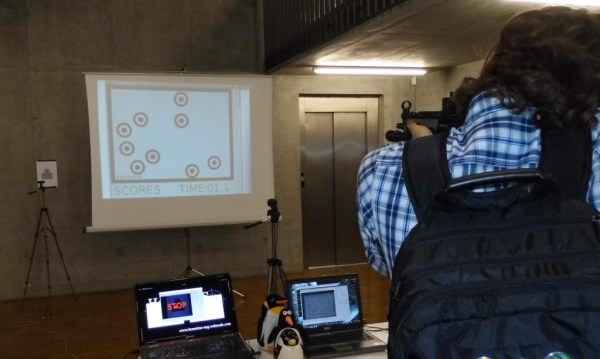
Looking to practice your marksmanship skills at home? Check out the homeLESS (Home LasEr Shooting Simulator), an open-source tool for marksmanship practice. [Laabicz] developed this system as a cheaper alternative to commercial laser shooting simulators, which are just as simple but very expensive.
[Laabicz]’s simulator primarily uses modified airsoft pistols that are fitted with batteries (installed in the magazine) and a laser in the chamber. Any gun can be used with the system as long as you can figure out how to attach a laser and trigger switch. To power the laser, a small capacitor is charged from batteries when the trigger switch is off. Once the trigger is pressed, the capacitor discharges through the laser and makes a short pulse of light.
The simulator is written in Processing and requires a projector and a webcam. The Processing sketch projects configurable moving targets on a screen or wall, and the webcam detects when a laser is triggered over any of the targets. The software supports multiple target types (including moving targets) and is quite configurable. Check out the video after the break to see the system in use.
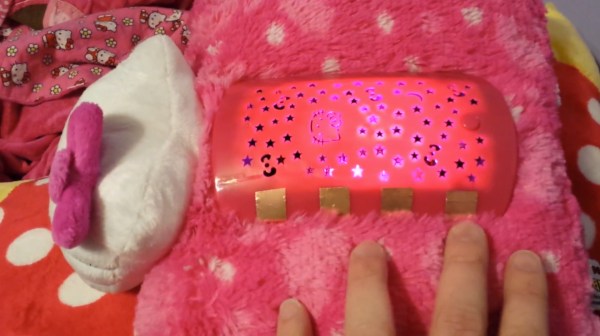
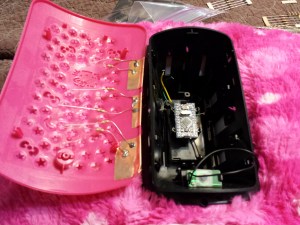 As a thing whose one purpose was to shine bright starry patterns on a child’s wall at night, the pillow failed miserably. [Dan] Wondered why his daughter’s toy couldn’t live up to reasonable expectations all while sucking batteries dry, so he opened the large pink plastic casing in the center of the pillow to find a rather minimal board driving three very dim LEDs. The LEDs that faded on and off to create mixtures of different colors weren’t even red, green and blue either. The makers of the toy used yellow instead of the slightly more expensive blue color. Having none of this, [Dan] replaced these sad innards with an Arduino Pro Mini which he programmed to drive an old salvaged speaker and three bright RGB LEDs borrowed from the end of a light strip. For the unnecessary but cool part, he used the additional pins of the Arduino micro-controller to add four touch sensitive buttons on the outside of the pink casing. These small capacitive tiles made from copper tape activate sound and change the color of the LEDs when touched, making the pillow a lot more reactive than it was before.