Hackaday In Shanghai: Electronica And A Gathering

electronica-china-shanghai-gathering

Whether you live in Shanghai, are at Electronics China representing your company, or by dumb luck just happen to be in town this week you can meet some of the Hackaday crew and score yourself some sweet swag.

Anyone in town on Thursday night will want to get a ticket to Hackaday: The Gathering. Right now it’s all sold out, but we hope anyone with a ticket who is unable to use it will cancel so that another may take your place. Free food, drink, t-shirts, stickers, and other swag await… no wonder the tickets are already gone!

The Electronica China conference started Tuesday at Shanghai New International Expo Centre, but it runs through Wednesday and Thursday as well. We’re attending, but we don’t actually have a dedicated booth. Hackaday is piggybacking with EEFocus, the Chinese contingent of our parent company. Both [Matt] and [Alek] will be hanging around the EEFocus booth (#W3.3686) shucking out hackaday T-shirts if you ask for one. Before he left, [Matt] mentioned that he’s excited to attend lectures on connected medical devices, the Automotive and EV boards, as well as the embedded systems forum.


MRRF: 3D Bioprinting


There were a few keynotes at this year’s Midwest RepRap festival, and somewhat surprisingly most of the talks weren’t given by the people responsible for designing your favorite printer. One of the most interesting talks was given by [Jordan Miller], [Andy Ta], and [Steve Kelly] about the use of RepRap and other 3D printing technologies in biotechnology and tissue engineering. Yep, in 50 years when you need a vital organ printed, this is where it’ll come from.

[Jordan] got his start with tissue engineering and 3D printing with his work in printing three-dimensional sugar lattices that could be embedded in a culture medium and then dissolved. The holes left over from the sugar became the vasculature and capillaries that feed a cell culture. The astonishing success of his project and the maker culture prompted him and others to start the Advanced Manufacturing Research Institute to bring young makers into the scientific community. It’s a program hosted by Rice University and has seen an amazing amount of success in both research and getting makers into scientific pursuits.

One of these young makers is [Andy Ta]. An economics major, [Andy] first heard of the maker and RepRap community a few years ago and bought a MakerBot Cupcake. This was a terrible printer, but it did get him involved in the community, hosting build workshops, and looking into 3D printing build around DLP-cured UV resin. At AMRI, [Andy] started looking at the properties of UV-cured resin, figuring out the right type of light, resin, and exposure to create a cured resin with the right properties for printing cell colonies. You can check out [Andy]’s latest work on his webzone.

[Steve Kelly] has also done some work at AMRI, but instead of the usual RepRap or DLP projector-based printers, he did work with shooting cell cultures out of an ink jet print head. His initial experiments involved simply refilling an ink jet cartridge with a bacterial colony and discovering the cells actually survived the process of being heated and shot out of a nozzle at high speed. Most ink jets printers don’t actually lay out different colors on a precise grid, making it unusable for growing cell cultures. [Steve] solved this problem with an inkjet controller shield attached to a RepRap. All of [Steve]’s work is documented on his Github.

It’s all awesome work, and the beginnings of both bioengineering based on 3D printers, and an amazing example of what amateur scientists and professional makers can do when they put their heads together. Video link below.

Continue reading “MRRF: 3D Bioprinting”

Retrotechtacular: Breaking Atoms To Break The Ice

retrotechtacular-lenin-nuclear-icebreaker

This documentary from 1959 gives a satisfyingly thorough look inside a nuclear powered icebreaking ship called Lenin. This actually set a couple of world’s-firsts: it was the first nuclear powered surface vessel and the first civilian vessel to be powered thusly.

The ship was built to clear shipping paths to the northern ports of Russia. Testing of both ice and models of the ship design point to the ability to break ice layers that are two meters thick. This requires a lot of power as ice-breakers generally use their hull shape and gravity to break the ice by driving up onto it to bend the ice to the breaking point. The Lenin achieved this power using its nuclear reactor to heat steam which drove electric generators. The energy produced drove three screws to power the vessel.

Of course this was back in the day when control panels were substantial, which you can get a peek at starting half-way through the twenty-minute film. This includes a demonstration of the ship’s network of radiation sensors which alert the control room, and sound a local alarm when they are triggered. During it’s 30-year operational life the vessel had a couple of accidents stemming from refueling operations. You can find more on that over at the Wikipedia page, but stick with us after the jump to see the vintage reel.

Continue reading “Retrotechtacular: Breaking Atoms To Break The Ice”

From Saw Dust To Stove Fuel

brisquit maker

[Alois Schmid] is an avid woodworker, and as such, he makes a lot of saw dust. Unfortunately, saw dust is kind of wasteful — it doesn’t burn very well unless it is compressed… so he built his own wood briquette press!

He originally looked at purchasing a machine designed for this, until he discovered they run upwards of 10,000 Euros. You could buy an amazing CNC mill for that! Needless to say, it was out of the question.

He started by purchasing a new more efficient dust extractor and an electric log splitter, and then he built an ingenious feeder system. He’s replaced the log splitter blade with a long metal dowel with a protrusion at the end (helps keeps the briquettes in one piece), which is slightly smaller than the compression tube he’s built.

Continue reading “From Saw Dust To Stove Fuel”

Listening To Electromagnetic Interference With A RTLSDR Dongle

Being curious by nature, [Marios] decided to see what kind of radio-frequency emissions may be generated by an Arduino connected to a simple breadboard wire, and more importantly try to pick them up using a RTLSDR dongle. Electromagnetic interferences are disturbances that affect electrical circuits due to either electromagnetic induction or electromagnetic radiation. Before going into the market, all electrical devices are thoroughly checked for unwanted electromagnetic emissions so they usually aren’t obvious suspects when such problems arise.

Using the Arduino embedded PWM controller in fast PWM mode and by manipulating the duty cycle, he actually managed to create a primitive form of amplitude modulation and was able to transfer a very simple audible signal at several frequencies up to 1.75GHz. Embedded after the break here is video of the system at work.

As a side note, did you know that during the solar storm of 1859 the EMI were so strong that the telegraph operators received several shocks? Pipelines maintenance systems also have to be aware of such events, that can lead sensors to provide inaccurate results.

Continue reading “Listening To Electromagnetic Interference With A RTLSDR Dongle”

Handheld Tetris Is Retro And We Love It

handheld tetris

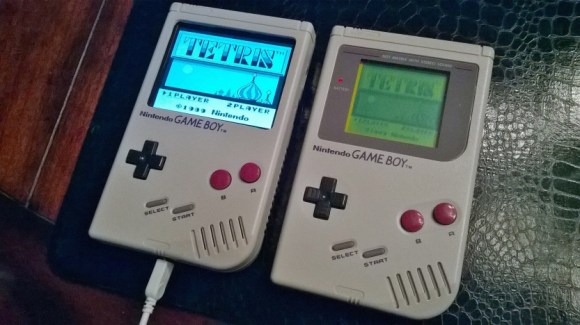
[Eduardo Zola] has been playing around with Arduinos, and ever since he started, he wanted to try making a game. Having fond memories of playing Tetris back on Windows 3.1, he decided to try giving a handheld version of it a shot.

He started with two 8×8 Neopixel Matrices due to their simplicity — not to mention the massive library of code available! To make it truly portable, he’s also included a 3.7v 4400mAh lithium ion battery which will keep him gaming for hours. He found a 5-way navigation switch on eBay which makes up the joystick. A small LED bar display tells you what level you’re on, and he’s even included a smaller speaker for music, and a vibrating motor for successfully completed lines in the game!

He borrowed the Tetris algorithm (and added some improvements) from the source code by [Valentin Ivanov], who completed a similar project last fall. Stick around to see a demonstration video of it in action.

Continue reading “Handheld Tetris Is Retro And We Love It”

Cute Tilt Beam Flashlight Adds Some Fun Interaction To Your Patio Table

Tilt-Beam-assembly

Here’s a cute little LED hack for your next soiree, it’s a solar charged piece of wood… with a motion controlled light in it!

[Zach DeBord] decided to try building his own version of this after seeing a commercial offering. He took a piece of oak and sliced off the top edge, and then laser cut the exact profile of the solar panel out of that slice. This allowed him to drill a nice big sloppy hole in the middle of it to fit the circuitry.

He’s using a nice big 8mm LED with a small 0.09V-5V DC boost circuit, a mercury tilt switch, a 4.5V solar cell, and a 2.7V 10MF super capacitor — plus a diode and 100ohm resistor. He’s glued the top slice of wood back in place, and sealed the entire thing with resin — you can hardly see the cut mark!

Continue reading “Cute Tilt Beam Flashlight Adds Some Fun Interaction To Your Patio Table”