Simple Mod To Keep Your Downstairs Neighbors From Hearing You Pound The Keys

[Mesoiam] managed to pick up a Viscount hammer weighted keyboard for pretty cheap. For those who are unfamiliar, Viscount makes keyboards that feel like you’re playing a piano, hammers and all. The only problem with this, as [Mesoiam] discovered, is that even when he’s jamming with headphones in, his friends down stairs can still hear the keyboard banging due to the vibration going through the stand to the floor. His resolution to this problem was to build some custom dampers to reduce the vibration. He built two brackets that fit over the stand and suspend the keyboard on two strips of flexible rubber. Quite a simple solution to a possibly annoying problem.

Converting A Manual Camera Lens To Use Motorized Zoom And Focus

[Guy] wrote in to share this motorized camera lens project he recently finished. He really loved the zoom lens, but since both zoom and focus are manually controlled, he sometimes had trouble getting both set to the right place in time to take the shot. With modern DSLR cameras which allow video capture, he also wants to have the option of a smooth zoom that is always in focus. The solution was to add motors to the rings and control them with a Wii classic controller.

This hack really shines when it comes to the add-on hardware. He has some beautifully made rings which wrap around the focus and zoom rings on the lens. They are then held in place by a timing belt. These belts have teeth which key into the gears on a pair of servo motors. From there it’s a snap to drive the motors with an Arduino, connecting to the Wii controller with a breakout connector. You can see [Guy] showing off the build in the clip after the break.

Continue reading “Converting A Manual Camera Lens To Use Motorized Zoom And Focus”

Controlling Raspberry Pi Expansion Pins With A Web Interface

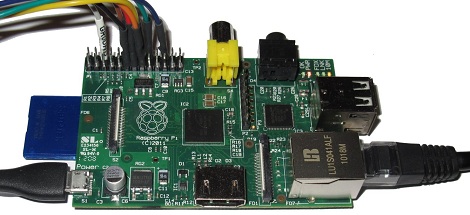
For the lucky few who have a Raspberry Pi board in their hands, you can now use the GPIO pins as a web interface (German, google translation). [Chris] is turning this magical board is turning a small device that can play 1080p video into something that can blink LEDs via the web.

The build started with an example of driving GPIO pins under Linux. [Chris] cobbled together a bit of PHP and Javascript on the Raspberry pi. Whenever he goes to the website hosted on the Pi, he’s greeted with the status and direction of a couple of expansion IO pins.

On a semi-related note, [Tony] is building a GPIO MIDI interface for his Pi. Yes, he could just get a USB to MIDI adapter and call it a day, but this is a far more professional looking solution to all the MIDI goodness the RasPi will deliver. If you’ve got any info on other RasPi breakout boards you’ve seen, send them in on the tip line.

Building A Prosthetic Leg From Scratch

[Radek] from Poland sent in a neat video of a bionic prosthetic leg he made for one of his patients. Even though [Radek] says it’s a ‘prototype of a prototype,’ we’d have to agree with him that it’s a very neat build that could provide inexpensive motorized prosthetic legs to amputees in the future.

[Radek] has been working on his project for about two years now, after building the motor and electronics by hand. The leg is powered by 1.5 kilogram battery pack – no details on the chemistry of the batteries, but [Radek] says it will last 12 hours on one charge. There are also small vibration sensors in the leg for a bit of feedback, and a few switches so the knee joint can be operated by the stump.

If you’re wondering where [Radek] got the proper tools and materials to make a carbon fiber prosthesis, he works for Carbon Prosthetics where builds simple prosthetic devices. His bionic leg creation looks really cool, and he says the final product will be much less expensive than the very high-end bionic prosthetic legs.

[Radek] was kind enough to share some more videos and a few pictures of his robotic prosthetic leg; you can check those out after the break.

Continue reading “Building A Prosthetic Leg From Scratch”

Using Pinball Score Reels As Wireless Displays

[Scott] put together a system where he can use pinball score reels as a wireless display. As you can see in the video below, the result is really neat. The sound alone makes this shoot pretty high on our “things that are cool” radar. The display required 24V AC to operate the solenoids that actually let the display rotate, but he found that an 18V DC supply would allow him to fire a single solenoid. No problem, he just staggered their operation. This is barely perceptible due to how long it takes for the mechanical part of the spinning to occur.

You can download his Arduino sketch and see more on his site. He has big plans too, he just got 4 more of these to add once they are cleaned up.

[via Adafruit]

Continue reading “Using Pinball Score Reels As Wireless Displays”

Playing The Song “Still Alive” On Hacked Exercise Equipment

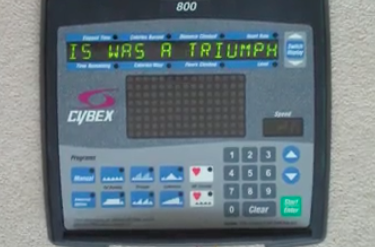
Back in 2009, [Evi1wombat] pulled of this interesting hack, and it has slowly made its way through the internet to find us today. He obtained the computer from a recently deceased treadmill and decided to hack into it. Finding himself unable to flash the existing chip, he yanked it out and replaced it with something he was more familiar with, a dsPIC30F4011. Unfortunately we don’t have any pics of the inside, but he says that he had some fun with wire because the pin mapping wasn’t exactly the same. [Evi1wombat] also gained some respect for the original designer judging by  this quote from the source code:

* Damn, the dude who designed that board pulled
* some pretty nifty tricks… took a while to
* get all the drivers working.

Of course, once you have control over some nifty new hardware, the first logical thing to do on it is play “Still Alive” from the game Portal.

Enjoy the video after the break.
Continue reading “Playing The Song “Still Alive” On Hacked Exercise Equipment”