Edison’s Cradle Is A Bright Idea

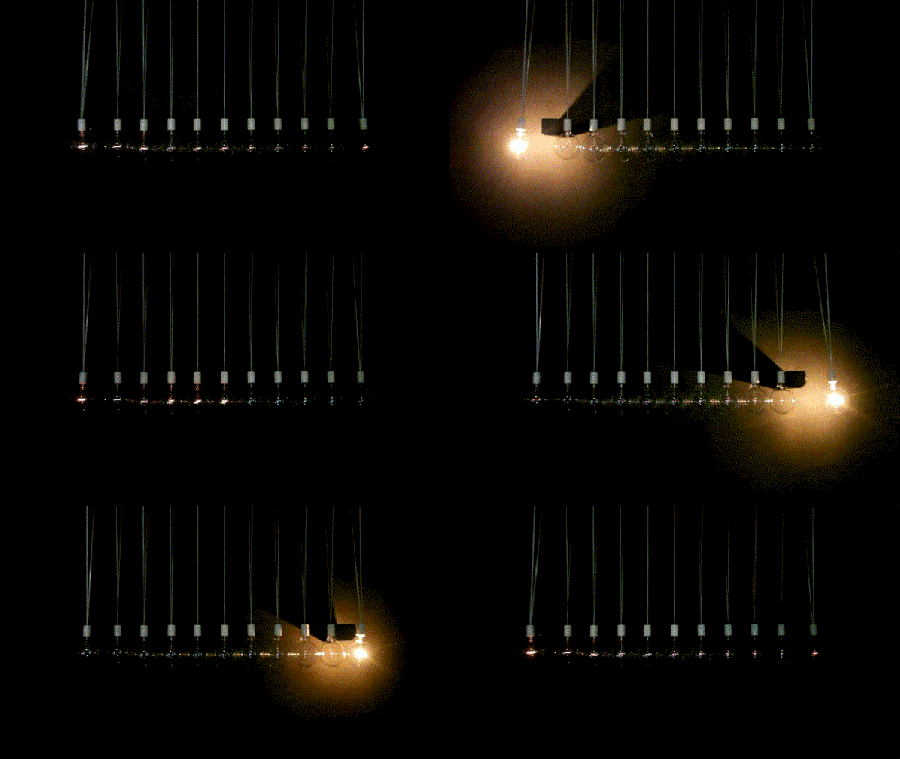
This interesting take on Newton’s Cradle is called “Asobi” and was created by [Yasutoki Kariya]. However, [Johnny] at Spoon and Tamago dubbed it “Edison’s Cradle”, which we think is a great name.

As you can make out in the video, it isn’t really a Newton’s Cradle. There is a solenoid pushing the bulbs at the end out at the correct time, but that’s fine. The overall result is quite brilliant. Unfortunately, we don’t know much about the setup. Anyone have more information? Anyone want to take a stab at making “Tesla’s cradle”?

[via Make]

Continue reading “Edison’s Cradle Is A Bright Idea”

Yet Another Arduino Blinkenlight Thing, Actually Pretty Cool

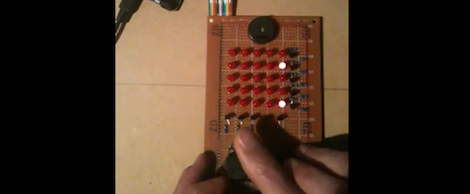
On the Tasmanian Linux User Group mailing list, [Hoolio] read someone complaining about the eventual downfall of their upcoming hackerspace as becoming a club of Arduino fanboys. [Hoolio] asked what was wrong with the Arduino, and this terrible, terrible Tasmanian replied, “there’s far too much boring blinkenlights and not enough actual cool stuff.” [Hoolio] took this as a challenge and created his own Arduino blinkenlight project that emulates Space Invaders on a 5×5 matrix of LEDs

The board is just a buzzer, 25 LEDs, 10 transistors, and a pot and button. Before the game begins, a LED chaser is traced out on the perimeter of the display, its speed controllable by the pot. When the button is pressed the game begins, allowing [Hoolio] to move his ship left and right with the pot and fire his lazor with the button.

Yes, it’s a game written for an array of blinkenlights for the Arduino. This doesn’t diminish the build, though. If this were put in a fabulous beige and transported back to 1978, we’d look on the LED version of Space Invaders as fondly as Mattel’s Football.

You can see [Hoolio]’s game demo after the break.

Continue reading “Yet Another Arduino Blinkenlight Thing, Actually Pretty Cool”

Drawing Things Very Slowly, Very Easily

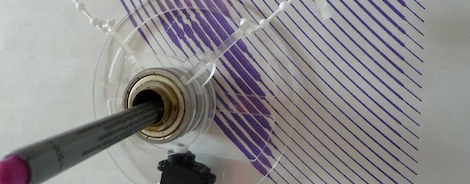
A while back, we saw [Euphy]’s polar pen plotter project. The mechanics of the build are very simple – just a pair of motors attached to a pen by a beaded cord. Even though the build is very simple, it’s possible to create awesome works of art albeit very slowly.

Since we featured [Euphy]’s polar pen plotter, a lot of improvements have been made. Now the Polargraph has an SD card slot for computer-less printing, a touch screen for manual control of the plotter, and a few new drawing styles that improve on the previous version a lot.

Right now the improved version of the Polargraph is set up in the front of a graffiti art supply shop in Edinburgh where it spends its time slowly drawing a window dressing. [Euphy] put up a few videos of what the Polargraph is capable of doing, very impressive and we hope he gets a few more PCBs in soon.

Continue reading “Drawing Things Very Slowly, Very Easily”

POV Bike Wheels With The MSP430

Being an intern a Texas Instruments isn’t all fun and games, but from [George], [Valerie], and [Ryan]’s TI intern design project, it sure looks like it. They built a persistence of vision display for a bicycle using the ever popular MSP430 Launchpad board.

The team of interns created a POV display by combining the power of the TI Launchpad with a row of 32 RGB LEDs soldered onto a booster pack. Once the whole circuit is fastened securely to the bike wheel, a hall effect sensor mounted to the bike frame allows the MSP430 to detect how fast it is going. From there, it’s just a matter of flashing LEDs at the right time to create a stationary display inside a rotating wheel.

Although the display will theoretically work with just one Launchpad/Booster pack combo, the team decided to use three of these circuits, totaling 96 LEDs per wheel, to create a really nice RGB display. The video (available after the break) shows a little bit of flicker but this is an artifact of the camera. In real life, the POV bike wheel display is simply stunning.

Continue reading “POV Bike Wheels With The MSP430”

Curiosity Landed, Here’s The LEGO Version

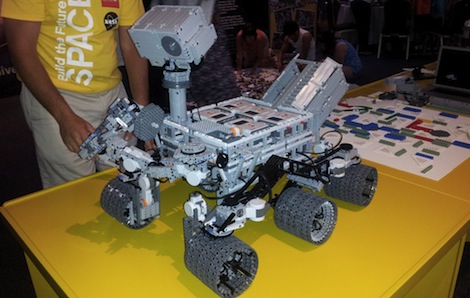
The Mars Science Laboratory hasn’t had her wheels down for a day and already the Curiosity-inspired builds are rolling in. [Will] and [Doug] built a LEGO model of the Curiosity rover for the Build the Future in Space event at NASA’s Kennedy Space Center. Everything on this scaled-down version of Curiosity is completely made out of LEGO, including the four powered wheels, motorized mast, and articulated, controllable arm.

The LEGO rover contains 7 NTX bricks, 13 motors, two power function motors, and over 1000 pieces of LEGO held together without any glue. The rover is under remote control from two operators. The driver controls the rotation and direction of the four powered corner wheels, while another operator uses a Waldo-like manipulator built out of LEGO to move Curiosity‘s mast and arm. Each of these controls communicate with the rover over a Bluetooth connection.

We’ve been wondering when we would see a Curiosity-inspired rocker bogie bot, and we’re pleased as punch the first one just happened to be a LEGO build. Having [Will] and [Doug] time their submission to the Curiosity’s landing on Mars is the icing on the cake.

You can see the LEGO Curiosity in action after the break.

Continue reading “Curiosity Landed, Here’s The LEGO Version”

Learn A New Language With The Babel Fish

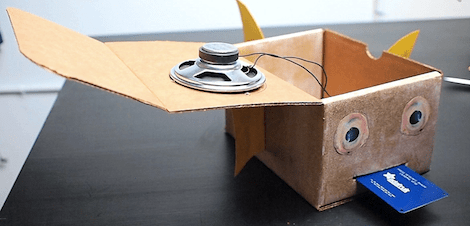
The Babel fish from Hitchhiker’s Guide to the Galaxy is one of the strangest things in the universe. After inserting a Babel fish into your ear, it feeds off brain wave energy and excretes a matrix from the conscious frequencies into the speech areas of the brain. It’s invaluable as a universal translator, but until Earth is targeted for demolition we’ll have to make do with [Becky] from Adafruit’s Babel fish language toy.

[Becky]’s Babel fish is still able to feed off the energy given off by language, but in this case the energy comes from a set of RFID cards on which Chinese characters are written. After waving these RFID flash cards in front of the Babel fish, a wave shield connected to the Arduino plays a recording of how the logogram on the flash card should sound when pronounced.

While it’s not a biologically engineered fish that simultaneously proves and disproves the existence of god, every human endeavor – learning a language included – needs more [Douglas Adams] references. You can check out [Becky]’s Babel fish demo video after the break.

Continue reading “Learn A New Language With The Babel Fish”

Biological-inspired Robotic Eye Movements

Researchers at Georgia Tech have developed a biologically inspired system to control cameras on board robots that simulate the Saccadic optokinetic system of the human eye. Its similarity to the muscular system of the human eye is uncanny.

Joshua Schultz, a Ph.D candidate, says that this system has been made possible in part to piezoelectric cellular actuator technology. Thanks to the actuators developed in their laboratory it is now possible to capture many of the characteristics associated with muscles of the human eye and its cellular structure.

The expectation is that the piezoelectric system could be used for future MRI-based surgery, furthering our ability to research and rehabilitate the human eye.

[via engadget]