Inconspicuous Guitar Hack Adds A Lot Of Control To Max/MSP

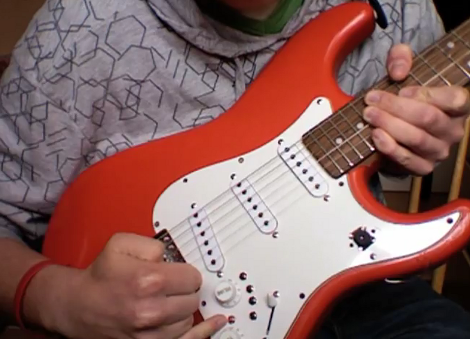
[Sam] is working on his Interactive Technology Degree and he made some alterations to this guitar as a class project. It doesn’t look much different, but closer inspection will reveal a handful of extra buttons, and a camera module. He actually added a Wii remote to the guitar which is used to control Max/MSP.

His pinky is pointing at one of the buttons. That one is red and triggers the Bluetooth sync function for the Wii remote. The other four buttons are wired to the up, down, A, and B buttons. In the video after the break [Sam] talks about the Max/MSP front-end which is used to connect the remote to the computer. Once communications are established the accelerometer sensor data is continuously streamed to the software, and the other four buttons are used for controlling the patches.

The camera module that is mounted in the guitar can be used to stream video but it appears to have no effect on the sound. In fact, the live video feed can be mixed with a waveform generation. Sound characteristics like volume affect the cross-fade between the two video signals. [Sam] talks about this feature, but when the playing demo starts about 6:10 into the clip we don’t seen any of the live video on the projection screen.

Continue reading “Inconspicuous Guitar Hack Adds A Lot Of Control To Max/MSP”
Signal Sniffing Some Laundry Pay Cards

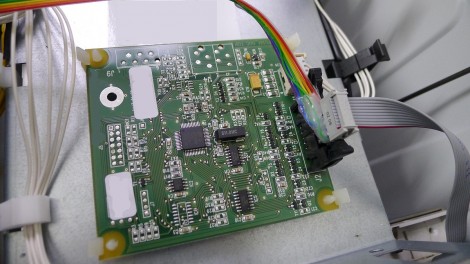
It seems that [Limpkin] was up to no good this weekend. He decided to snoop around inside a smart-card laundry machine. He posted about his larceny  adventure and shared the details about how card security works with this machine.

We’re shocked that the control hardware is not under lock and key. Two screws are all that secures the panel to which this PCB is mounted. We know that machines using coins have a key lock, but perhaps there isn’t much need for that if there’s no currency to steal. [Limpkin] made a pass-through connector for the ribbon cable coming in from the card reader. That’s the rainbow cable you can see above and it’s being fed to his logic sniffer. He used the ‘card detect’ signal as a trigger and captured enough data to take back to his lair for analysis. Using what he found and a Bus Pirate to test the smart card he laid bare all the data that’s being sent and received by the controller.

LED Clock Lights Up A Dead Mac Mini

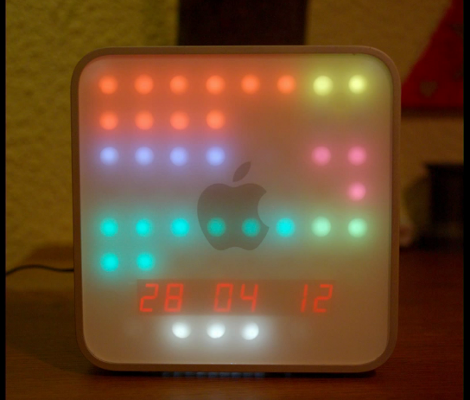
[Professor Shadoko’s] Mac Mini died. But since the case designs on Apple products are half the reason to buy them, he decided to reuse the enclosure by turning it into this clock (translated).

As with the binary clock we saw yesterday, this one uses a bunch of LEDs to display the time, but it does it in a way that’s a bit more readable if you know what you’re looking for. The face has been divided up into two columns. On the left is hours, then minutes and seconds in increments of five. To the right is AM/PM, with minutes and seconds in increments of one. If we’re doing this right, the time seen above is 10:23:42 PM on April 28th, 2012. The white LEDs below the date act as a digital pendulum, scrolling left and right as the seconds tick by.

The display uses two MAX7219 LED drivers to control the grid which is build on a big hunk of protoboard. An Arduino ties the whole system together with a Chonodot for accurate time keeping. There’s even an ambient light sensor which adjusts the LED intensity to make this readable in direct sun, or the dark of night. See a demo clip embedded after the break.

Continue reading “LED Clock Lights Up A Dead Mac Mini”

Watch A Rocket Engine Test Live This Afternoon

If you want to see something awesome this afternoon, watch SpaceX’s live broadcast of an engine test today at 3:00 pm EDT/12:00 pm PDT/7:00 pm GMT. You’ll see nine Merlin rocket engines power up to full thrust during a test for the upcoming launch of a Dragon space capsule to the ISS.

This is just a static test – hopefully the nine Merlin engines won’t go anywhere. To get an idea of the power behind these engines this is a test of just  Merlin engine being fired at the SpaceX open house in Texas a year or so ago. Today, nine engines will be fired at once.

Check out the videos after the break to see just how awesome the Falcon 9 is going to be.

via boingboing

Continue reading “Watch A Rocket Engine Test Live This Afternoon”

Adding A Remote Shutter To A Cheap Digital Camera

[Luo] sent in a very easy way to add a remote shutter to just about any Canon Powershot. Even though it’s just a button, battery, and USB cable, we’re sure this would be a great project to teach the younglings about the power of soldering.

Some Canon Powershot digicams are impressive beasts with the ability to take time-lapse, long exposure, and high-speed photos. These cameras are generally crippled by their firmware, but by installing CHDK these features can be enabled.

[Luo] read the CHDK wiki and found the firmware has the ability to snap a picture whenever a button is pressed. All he had to do is send 5V down a USB cable. After whipping up shutter button housed in a tin of Eclipse gum and attaching a cable, [Luo] had a functional shutter.

With the CHDK firmware, you can do a lot of really interesting stuff with the old Canon camera sitting on your shelf: we’ve seen a lot of intervalometers and even a few book scanners that use a similar setup. Nice work, [Luo].

Getting A Textured 3D Scan From Just A Webcam

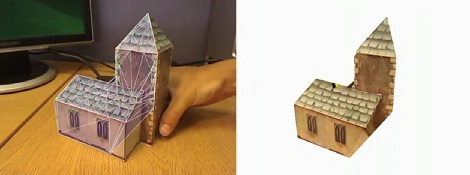
Here’s an oldie but a goodie that passed us up the first time it went around the Internet. [Qi Pan], (former) PhD student at Cambridge, made a 3D modeling program using only a simple webcam. Not only does this make very fast work of building 3D models, the real texture is also rendered on the virtual object.

The project is called ProFORMA, and to get some idea of exactly how fast it is, the model of a church seen above was captured and rendered in a little over a minute. To get the incredible speed of ProFORMA, [Qi] had his webcam take a series of keyframes. When the model is rotated about 10°, another keyframe is taken and the corners are triangulated with some very fancy math.

Even though [Qi]’s project is from 2009, it seems like it would be better than the ReconstructMe, the Kinect-able 3D scanning we saw a while ago. There’s a great video of [Qi] modeling a papercraft church after the break, but check out the actual paper for a better idea of how ProFORMA works.

Continue reading “Getting A Textured 3D Scan From Just A Webcam”

Multitouch Table Uses A Kinect For A 3D Display

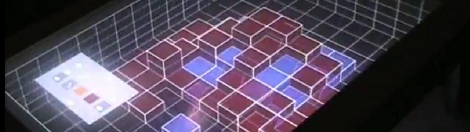
[Bastian] sent in a coffee table he built. This isn’t a place to set your drinks and copies of Make, though: it’s a multitouch table with a 3D display. Since no description can do this table justice, take a look at the video.

The build was inspired by the subject of this Hackaday post where [programming4fun] was able to build a ‘holographic display’ using a regular 2D projector and a Kinect. Both builds work on the principle of redrawing the 3D space in relation to the user’s head – as [Bastian] moves his head around the coffee table, the Kinect tracks his location and moves the 3 dimensional grid of boxes in the opposite direction. It’s extremely clever, and looks to be a promising user interface.

In addition to a Kinect, the coffee table uses a Microsoft Surface-like display; four infrared lasers are placed at the corner and detected with a camera next to the projector in the base.

After the break you can see the demo video and a gallery of the images [Bastion] put up on the NUI group forum.

Continue reading “Multitouch Table Uses A Kinect For A 3D Display”