HackaDay Is Entering In The Redbull Creation Contest

When I returned from MakerFaire Kansas City I was very pleased to find a Bullduino waiting on my doorstep! Hackaday has been accepted into the first round of the Redbull Creation Contest. I’m doing the physical building while the other writers are consulting for this round. I’m also pulling people from around me here at SquidFoo (my local hackerspace) that can help.

Today, I got lucky enough to run into [Tony Sherwood] from MakerBot. I told him my idea and he eagerly volunteered to lend his brains and his brawn… as well as his Makerbot Replicator. He’s been extremely helpful so far offering very good ideas on how we can get this thing operational as fast as possible.

I’m not going to share exactly what we’re building yet. I can tell you it will not be the most complex project, but it will be really fun, and most likely dangerous. We’re starting today, which means we have very little time to build. Lets hope we can make something interesting enough to go to round two!

Bicycle Quadcopter Flies For Dozens Of Seconds

If you decide to fly into town on this bicycle-powered quadcopter your arms and legs really will be tired. That’s because this athlete had to give it his all to power the rotors through the foot pedals and the hand cranks. You can see just one of the rotors on the right side of the background. Yeah, this thing is big!

You’re looking at the Gamera II, a craft developed by students at the University of Maryland. About a year ago they were showing off the first version of the aircraft. With the passing of the year comes the breaking of world records as a different rider manages to keep it up for 50 seconds in the video after the break. Although the structure is huge (over 100 feet across) the building materials and techniques let it weigh in at only 71 pounds.

It still looks like way to much physical work for us. We’re sticking to the pedal-powered hydrofoil as our dream transport.

Continue reading “Bicycle Quadcopter Flies For Dozens Of Seconds” →

Taking A Dump From Some Old Hardware

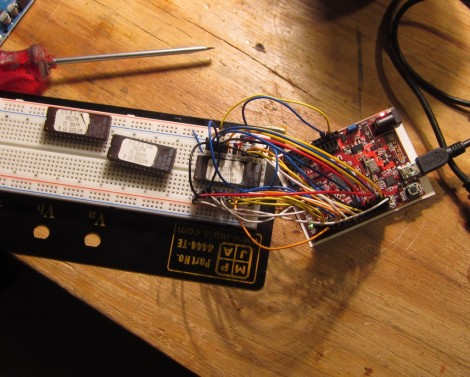
NYC Resistor shows you how to have some fun with electronics from the junk bin. Their post called The Joy of Dumping encourages you to look around for older memory chips and see what they’ve been hiding away for all these years.

The targets of their hunt are EPROM chips. Note the single ‘E’. These are Erasable Programmable Read-Only Memory chips, and predate EEPROM which adds “Electrically” to the beginning of the acronym.  You used to use a UV light source to erase the older types of memory. In fact we’ve seen some EPROM erasers as projects from time to time. These shouldn’t be too hard to find as they were prevalent as cheap storage back in the 1980’s.

If the quartz window on the top of the chips has been shielded from ambient UV light, you should still be able to read them and it’s as easy as hooking up your Arduino. Is it useful? Not really, but it still can be neat to interface with what might otherwise never make its way back out of the junk box.

Offloading VGA Generation Onto A Coprocessor

[Alessandro] sent us a link to his post about a PRU software VGA rasterizer. It’s not the easiest read, but we think it’s worth your time.

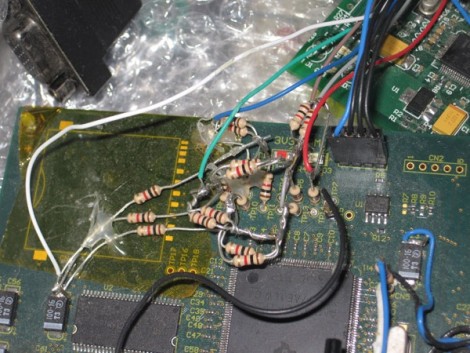
The gist of his background information is that back when his company was developing for an ARM9 processor he wanted to test his mettle with the coprocessor chips. The first iteration was to write a character LCD driver that pulled data from the main processor’s memory and displayed it on the screen. This makes for a low-overhead debugger display, it’s also very limited (32 characters over two lines doesn’t tell you much). And thus began his work on a VGA generator for the Programmable Realtime Unit (PRU is what TI calls this coprocessor) that grabs data in memory just like the original version. But with a much larger display area this becomes quite useful for debugging. That resistor mess is the R2R ladder he soldered together to perform the Digital to Analog Conversions. There’s a quick demo clip after the jump.

This work could end up being useful to you. [Alessandro] reports that the BeagleBone has similar hardware. A bit of porting could get his generator working on that board as well.

Continue reading “Offloading VGA Generation Onto A Coprocessor” →

Tricking The BeagleBone Into Outputting Video

[FlorianH] wanted to get video out working with his BeagleBone but he just couldn’t figure out how to make the kernel play ball. Then a bit of inspiration struck. He knew that if you plug in the official DVI cape (that’s the BeagleBone word for what you may know as a shield) the kernel automatically starts pumping out the signals he needs. So he figured out a way to spoof the cape and output video.

At boot time the kernel polls the I2C bus to see what’s connected. The DVI cape has an EEPROM which identifies it. Since the data from the EEPROM is available for download [FlorianH] grabbed the data he needed, then used an ATmega32 to stand in for the memory chip. When he got the chip talking to the BeagleBone he was able to detect the video sync signals on his scope and he knew he was in business.

Look closely at the breadboard on the right. We love that SIL breakout board for the ATmega32. Very prototype friendly!

Strange Login Request At Hackaday.com

We’ve received numerous messages about this new login popup on our site. This is NOT our doing. It is most likely some ancient script from our ancient template that has finally become outdated or expired. We’re working on a resolution. If you hit cancel it will go away.

We are truly sorry for the inconvenience and are working to get rid of this immediately.

Update: It is gone. It was a site statistics script from sitemeeter that suddenly had issues on many sites.  We try VERY HARD to make sure our advertisements are unobtrusive since we rely on those ads to support us. Anything that gets in the way of you reading our site is bad.

Bench Power Supply Resetting Thingy

As is common among some hackers, [Henry] re-purposed an ATX power supply unit to function as a bench power supply for testing circuits on a breadboard (much like this fancy example).

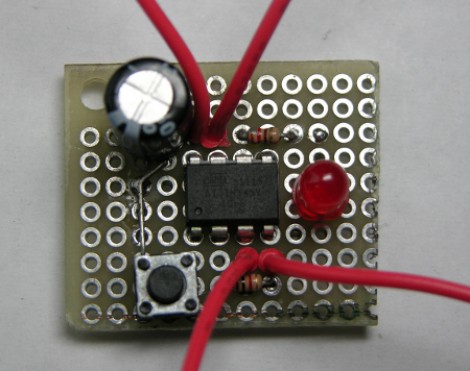
However, safety mechanisms on some modern PC PSUs do not automatically reset after over-current protection has kicked in, which soon became annoying for [Henry]. In order to make his power supply more hacker-friendly, he wired up and programmed an ATtiny85V, using some Arduino libraries, to do that for him. This simple project is a great example of using a hack to improve a pre-existing hack.