
Android Legs Stability Testing

This is [James’] latest android build, a set of legs that use gyroscopes for balance.

He started off by planning the build with some LEGO pieces to get an idea of how each foot and leg joint would fit together. This let him achieve one of his goals. From the start he wanted to create a robot that would remain stable, and not build up enough momentum to tip itself over if there is a problem. With the dimensions established he cut out parts from 2mm sheets of HIP plastic using a hobby knife. They work in conjunction with a frame made from aluminum and HDPE. The whole thing houses eight servos responsible for movement, but he found an interesting way to use them for balance as well.

[James] came across some gyroscopic sensors which are made for use with RC helicopters. They connect in-line with a servo motor and offset it based on the gyro data. He’s using four of them with this bot, playing the hip and ankle servos against each other for balance. What results is a set of legs that look like their jonesin’ for a fix. See for yourself in the clip after the break.

Continue reading “Android Legs Stability Testing” →

Troubleshooting Household Light Timers

timer-repair

When [Todd Harrison’s] Christmas lights stayed on well past the pre-defined shut off time, he knew there was something wrong with the timer. He took the device into his workshop and spent some time diagnosing and repairing the device, a process he recorded for all to see.

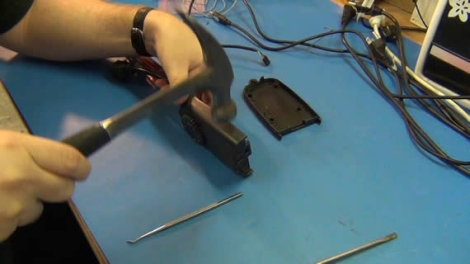
After busting the screw-less timer open with a hammer, he inspected the PCB for any apparent signs of damage. After seeing what looked like a damaged transistor, he desoldered it from the board for testing. After the transistor passed his tests with flying colors, [Todd] assumed that the fault had to be in the relay which the transistor was responsible for switching.

Sure enough, the relay had shorted out, and upon cutting it open he found that the contact points were fused together. He separated and sanded the contacts down, enabling him to get the timer working – at least for the time being.

Part of [Todd’s] goal with this video was to show off different methods of desoldering, including a manual solder sucker (my favorite), desoldering braid, and a purpose built desoldering iron. If you’re in the market for some desoldering tools, but don’t know what to buy, [Todd] is more than happy to offer his advice.

Continue reading to see a video of [Todd’s] troubleshooting process.

Continue reading “Troubleshooting Household Light Timers” →

Simple IR Sensor Simplifies Laptop Audio Control

tiny-ir-tv-remote-receiver

[Owen] has a fairly big project in the works, where he’ll need to use infrared light to send data wirelessly between two nodes. The only problem with his grand plan is that he has never built anything of the sort. As a learning exercise, he decided to try his hand at building a wireless control interface for his laptop, which he uses to play music while doing homework.

His laptop usually sits across the room from [Owen], where it is connected to a speaker and amplifier. He hates getting up repeatedly to change songs, so he figured he might as well build an IR receiver to control Winamp that responds to commands from his TV’s remote control. Using his Open Bench logic sniffer and an IR receiver from an old VCR, he deciphered his remote’s encoding system. He then programmed an ATtiny13 to decode messages received by the IR sensor, sending them to his laptop via USB.

He packaged things inside a tiny mint tin, which he hangs from a desk lamp while in use. Now he can easily perform just about any action in Winamp with a few button presses on his remote. [Owen] says that he’s incredibly happy with the results, and now that he has a firm grasp of IR signaling concepts, we can’t wait to see what he builds next.

Ask Hackaday: Organizing A Growing Collection Of Electronic Odds And Ends

ask hackaday

[Tim] wrote in, lamenting a problem that many of us can likely echo. Over the years, he has acquired all sorts of small electronic parts and components, along with tools and accessories – all of which are starting to crowd his workspace. He says that most of his stockpile is being stored in a tackle box, but it’s getting unwieldy and he would like to find a better way to organize things.

Yours truly suffers from the same sort of situation. It’s mostly a result of being a tad bit lazy, while conveniently finding alternative storage containers for my electronic odds and ends. My workbench is strewn with plastic snack baggies (for screws, not ESD-sensitive bits), Glad-Ware containers, Eclipse gum packages, and old plastic baby formula tubs for larger items. While I’m certainly doing my share to reuse plastic packaging, I am aware that it’s not exactly the best organization methodology.

This topic does come up pretty often, and even though we’ve talked about it on several occasions, people still like to hear fresh feedback from their peers. If you have some clever organization tips, or a novel way of storing your electronics components, be sure to share them in the comments!

Dial 1 To Get Siri As Your Operator

Back in the days of yore when hats were fashionable and color TV didn’t exist, there were real life people who would answer the phone if you dialed 0. These operators would provide directory assistance, and connect you to another number (such as KL5-8635). Apple’s Siri is a lot like an olde-timey phone operator, so [davis] decided to put Siri in an old rotary telephone.

The build started off with a very inexpensive Bluetooth headset and very old rotary phone. The single button on the Bluetooth headset was wired to a contact of the dial – in this case, the number 1. Dialing 1 shorts two contacts in the phone and the Bluetooth headset turns on.

[davis] came up with a very easy build but dialing 1 just isn’t the same as dialing 0. Connecting the Bluetooth button to 0 closes the button for too long. He says ‘0 for operator’ could be implemented with an ATtiny or similar, but we’re wondering if [davis] could make due with a dial-less candlestick phone.

Continue reading “Dial 1 To Get Siri As Your Operator” →

Building The Ocarina Of Time With An FPGA

[Joe] and [Evan] wanted to have some fun with their FPGA course at Cornell. When faced with what to do at the beginning of the semester, they figured additive synthesis was a worthy pursuit. They ended up building the Ocarina of Time for their final project.

The guys started by recording a real ocarina and figuring out the relative power levels of each harmonic. Because any sound can be synthesized from a bunch of sine waves, having their Altera FPGA board replicate those frequencies produces a nice ocarina sound

[Joe] and [Evan]’s ocarina has a ‘mouthpiece’ that is just a small microphone. This mic is hooked up to the FPGA board and controls the volume. Sadly, the guys didn’t have time to take apart an N64 controller so 6 red buttons serve as the finger holes.

From the video after the break, [Joe] and [Evan] really pulled together something that sounds like Link’s Ocarina. Great work, guys.

Continue reading “Building The Ocarina Of Time With An FPGA” →

Half Keyboard, Half Guitar, Totally Radical, The Tabstrummer!

While tablature-based music probably annoys “properly” trained musicians to no end, it has given many musicians and musical-hobbyists their first introduction to the world of guitar. The [Tabstrummer] takes this to a whole new level, allowing chords to be programmed into this instrument and played back. Once pre-programmed chord is set, the “conductor-strings” are strummed to allow the chord to play.

This device is based around an Atmel microcontroller and features a MIDI output as well as an audio-out jack. Besides the interesting electrical hardware, the housing seems to be quite well-built featuring what appears to be an acrylic or polycarbonate body. Although not quite the same thing, possibly some influence was gained from the [Keytar]. It’s heyday may be past, but not forgotten.

Check out the video below for a Christmas-themed jam played on the [Tabstrummer] or check out their video page for several more songs. This “hack” is being considered as a commercial product, so the inventors would love to hear your feedback! Continue reading “Half Keyboard, Half Guitar, Totally Radical, The Tabstrummer!” →