Fixing Arduino’s Serial Latency Issues

arduino_latency

[Paul] wrote in to tell us about some interesting Arduino latency issues he helped nail down and fix on the Arduino.

It seems that [Michu] was having some problems with controlling his Rainbowduino project we featured earlier this year, and he couldn’t quite figure out why he was experiencing such huge delays when sending and receiving data.

Searching online for answers turned up very little, and since [Michu] was using Processing, the pair designed a set of tests to see what kind of latency was being introduced by Java. Pitting an Arduino Uno and an Arduino from 2009 against a Teensy 2.0, the tests gauged the latency of native data transfers versus transfers facilitated by Java via the rxtx library it uses for serial communications.

The results were pretty stunning. While both of the Arduinos lagged behind the Teensy by a long shot, their latency values under Java were always 20ms at a minimum – something didn’t add up. [Michu] poked around in the rxtx code and found a mystery 20ms delay programmed into the serial library. It made no sense to him, so he changed the delay to 2ms and saw a drastic increase in performance when transferring less than 128 bytes of data.

The pair’s fix doesn’t seem to affect latency when larger amounts of data (>1kB) are being transferred, but it makes a world of difference when manipulating smaller chunks of data.

For the sake of disclosure, it should be noted that [Paul’s] company produces the Teensy mcu.
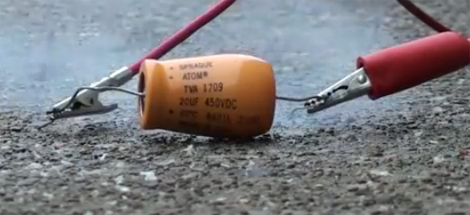
Blowing Up Capacitors

[grenadier] wrote in to show us a video of some capacitors being blown up. Yup, that’s it. Just some capacitors being blown up. You might be wondering what there is to learn from this video. The answer is… nothing. It sure is fun to watch though. We’re all busy trying to find some nice hacks to share with you, so we figured you could watch some stuff getting destroyed while you waited.  Here’s someone using explosives to reveal art behind a thin layer of concrete on a wall. Here’s some high voltage destroying multimeters. How about a turkey being cooked with thermite? Thermite works on hard drives too.

Ok, enough of that. This was a gentle reminder to send us tips to your projects.

Continue reading “Blowing Up Capacitors”

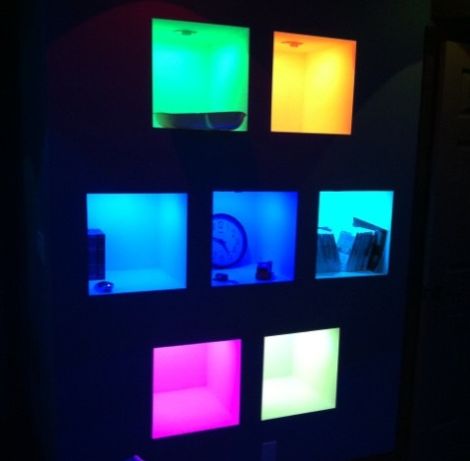
Awesome Custom Disco Basement

led_shelves

[Evan] is one of those neighbors you only wish you had.

His neighbors were renovating their basement for use as home theater, and he stopped by to check out how things were coming along. While there, he suggested they add some LED lighting to their shelving unit to make them pop. His neighbors were game, so he sourced some cheap RGB LEDs online and began working on the circuits and firmware needed to control the lights. His neighbors wrote some custom software that interfaces with iTunes to create a neat visualization in the shelving unit whenever music is played.

Once everything was complete, his neighbors informed him that they wanted an additional 20 overhead can lights and a set of 4 wall sconces wired up as well. Needless to say he was pretty excited, so he got busy wiring up the remainder of the basement.

He pushed the installation’s PIC microcontroller about as far as he possibly could, resulting in the awesome show seen in the video below.

Needless to say, it’s pretty impressive, though we wish we could have a peek at the code used to run everything. Wink, wink, nudge, nudge.

Continue reading “Awesome Custom Disco Basement”

Bluetooth Super Nintendo Controller For Android Gaming

bluetooth_snes_controller

[Rich] needed to come up with a senior design project and decided to combine two things he loved: his Android phone and Super Nintendo.

While touchscreen phones are great, he felt that nothing beats the tactile feedback of a physical controller when it comes to gaming. He figured out how the controller’s signaling works, then wired it up to an Arduino Pro Mini 328. The Arduino interprets the SNES controller’s signals, sending them to his Android phone via a BlueSMiRF Bluetooth module.

He originally had all of the components crammed in a cardboard box, but much like we pointed out yesterday, he realized that a project really comes together when housed in a proper enclosure. He managed to squeeze all of his components into the SNES controller’s shell aside from the battery pack he used to power the remote. After a little bit of Bondo and a few coats of paint were applied, the controller is looking quite sharp.

Stick around to see a quick demo video of his controller in action, and check out this tutorial he put together explaining some of the principles he used to construct it.

Continue reading “Bluetooth Super Nintendo Controller For Android Gaming”

RFID Smart Card Reader

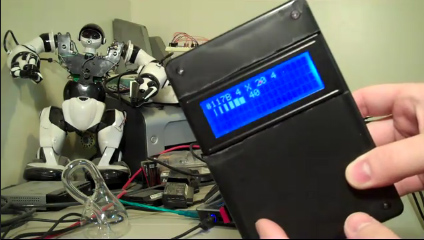
[Navic] wrote in to show us his latest project. This is a portable smart card reader with a nice LCD display. he just happened to have a Basic Stamp 2px, smart card reader, and smart card reader/writer sitting around waiting to be used. What better use than a hand held smart card reader?  Tossing the bits together in a nice project enclosure, [Navic] scoured the code available to him and pieced together what he needed. Now, when you slide in a card, you get a nice readout of the data on that pretty blue screen. Unfortunately, if you pull the card before the read is finished, everything just freezes.

You can see the final video after the break, and you can also see some in-progress videos linked in youtube. He asks if he should add the ability to write, and we say YES. Store that data, then write (duplicate) to another device.

Continue reading “RFID Smart Card Reader”

Electro-static See-saw

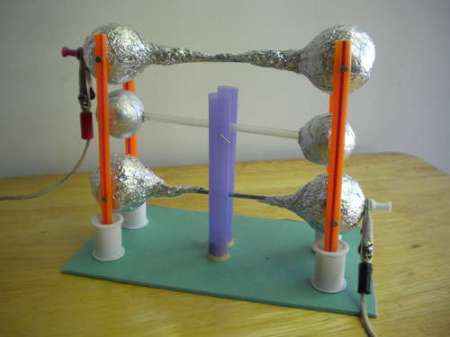
Many of you may have seen these fun little toys in museums or possibly even in school. Instructibles user [brazilero2008] takes us through the process of constructing one on our own.

Most of this toy are constructed from fairly household materials like foil, paper, straws etc. The fun part comes when you find the power supply. [brazilero2008] is using an air ionizer that he found at a rummage sale, though any high voltage DC source should work. He shares some tips on how to save time and effort creating the balls on the end by telling us how he did it the difficult way.

We admit this isn’t the most attention grabbing project, but we think it would be a fun educational weekend project.

Last Mile WiFi Over TV White Space

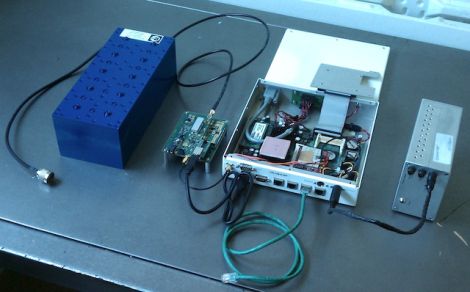
tv_wifi_gear

What do you do when you can’t afford broadband and no-cost WiFi is just out of reach?

That was the problem Rice University grad student [Ryan Guerra] was tasked with solving. A local Houston resident could barely tap into the free service offered in her area, so [Ryan] set out to extend the signal’s range using white space previously occupied by TV signals.

Using channel 29 which operates at 563MHz, his “Super WiFi” project utilizes standard WiFi protocols and can extend the signal’s reach up to a mile. The WiFi signals at the closest tower are piped through a prototype frequency translator, shifting the signal from 2.4GHz down to 563MHz, which is far better suited for long(er)-haul transmissions. The system does not use channel bonding just yet, so it is limited to using about 25% of WiFi’s maximum bandwidth, which is far better than no signal at all.

While the widespread practical use of TV white space will take some time to come to fruition, this is definitely a step in the right direction.

[Thanks Chris]