Doom II On Epaper Display

We love to see Doom ported to new hardware because it usually means that someone has found a way around the manufacturer’s security measures. But the most exciting thing for us to see this time is that Doom II is played on an epaper display. These are notorious for slow refresh rates, but as you can see in the video after the break, this one achieves an admirably fast page redraw.

According to a translation of the original forum post, the PocketBook 360° Plus boasts a 5″ E Ink Pearl screen, 533 MHz Freescale i.MX35 ARM11 processor, 128 Mb of RAM, 2 gigs of storage, and WiFi. No word on price for one of these babies as it seems they’ve not yet been release. Remind anyone of the green monochrome goodness from the original Game Boy?

Continue reading “Doom II On Epaper Display”

Are Phones With Haptic Feedback In Our Future?

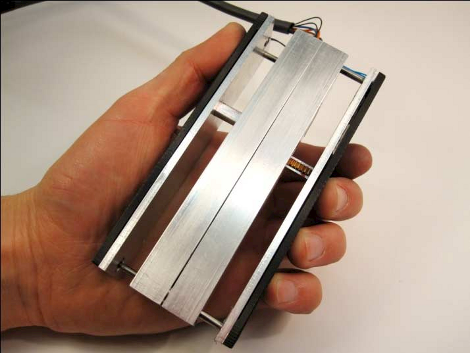
Can we do away with a keypad and just squeeze our phones to check messages and dial contacts? [Sidhant Gupta] has been researching the idea of an electronically adjustable spring mechanism that might just make this possible. He calls the prototype above the SqueezeBlock. If you pick it up and give it a squeeze you can feel springs pushing back against your fingers, but it’s all a trick. Inside you’ll find one motor with a gear that converts the linear motion into a rotating force. Attached to the same axle as that gear are a motor and a rotary encoder. A microcontroller monitors that encoder to detect a user squeezing the two plates together, then drives the motor to vary the resistance. [Sidhant] outlines some possible uses that included stiffer resistence as unread email starts to pile up, or squeezing the device to its smallest size to turn the ringer volume all the way down.

We’re a little skeptical of this functionality in handhelds just because of the power consumption issue. But if that is somehow overcome we think this would make a pretty interesting phone feature… at least at first. Click through the link above for a video demonstration or get the details from the research presentation (PDF)

[Thanks Dan]

Webcam Images Processed And Played Back On LED Display

[Mathieu] has bee working to refine the code running on an LED matrix, and added some neat display tricks along the way. He wanted to make the display directly addressable from a computer. The 96×64 bi-color LED display is powered by an Atmel FPSLIC and already used double-buffering. Enabling a PC to write directly to one of the buffers was not too hard, requiring just a bit of optimization to get the timing right. From the look of the video after the break, he nailed it.

The video feed is generated from a webcam stream using Matlab to process each image. Just 50 lines of code captures a frame, sizes it appropriately, converts the result to black and white for edge detection, then finishes the job by compressing image data for transmission to the embedded processor. We’d like to say it’s easier that it sounds but we’re pretty impressed with this work. The display manages about 42 Hz with the current setup.

Continue reading “Webcam Images Processed And Played Back On LED Display”

Hackaday Links: April 10, 2011

Sunlit LCD screen

[A.J.] did some experiments and managed to replace his LCD backlight using fiber optics and the sun.

Game Boy LCD Repair

[Alan] found that he could fix dead columns on his Game Boy LCD screen with a little reflow work on the connector.

3DS Design Flaw?

Anyone having problems with the way their Nintendo 3DS closes? [Jeroen] noticed that his screen touches the other half of the device when closed. He added rubber feet to protect it, but we wonder if anyone else has noticed this issue?

Mac TP dispenser

This one takes iLife to a new level. Never poop without Apple’s consent again thanks to this Macintosh toilet paper dispenser. [Thanks Rob]

Children are the future

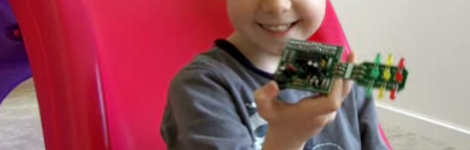
Here’s a heart warming way to end; [Bret] is teaching his 5-year-old son to solder. There’s a video that is sure to put a smile on your face. You’ll remember [Bret] (aka [FightCube]) from the adjustable prank box, a few 555 timer contest submissions, and several other hacks. We expect big things from your progeny!

Growling Doorbell Lets You Know Guests Have Arrived

wireless_doorbell_hack

[Sean] was screwing around online looking for nothing in particular when he came across a mailbox hacked to notify the homeowner when the mail had been delivered. Since his mail is delivered via a slot in the door, he had no use for the hack as is, but something similar soon came to mind.

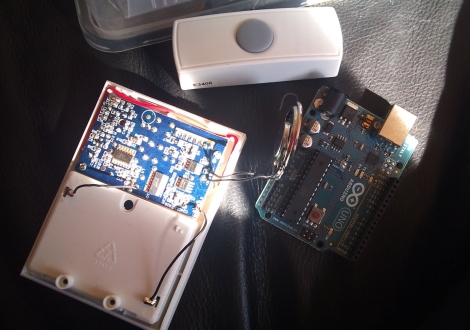
His dog isn’t too keen on visitors, and he figured that he could save himself a bit of grief (and a lot of unnecessary barking) if he were to wire up his doorbell to notify him of guests via his iPhone. He stopped by the local hardware store and picked up a wireless doorbell. It was quickly disassembled and wired up to an Arduino he had set aside for a different project. Tweaking some code he found online, he soon had the doorbell talking with the Arduino and was ready to interface it with his iPhone. He decided that he wanted to deliver notifications to his phone via Growl and found a Perl script online that was close to what he needed. A few tweaks later, and he had a Growling doorbell.

As you can see in the video below, it works, though there seems to be a bit of a delay in the notification. We don’t think that it would be enough to send his visitors packing before he made it to the door, but the lag can likely be reduced with a few small modifications.

As for the post that started this whole thing, we’re pretty sure this is it.

Continue reading “Growling Doorbell Lets You Know Guests Have Arrived”

How Low Can You Go?

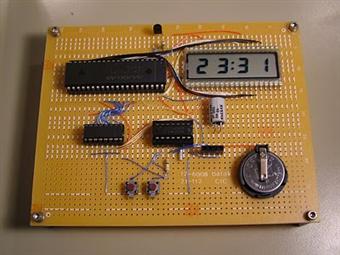
That’s exactly what [Kenneth Finnegan] figured out with his original investigation into low powered MSP430-based circuits. He was able to keep a count-up timer running off of 20F worth of capacitors for over 10 weeks. Although quite impressive by its own merit, many people left comments that questioned whether similar results would be seen in a circuit with functionality more advanced than simply incrementing a single digit on an LCD. Well folks, [Kenneth] has stepped it up again with this ultra low power LCD clock.

The biggest challenge in creating this clock was finding an efficient way to drive the 28 LCD segments off of the limited number of pins on his MSP430G2231 chip while still having open pins for button inputs as well. An ICM7211 LCD driver is definitely up for the task (with a few clever modifications to drive the auxiliary characters such as the center colon), but requires 8 pins to drive it. A standard 74HC595 latching shift register brings this number down to a more manageable number of 3 total pins.

Once completed the total current consumption was found to be around 12μA – low enough for a claimed run-time of approximately two and a half years from the 3V 200mAh CR2032 coin cell used. If true, a set of standard AA alkaline cells in series as found in many clocks would run this little circuit for decades.

Stick around for a short video after the break and make sure to check out the original blog entry for schematics and the complete source code!

Continue reading “How Low Can You Go?”

Bolt Action Pneumatic Spud Gun

No one should ever make a potato cannon. They are wildly unsafe, powerful, and can easily shatter your neighbor’s gaudy bay window, you know the neighbor with the mean dog.

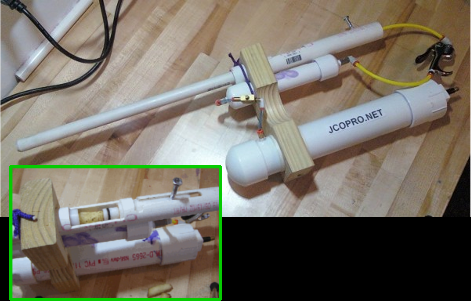
That said, [Jeremy Cook] made a minature bolt action spud gun! Using a custom machined Delrin bolt, a fitted Delrin reducer, and some PVC, the spud gun is capable of quickly loading custom shaved potatoes with the greatest of ease. Pushing the bolt (literally a bolt) forward forces the spud through the reduction coupling and into the barrel. Lock the bolt to the side, pull the trigger (an air blower) and two expansion chambers toss compressed air behind your starchy projectile. The design is reminiscent of  a common bolt action rifle, but all that Delrin reminds us of paintball markers.

[Jeremy] is writing up the project in multiple posts, so check his blog for info. We are also no strangers to the strange, dangerous and wonderful world of potato launching tech.

Stick around for a video of the launcher in action!

Continue reading “Bolt Action Pneumatic Spud Gun”