According To Pete – New Online Video Series

This is [Pete Dokter], the fourth employee that Sparkfun ever had and currently Director of Engineering there. As you can see, they’re not letting [Peter] come out of his hole. Instead of designing new breakout boards they’ve given him a camera that he’ll be using to record his occasional pontifications. ‘According to Pete’ will become a regularly occuring online show where he answers questions from around the Internets. We’ll admit that the first episode, embedded after the break, is a bit content thin – serving only as an introduction. But we think [Pete] has a pleasant manner and we look forward to what blossoms out of this modest beginning.

We’ve long been fans of engineering-oriented online shows such as [Dave Jones’] EEVBlog, [Bill Hammack’s] The Engineer Guy, A collaboration between [Chris Gammell, Dave Jones, and Jeff Keyzer] call The Amp Hour, [Jeri Ellsworth’s] A-Z Videos and her upcoming series, [Ben Heck’s] The Ben Heck Show…. and we could go on.

With offerings like these you don’t need to wait for traditional TV to transition to IP delivery. Just stop watching crap and start watching these interesting shows.

Continue reading “According To Pete – New Online Video Series”

Kequencer 2.0 Is Cheaper And Easier To Build — Still Awesome

[Rich Decibels] decibels received so much interest in his original sequencer build that he decided to make another one that was a bit easier and less expensive to replicate. The original design, called the Kequencer, featured a nicely finished look for the user interface. For the Keyquencer 2.0 he decided that adding a lid to the enclosure meant not spending quite as much for controls (nice looking knobs tend to increase the cost of potentiometers).

A rectangle of protoboard serves as the panel face for the device. It looks like he painted it black on top so that it doesn’t distract from the neatly organized parts layout. He used point-to-point wiring to make most of the hookups, but he did create a board layout which will help to guide you when the number of wires starts to get out of hand. This was made after the fact and he regrets not having it for the initial build. Check out the demonstration video embedded after the break to hear how the second iteration sounds.

Continue reading “Kequencer 2.0 Is Cheaper And Easier To Build — Still Awesome”

Compost Heap Temperature Logger Helps Keep Things Hot

compost_temp_logger

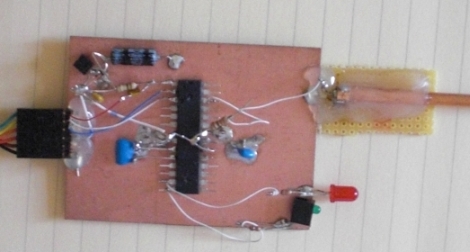
HackHut user [lackawanna] is looking to start his own compost pile, but as many urban composters discover, things can get quite smelly if you don’t manage it properly. The process of composting is broken up into two phases, aerobic and anaerobic decomposition. The former is the first stage to occur and produces plenty of heat, but should be scentless. The latter gives off less heat and is more of a stink due to putrefaction. Carefully monitoring the temperature of the pile and restarting the aerobic phase when necessary helps to keep the process “healthy” and scent-free.

[lackawanna] built a simple temperature monitor that he plans on using to track the status of his compost pile once he gets started. It uses an ATmega328 as the brains of the operation and an old metal can transistor as his temperature sensor. Using relative measurements of the compost pile taken in 10 minute intervals, he can determine when the aerobic phase is underway, as well as when things begin turning anaerobic. At that point, the sensor alerts him that the pile needs to be turned.

The build is pretty simple, but leaves plenty of room for expansion. It should be relatively easy to add a more friendly notification interface as well as install multiple sensors to the pile for obtaining aggregate temperature data.

mobo_salvage

PCB Parts Salvaging Made Easy

Take a moment to think about how many old or damaged computer motherboards you have tossed away over the years. Sure we try to repurpose everything we can, but reclaiming electronic components from complex devices can be overly time consuming if you don’t have the proper means of doing so.

Ideally, if we were to try removing components from a motherboard, an old stove or an unused toaster oven would be great. If you didn’t have either item at your disposal, you could always attack the board with a soldering iron and some braid – but who has the time for that?

[Giorgos Lazaridis] over at PCBHeaven put together a quick video demonstrating his favorite technique for salvaging components after a motherboard has outlived its usefulness. Using a 2000W heat gun, a few hand tools, and couple of metal pans, he had the entire board stripped bare in about 30 minutes time. He talks about some of the best parts he has discovered while salvaging and points out a few hard-to-find items that can be easily obtained by tearing down a motherboard.

Sure his process might not be as easy as inverting a PCB in an oven, but his method is cheap, portable, and takes up very little space.

Keep reading to see [Giorgos’] video demonstration and don’t forget to check out some of the other cool stuff he has done in the past, such as his temperature-controlled soldering station, this acrylic bender, or this bench top function generator.

Continue reading “PCB Parts Salvaging Made Easy”

Light-sensing Circuit For Power Saving Applications

light_sensing_circuit

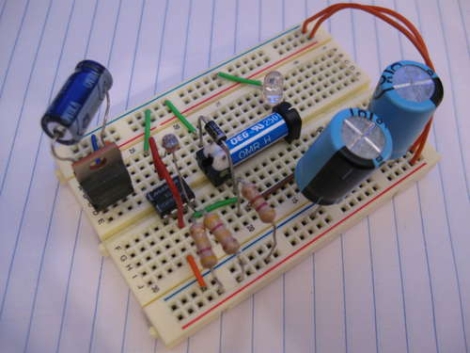
Instructables user [MacDynamo] was thinking about home security systems and wondered how much electricity is being wasted while such systems are powered on, but not activated. He pondered it awhile, then designed a circuit that could be used to turn a security system on or off depending on the time of day, but without using any sort of clock.

His system relies on a 555 timer configured as a Schmitt trigger, with a photoresistor wired to the reset pin. When the ambient light levels drop far enough, the resistance on the reset pin increases, and the 555 timer breaks out of its reset loop. This causes the circuit to power on whatever is connected to it. When the sun rises, the resistance on the reset pin drops and the 555 timer continually resets until it gets dark again. He notes that this behavior can be easily reversed if you were to put the photoresistor on the trigger pin rather than the reset pin.

We like the idea, though we are a bit wary about using this for any sort of real security system. An errant insect or debris could cause the system to be turned on, and we’d feel pretty foolish if someone disabled our alarm with a flashlight. That said, this sort of circuit still has plenty of practical, power-saving applications outside the realm of home security.

NXT Machine Sorts LEGO Blocks Automatically

Smart people don’t put their toys away, they build machines to do it for them. Case and point: this NXT project which can sort LEGO pieces. Just dump a bucket of random blocks in a hopper on one end of the machine. One slice at a time, these plastic pieces will be lifted onto a conveyor system made up of several different belts, which allows for separation of the parts. One block at a time, each piece enters a specially lighted chamber where they are visually identified by the NXT brick. Once it identifies the block, a carousel of plastic containers rotates to place the correct home for the block below the output shoot seen above.

So do we now have a completed LEGO circle of life? Not quite. You can build structures automatically using a 3D LEGO printer and this sorter will have no problem organizing the parts for that purpose. But we still need a LEGO machine that can tear assembled bricks apart.

Continue reading “NXT Machine Sorts LEGO Blocks Automatically”

MIDI Drum Interface Helps You Step Up Your Game

rb_drum_trigger

[Dan] likes Rock Band, but playing it makes him feel as useful as a one-legged man in an ass-kicking a drumming contest. He says that even using his friend’s ION kit leaves him searching out excuses as to why he’s not as good as he should be on the drums.

Eventually, he decided that he would settle things once and for all. The final excuse he came up with was that it is too difficult to press the drum pedal rapidly without getting tired, as the Rock Band gear does not properly simulate real drum equipment. Bass pedals on professional kits are weighted and balanced to allow the drummer to exert the least amount of work for the most return, resulting in a less tiring experience.

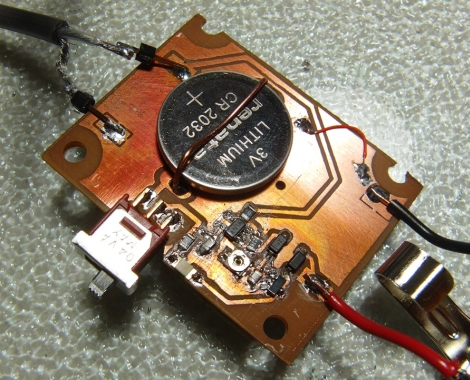
To give him a leg up while playing the game, he decided to rig a trigger to his Yamaha MIDI bass pedal, which is properly weighted. He consulted the Rock Band forums, and after looking at a couple of different circuit diagrams, he designed his own. He etched a PCB, mounted his SMD components, and was well on his way to becoming a drum legend.

He says that the pedal interface works quite well, and despite a couple of tiny soldering setbacks, he has yet to see any errant hits register in-game.

Be sure to check out the video below of his drum trigger undergoing some tests.

Continue reading “MIDI Drum Interface Helps You Step Up Your Game”