Follow-up: Radio-controlled LED Light Show

travelling_light_circus

[Alan] shared an update with us regarding a project he has been working on for some time, radio-controlled LED light strips destined for use by the Travelling Light Circus. If you are not familiar with the project or need a quick refresher, you can read our post about it here.

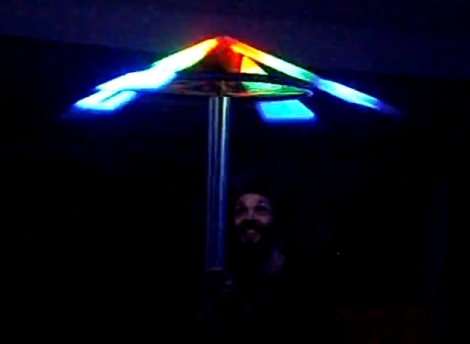
He recently met up with the guys from TLC to finish things up and was happily surprised that they did not want to mount his lights on the performers, as was originally planned. He would have had to make a few modifications if that was the case, but instead, they planned on attaching them to bicycle wheels. The light strips were mounted inside translucent plastic tubes that fan out from the center of the wheels, where the battery and radio equipment is located. The wheels were mounted on aluminum poles, allowing the performers to create a visually stunning show, just by spinning the pole.

Check out the pair of videos we have embedded below, the project came together quite nicely.

Continue reading “Follow-up: Radio-controlled LED Light Show”
Autonomous Cars Already Drive The Roads Among Us

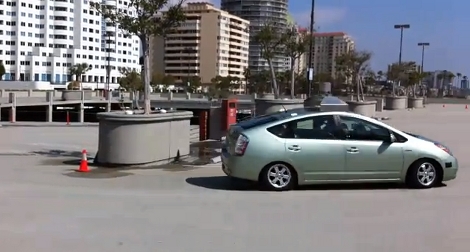
Google’s showing off this autonomous car at the TED convention right now, but the hardware has already made automated trips from San Fransisco to Los Angeles. According to the commentary in the video after the break, the scene above shows the car “hauling Prius ass” on a closed course. The car learned this route while being driven by a person and now the vehicle is set to take riders through an aggressively driven loop in the cone-adorned parking ramp. But on the open road you do not need to teach it anything. It has no problem taking a GPS route and following the rules of the road while traveling from one waypoint to another.

The link above doesn’t include hardware information but they did point to a Times article which includes an infographic. The spinning box on the top of the car is 3D-mapping LIDAR with a 200 foot radius. There’s a rotary encoder on one of the wheels for precise movement data, radar sensors on the front and back bumpers, and a rear-view-mirror-mounted camera for image processing. It makes us wonder how the system performs when the car is coated in road-muck? Maybe you just add a dedicated wiper for each sensor.

Continue reading “Autonomous Cars Already Drive The Roads Among Us”

ICE Uses Wide Set Of Tools To Hunt For Media Pirates

If you’re rebroadcasting copyrighted video streams how will the authorities ever track you down? Well it looks like you don’t even need to be the content originator, and they’ll track you down because you didn’t really cover your tracks in the first place. [Brian McCarthy] found this out the hard way when his domain name was seized by Immigrations and Customs Enforcement earlier this year.

So how did  they find him? They started by getting the records from the domain name registrar. He had used an alias instead of his real name so the next step in the investigation was to get a name from Comcast to go with the IP which had logged into the name registrar’s interface. They matched the Comcast account holder’s home address with the one given during domain registration, then matched the Gmail account registration infor from the registrar to the same person. The final piece of the puzzle was to stake out his house (no kidding) to confirm that [Brian] lived at the address uncovered by investigators.

ICE really went the whole nine yards. Especially if consider that the website they seized provided links to copyrighted media but didn’t actually host any of it. Nonetheless, [Brian] could find himself spending five years in the clink… ouch.

Micro Audio Player Can Hide Behind A Postage Stamp

The original iPod shuffle was a pretty small device, there’s no doubt about that. However, in the world of miniature audio players, [Chan] is no slouch either.

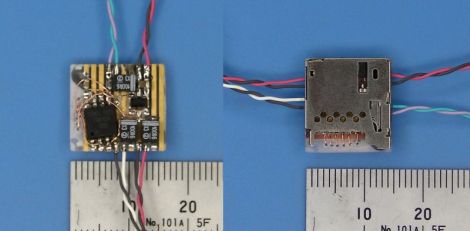
A few years ago, he set out to construct a micro audio player that used little more than a small microcontroller and a microSD memory card. He chose an ATinyX5 series microcontroller to run the show, utilizing its pair of PWM output pins to directly drive the speakers. Since there is no built-in amplifier, the audio volume is not loud, but it does sound reasonable if you use a set of high efficiency desktop speakers. He does mention that the sound can easily be amplified after passing the signal through a filter, so there is hope for those of you who like your music turned up to 11.

The only downside we can see is that the audio player can only process Wave files, but it’s hard to expect more from a DIY audio player smaller than a postage stamp. It would be great to see what sort of micro-handiwork [Chan] could perform if he were to update his design and build a full-functioning MP3 player based upon this project.

Open Source 5-axis CNC Router

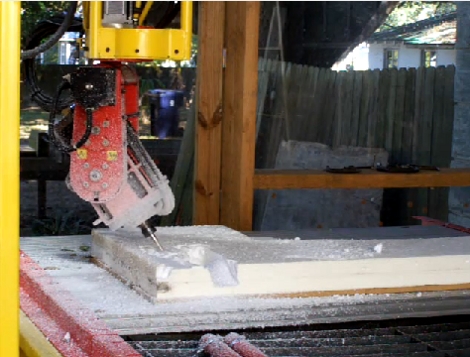
This 5-axis CNC router could soon be an open source tool. [Mike Calvino] built it for the School of Architecture at the University of Arkansas. It can be used as a router or as a plasma cutter/welder. Now he’s trying to raise some money that will underwrite his time and effort to develop and release instructions, design files, and specifications to make it an open source hardware project.

It is extremely large, and in addition to the X, Y, and Z axes that you’d expect to find on CNC machinery, it can tilt and rotate the cutting tool. This is not something you’re likely to build at home. But the availability of plans would be a huge contribution toward making machine tools accessible at a relatively small price tag. It’s not hard to image universities building this as a class project. We also think it would be a perfect group project for you and your buddies over at the local Hackerspace to undertake. Check out some milling action in the clip after the break.

Continue reading “Open Source 5-axis CNC Router”

Audio Two-fer – Sneaker Speakers And DIY Mid-Fi Woofers

speakers

Nike Air Force 1 shoes are probably some of the most well-recognized sneakers around the world, aside from the always timeless Chuck Taylor All Stars. So when [Alex Nash] was asked to create some art using something ordinary with a goal of turning it into something special,  he immediately grabbed a pair and got to work.

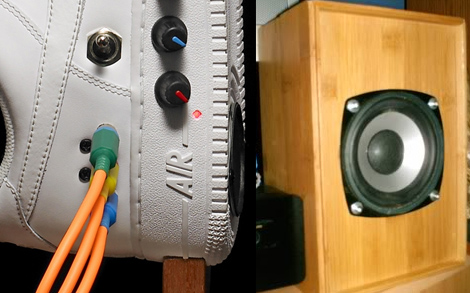
His vision was to build a set of PC speakers by embedding a small amplifier and speakers into a pair of Air Force 1s. As you can see from the pictures on his site, they look awesome. He doesn’t say how good they sound, but we’re betting they perform better than that old pair that came with your last computer.

When [Stacy] was in college, she didn’t have a ton of room or money for a nice audio setup, so she decided to build a pair of speakers rather than buying them. She admits that these “Mid-Fi” woofers won’t be the centerpiece of your Hi-Fi setup, but they still sound pretty darn good for $50 DIY speakers. She compares them to units you would find in the store for $300+, and they sound so good she continues to use them as a compliment to the rest of her Hi-Fi setup now that she has a place of her own.

Recover Acer Aspire One From “failed To Initialize HAL” Error

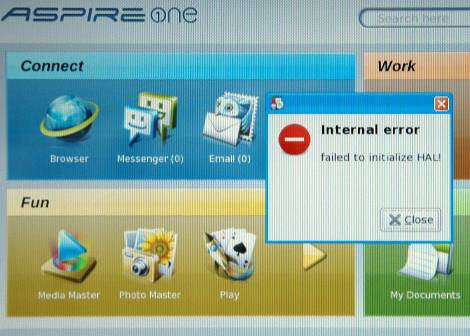
The Acer Aspire One is a netbook that often ships with a Linux OS preinstalled. This is great for fans of open source as market share is calculated based on units shipped, not what users install after they buy the hardware. Unfortunately there is a pretty major flaw that can cause a “failed to initialize HAL” error as seen above. [Michael Crummy] came up with a set of steps you can use to recover from this error.

So what is this error? HAL stands for Hardware Abstraction Layer and it’s what allows one user interface to communicate with many different types of hardware. If you’re the proud owner of an Aspire One and are struck with this error you will suddenly find that you can no longer use the USB ports, card readers, wired or wireless network connectors, or the sound card. So you can’t connect to the Internet, and you can’t get any files on or off of the device using the currently installed operating system. For an OS that [Neal Stephenson] once described as “like the M1 tanks of the U.S. Army, made of space-age materials and jammed with sophisticated technology” this is a very big problem.

We know what you’re thinking… boot into a live session on a thumb drive and get what you need from the hard disk. Well that’s all fine and dandy, but you shouldn’t ever be forced to clean install Linux to fix a problem. So check out [Michael’s] method and make sure you turn off the Acer live update server which was mostly likely the cause of the problem in the first place.