Headphones Use Standard-sized But Proprietary Rechargeable Batteries

Here’s something we haven’t run across before. We’re familiar with proprietary battery shapes (we’re looking at you, digital camera manufacturers), or custom recharge connections (look of death directed toward cellphone manufacturers), but using electrical tricks to force AAA brand loyalty is a new one. It seems that’s exactly what is happening with [OiD’s] wireless headphones which were manufactured by Phillips.

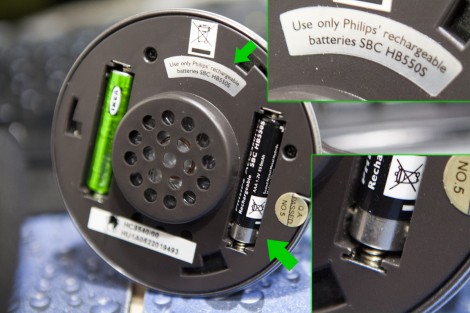
The headphones take AAA sized batteries and can use either disposable or rechargeable varieties. There is a warning label advising that only Phillips brand rechargeables should be used, and sure enough, if you try a different brand the performance suffers both in charging time and in battery life. The original batteries are labelled as Nickel Metal Hydride at 1.2V and 550 mAh, which falls within common specs. But [OiD] noticed that there is an extra conductor in the battery compartment that makes contact with the sides of the battery case. Further inspection reveals that a reverse-biased diode makes contact through this conductor with a portion of the battery which has not been painted. This is not true with other brands, allowing the circuit to distinguish between OEM and replacements.

[OiD] shorted out that connection and immediately saw a performance boost from his replacement batteries. It’s hard to know exactly what’s going on here without a full schematic for the circuit, but we’d love to hear your speculation on this setup in the comments. Is this a low tech version of the identity chips that camera batteries sometimes hide?
Propeller Lamp

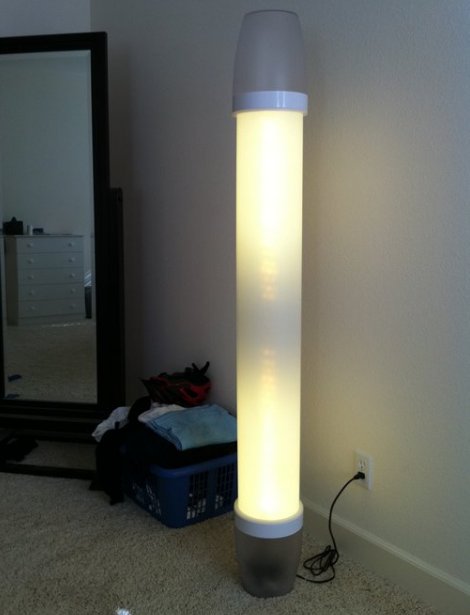
Wanting to replace a power hungry halogen lamp in the living room, [Jason Dorie] went out to design a Remote Controlled, Dimmable Led Lamp (pictures). The body of the lamp is a pretty interesting idea, sporting a couple waste baskets with a translucent HDPE skin as the lampshade and a PVC column for structure.

The column is wrapped in a spiral of 16 foot long led strips , and are wired so they can be controlled in groups. Light output is (estimated) at about the same as a 100-150 watt incandescent while only consuming 24 watts.

The lamp is controlled via a universal remote and features a TLC5940 driven by a Propeller, all sitting on a CNC machined PCB. With that much horsepower under a lamp you can expect that it will not just simply dim in and out, so join us after the break for a video to see how to turn on a lamp with style.

Continue reading “Propeller Lamp”

SNES To PC

The Nintendo Entertainment System is by far the most popular 8 bit post crash video game system. Therefore, the NES gets all sorts of mods and hacks done with it, but there is not a whole bunch of noise for its bigger badder 16 bit brother the Super Nintendo. Have no fear though [Vigo the Carpathian] (I did not know it was the season of evil!) helps to correct that in his first Instructable, turning a SNES into an all in one classic video game player.

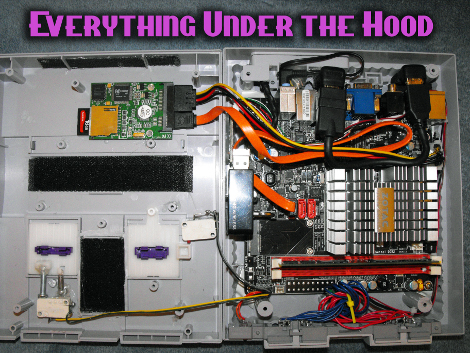
Using the shell of a Super Nintendo the bottom half includes ZOTAC IONITX-C-U mini ITX motherboard, and a dual SNES controller port to USB that fits in the original openings to use the real deal controllers. A USB port is also mounted for some wireless dual shock action.

On the top half, the eject button, and cartridge slot flaps have been removed and speaker grill cloth was added to provide venting. Near the back of the unit, SD-card to SATA adapter provides storage, which we think is a good idea for cheap SSD storage. Micro switches are also rigged up so that the original power and reset buttons control the same computer functions.

Clean looks, small form factor, join us after the break for a quick video.

Continue reading “SNES To PC”

Robotic Bird Flaps Away Last Bits Of Privacy

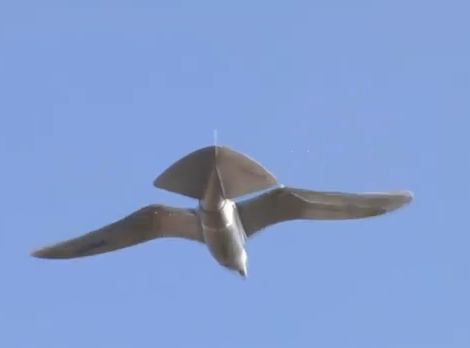
This really gives a lifelike look to the eye in the sky. In case you were worried that every part of your life wasn’t being recorded by a surveillance camera, the Festo Bionic Learning Network has come up with a drone that will be hard to discern from the wildlife.

Watch the video after the break. We’re not 100% certain that it’s not fake, but it looks real enough (the mark of a truly amazing design). You’ll see the robo-bird flapping away both from a fixed point on the ground, and from a camera view behind the head of the device. It propels itself both by flapping and rotating the wings and is capable of taking off, flying, and landing autonomously.

It’s bigger than the hummingbird drone that was developed for DARPA, but we think that it sticks out less when caught at a glance. No word on the intended use for the device, but we’re sure that some of you are enjoying the nostalgia of the mechanical owl from Clash of the Titans, and that’s why we want one.

Continue reading “Robotic Bird Flaps Away Last Bits Of Privacy”

Wireless Luge Timer Levels The Playing Field

wireless_luge_timer

In Colorado, amateur luge competitions are serious business.

Every winter, [Ryan’s] friends dig a long luge track through the many feet of snow that occupies their yard, and have competitive sled races to see who can make it down the giant hill in the least time. They call it the Mario Cup, after one of the participants, not the Nintendo mascot, and they were in desperate need of some timing equipment.

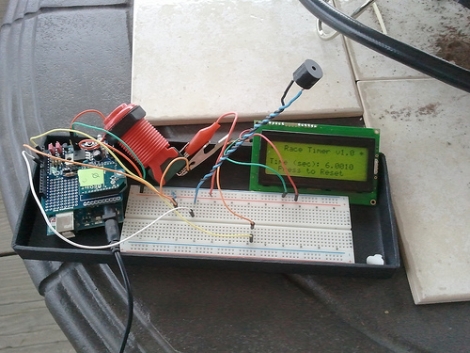
You see, the luge track is several hundred feet long, and they decided that a human armed with a stopwatch is not a good enough means of picking a conclusive winner. A set of three Arduino sensors packed inside plastic food containers were used along with light sensors to track when the luger passed the start, midpoint, and finish lines of the race. XBee radios then transmitted the timing data back to the base station for recording.

The system worked quite well according to the participants, and they look forward to using the system again in the future. Of course, improvements have been planned, including dual timers at each checkpoint to gauge the luger’s speed, as well as a Christmas-tree starting signal like you see at drag races.

Continue reading to see a video below of the luger’s in action, as well as the timer system undergoing some tests.

[via Make]

Continue reading “Wireless Luge Timer Levels The Playing Field”

Propeller-Android Communications Using Debug Mode

Here’s a new way to connect an Android phone and a Propeller microcontroller. It’s called the PropBridge and uses a very simple circuit with a voltage regulator, a couple of transistors, and a few resistors. The trick to this method lies in creative use of software features that already exist on Android hardware, the Android Debug Bridge (ADB). The ADB was added with development in mind, but since it provides low-level control of certain parts of these devices it was just waiting to be incorporated into a hack.

The Propeller itself uses firmware to make Android think it is one of two different externally connected hardware devices. It can act like a PC running the ADB client or it can mimic a TCP connection. There’s still plenty of room on the uC to add your own firmware, and the majority of the I/O pins are unneeded for the basic connection. Check out the video after the break for a quick overview of the system.

If you need a little help with Android programming before you’re able to use this in your own projects, check out our Android development series.

Continue reading “Propeller-Android Communications Using Debug Mode”

CFL Breakdown

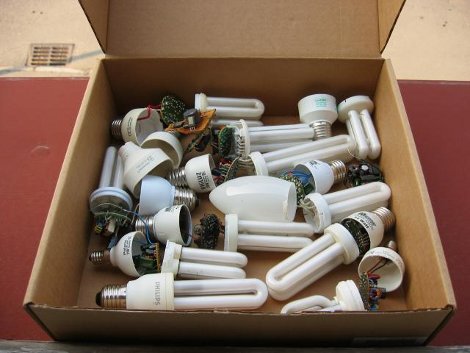
Reader [Jay] was inspired by one of our earlier articles and started digging around the web for some more information, and found a handy web page with tear downs and schematics of popular compact florescent lamps.

Schematics are provided to 15 fairly common models including bigluz, isotronic, luxtek, maway, maxilux, polaris, brownie, Phillips, Ikea, Osram, and eurolight. Also, just in case you were ever interested in these little packages but did not want to open them due to sharp glass, mercury vapor, or phosphorus powders, photos are provided as well.

So if you need a few hundred extra volts to pack a little spark in your next project, need a 63rd way to cook your goose you should check this page out.