Internships: Have Fun While Working Toward A Career

Attention Students: Living your life with a devil-may-care attitude will soon come to an end… But while you’re at it, take the summer away from your normal school’s-out activities to hack together something cool while tricking family into thinking it’s good for the career.

That link will take you to Waterloo Labs’ announcement that they’re hiring four paid interns this summer. You’ll need a bucketful of hacking skills from mechanical, to electrical, to coding (or any combination thereof). If the name doesn’t strike a bell be warned; these guys and gals do things like riding the roof of remote-control cars, and playing video games with real armaments.

Is your company offering similarly radical internships? We’d love to connect some hardcore hackers with good summer homes. Send a tweet a to Mike (@szczys) so that we can post an internships follow-up with more opportunities.

[via Twitter]
See-through LED Display

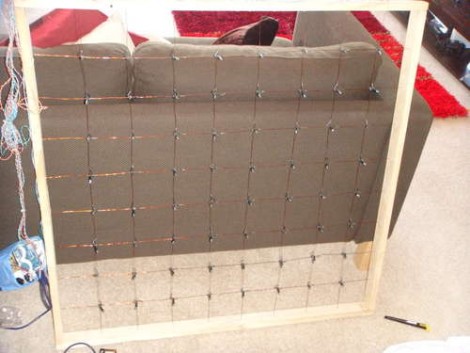
[Ndsit] is having a party and wanted to liven up the place with some blinky lights. He’s a bit new when it comes to hobby electronics, and although we’d highly recommend inviting some resistors to participate, the LED matrix that he built is very nice. It’s 8×8, it’s big, and (as shown in the clip after the break) the lights seem to hover in midair. That’s because he didn’t use a substrate to make the display. A grid of enameled wire is strung between the four sides of the wooden frame. LEDs were gathered from a string of Christmas lights which means they’re in a holder and have insulated wires already connected. Each one was tied on at a junction point of the grid, then connected to a portion of the wire where enamel had been scraped off.

It works but there’s already one light that is out. We hope some current protection is added so that this can be used again and again.

Continue reading “See-through LED Display”

Location Recorder And Mapper

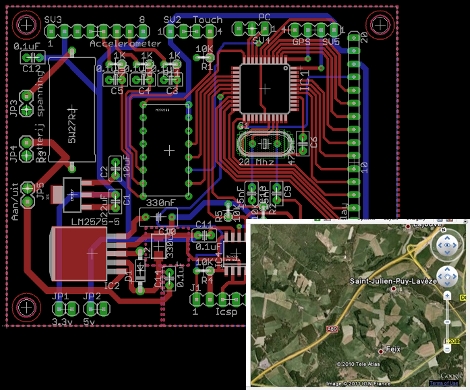
[Jeroen’s] student project is a module that uses GPS tracking to create travel data on Google maps. It’s not really a spy device as the data isn’t transmitted, but would be a lot of fun to use on cycling and hiking adventures. A PIC 18F2550 reads location and altitude data from a GPS receiver as well as data from an accelerometer. This information can be displayed on an attached touchscreen display and it is also saved to a pair of EEPROMs. When you get back from your trip, the data pulled from the device via a serial connection is processed by [Jeroen’s] C# application and used to overlay the route on a google map. He’s got a source code package available for download but we’ve saved you the trouble if the schematic is all you’re after. It’s attached after the break.

Continue reading “Location Recorder And Mapper”

Simple Touch Sensor And Other Lessons

[HankDavis] sent along this link to a video showing a tutorial on how to make touch sensors using a “darlington pair”. In the video we are taken through the idea and how we’re going to construct it.  [Thad]explains in detail how this works in simple terms and illustrates it clearly. Unfortunately they don’t show an actual constructed system, but this is so simple you could toss it together quickly and see for yourself. This is a great lesson on how to get a simple touch sensor into your projects. This video appears to be one of a series of class visuals, and you can find several others on youtube under this account.

Continue reading “Simple Touch Sensor And Other Lessons”

STK200 Pocket Change Programmer

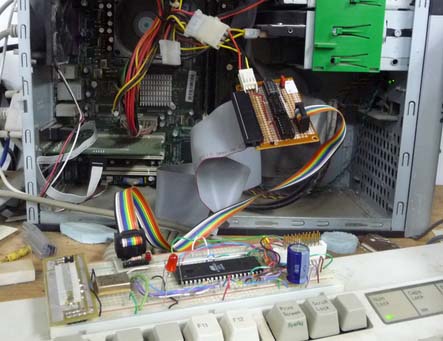
A common complaints of beginners to microcontroller programming is the availability of DIY tools that do not require a parallel port.  Using not much more than a couple of 74xx series chips and some protoboard, [Rue] was able to create an AVR programmer for less than the cost of some chips it can program – giving parallel programmers a run for thier money. [Rue] used Linux treat the ubiquitous PATA/IDE port as a parallel port. By having avrdude treat the programmer as an Atmel STK200, [Rue] was able to upload a blinky program to his AVR microcontroller through ISP. If anybody can think of an even lower cost unconventional solution give us a shout.

Robo Rainbow Graffiti Machine

[mudlevel] built this rainbow graffiti producing robot for an art exhibit in San Diego. While there are no build details we can easily pick this apart from the pictures. Looks like the brains are an arduino, the drive is a power drill with the trigger removed, and a few other servos for firing the spray cans.  The counter weighted arm for creating the rainbow was a pretty good idea too. Watching this, we had an idea for a super simple purely mechanical way to do this that would be similar to a catapult.  You could use the motion of the trailer to “wind up” the counter balance with a simple ratcheting spool of string attached to the axle. Engage your spray cans and let the balance drop and you’re done.  Pedal on to re-wind the counterbalance for another rainbow.

Have A Face For Radio?

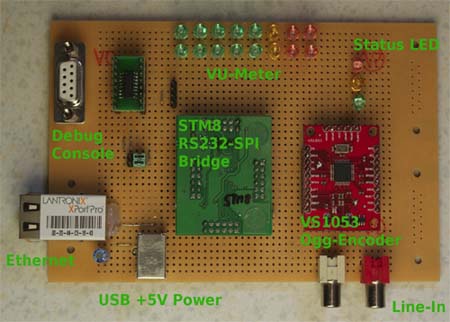
The help of fellow members of the Austrian technology collective/hackerspace [Otelo] allowed [Georg] to develop a networked audio streaming board, with less than $20 worth of components. Dubbed the OggStreamer for obvious reason, it’s designed to relay audio from a mixing board to an Icecast server (an open source implementation of SHOUTcast) in real-time. The board is based on the STM8 Discovery kit and the Xport Pro. It features stereo input, an onboard OGG Vorbis encoder, and (to top it off) is running uClinux. We think it’s very well thought out – but don’t take our word for it… the OggStreamer won second place last year in the Lantronix XPort Pro Design Contest, and [Georg] has documented it extensively (pdf).