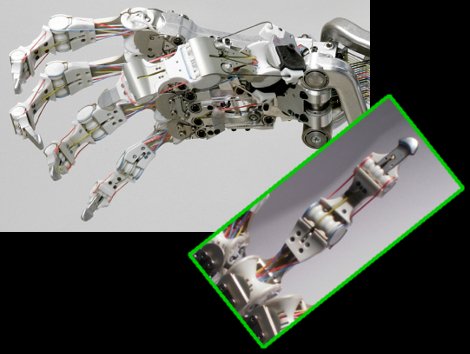
Robot Hand Has No Problem Giving You The Finger

Get your Terminator clichés ready, this robot hand reeks of Skynet. It is designed to function like the human hand, but the main goal is one of robustness. A lot of effort went into making sure this won’t break in the field. Instead of rigid gears, a system of tendons actuates each digit. The pulleys that control these are located in the forearm and each has a spring mechanism that helps to cushion shocks to the apparatus which might damage other grippers. It has bone-crushing power behind the 19 degrees of movement and, as you’ve already guessed, this comes at a pretty steep price tag; topping out around 100,000 Euros. It’s more complicated, and more expensive that jamming grippers, but it’s also far scarier. See for yourself in the silent movie after the break.

Continue reading “Robot Hand Has No Problem Giving You The Finger”
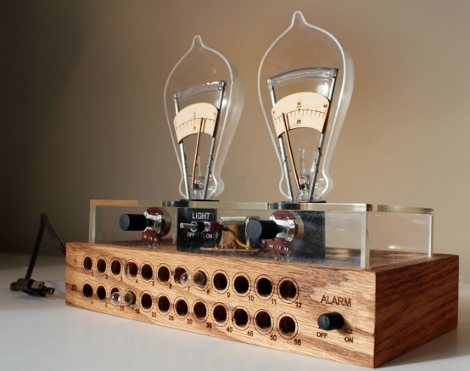
Edison Clock Uses Ammeter Plus Bulbs To Set Alarm

This is the Edison clock, designed by [David Krawczyk]. It shows time in the same way as the multimeter clock, regulating power to two analog needle meters. The feature that makes this one a bit different is the alarm. You can see the series of holes on the front of the base. These have a small light bulb socked in each, and correspond to hours and 5-minute increments. Insert two bulbs to set the alarm time, and make sure that the alarm knob points to ‘on’. As you can see above, the alarm has been set to 8:15. Hidden on the last image of the article above is a PDF with just a bit more explanation. Still, much has been left out so if you replicate this clock we want to hear about it.

[via Gizmodo and Walyou]

Reverse Engineering Radio Controlled Outlets

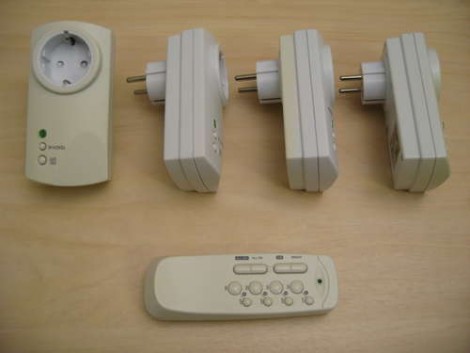
[Chr] picked up a pack of remote control outlets in order to reverse engineer them and build control into his own projects. These can be plugged into outlets around your house and a relay inside each module will switch whatever device is plugged into it after receiving a command from the remote. Once he cracked open the control housing it was easy to find the data line for the RF module which was on its own board. He used a logic analyzer to capture data from various button presses and then spent some time deciphering the communication protocol. He used what he learned to roll the module and code into an interface box where an ATmega8 connects via USB and passes commands from a computer to the RF board. Now he’s added home automation via a computer quite inexpensively. After the break you can watch a clip of the outlets switched using a smartphone.

So why not just patch into the buttons on the remote? Well, this same project was attempted at our local hackerspace earlier this month and the buttons don’t just pull a pin to ground. They use tri-state logic and are arranged into a matrix that is a lot harder to mimic (if not impossible) with a microcontroller. Analyzing the communications going into the RF module is definitely the less labor-intensive of the two approaches.

Continue reading “Reverse Engineering Radio Controlled Outlets”

12 Foot LED Display Keeps Your Office Informed

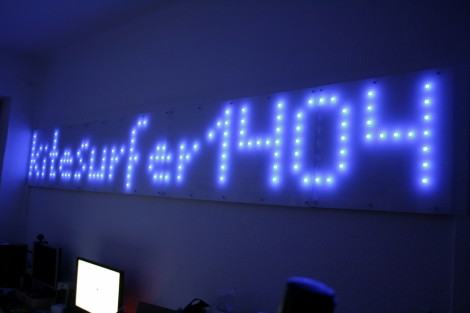
Don’t reach for a sticky note when you need to leave a message for your office mates, write it down on a 12 foot LED marquee. [Kitesurfer1404] built this for his home office, but we’re sure he’ll find fun stuff to use it for. The display has 512 LEDs driven by plain old 595 shift registers for the high-side columns, with an ULN2803A Darlington Array to pull the eight rows to ground. The whole thing is controlled by an ATmega8 via a serial connection. Our compliments to the builder for accurately drilling a grid of 64×8 holes in each hardboard panel of the display. The buses for each row and column also look nice and clean. For the final look a 79% light transmittance frosted acrylic panel was added to diffuse the light.

We used the same method to build our LED pumpkin. Transistors ran the low side, and if we had needed more columns, shift registers are a popular go-to for I/O expansion. Check out that project to learn more about display multiplexing.

ROS Gains Full Body Telemetry

[Taylor Veldrop] has been playing with an NAO robot and ROS, mixed with a Kinect to get some pretty amazing results. The last time we saw any work done with ROS and the Kinect, it was allowing some basic telemetry using the PR2. [Tyler] has taken this a step further allowing for full body control of the NAO robot. Basic mimicking mixed with a little bit of autonomy allow the NAO to follow his steps around a room and even slice a bananna, or hammer nails. We think this is pretty impressive, especially if he were to mix it together with a motion tracking stereoscopic display. Follow along after the break to see it pull off some of these cool feats.

Continue reading “ROS Gains Full Body Telemetry”

Abusing HTTP Status Codes

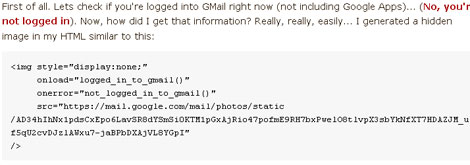
Concerns over privacy online are an ever growing theme. Every day we see people complaining about the policies of facebook and the like. [Mike Cardwell] points out another method of gleaning a bit of personal data from you that you may not have seen yet. By embedding a hidden image or using some really simple javascript, he can tell if you are currently logged into Gmail, Twitter, Facebook, or Digg. While this could possibly be used for more nefarious things, he points out that you could also use it for customizing your website to better suit the experience of the browser. For example, if the “reader” is already logged into Gmail, you could have any email links automatically open a gmail instance instead of the local mail client.

Wireless Sniffing And Jamming Of Chronos And Iclicker

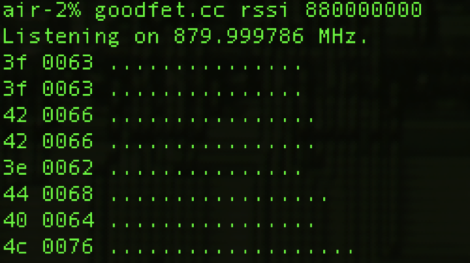
The ubiquitous presence of wireless devices combined with easy access to powerful RF development platforms makes the everyday world around us a wireless hacker’s playground. Yesterday [Travis Goodspeed] posted an article showing how goodfet.cc can be used to sniff wireless traffic and also to jam a given frequency. We’ve previously covered the work of [Travis] in pulling raw data from the IM-ME spectrum analyzer, which also uses goodfet.cc.

The Texas Instruments Chronos watch dev platform contains a C1110 chip, which among other things can provide accelerometer data from the watch to an interested sniffer. The i>clicker classroom response device (which houses a XE1203F chip) is also wide open to this, yielding juicy info about your classmates’ voting behaviour. There is still some work to be done to improve goodfet.cc, and [Travis] pays in beer–not in advance, mind you.

With products like the Chronos representing a move towards personal-area wireless networks, this sort of security hole might eventually have implications to individual privacy of, for example, biometric data–although how that might be exploited is another topic. Related to this idea is that of sniffable RFID card data. How does the increasing adoption of short-range wireless technologies affects us, both for good and bad? We invite you to share your ideas in the comments.