Variable Super Capacitor Battery Provides Power On The Go

super_cap_battery

Instructable user [EngineeringShock] got sick of buying batteries for his devices all the time and has instead opted to build himself a super capacitor bank that can be used to power common household items.

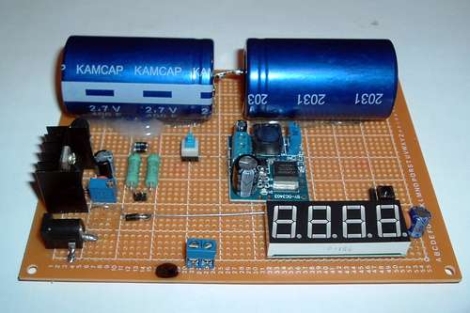
His “forever” rechargeable capacitor bank is made of two large super capacitors rated at 400 farads apiece. It is charged through a LM317-based charging circuit that is adjustable to allow for slow or fast charging, the latter of which he admits, is slightly dangerous.

Since the super caps are only rated at 2.7 volts, they are wired through a DC-DC booster circuit that allows him to adjust the output voltage from 4.3 v to 34 v. The adjusted voltage is then passed through a digital display that allows him to see what the output voltage is at any time.

He says that the super cap bank can power his computer’s speakers for about two hours before requiring a recharge, which takes just a few short minutes, depending on how he is charging them.

While it’s not exactly cheap, the capacitor bank could be useful for those requiring quick portable power for relatively short periods of time. If we were to build one ourselves, we would likely fit all of the components into a small project box to protect the caps from accidental discharging, and top it off with a couple of solar cells to charge it for free during the day.

Keep reading to see a quick video demonstration of his super cap “battery” in action.

Continue reading “Variable Super Capacitor Battery Provides Power On The Go” →

HsNet: Node Communications For Feature-limited Microcontrollers

[Diego Spinola] wrote in to tell us about a node communication system he’s been working on called HsNet. The aim is to build a system of nodes that can be made up of small and inexpensive microcontrollers. The problem is that the least expensive controllers often don’t have a hardware UART. HsNet implements the RS485 protocol using a software UART along with a slim and sleek addressing scheme.

The first module developed, seen in the image above and video after the break, is a single channel pulse-width-modulation node using a PIC 12F683. It can be sent commands in the payload of the HsNet packet format. The PWM modules accept three different commands; one is a desired PWM value, another is a delay between steps for the PWM, and the last toggles a blink function.

He has also developed an analog sensor module and an Arduino-based TCP/IC gateway module. Now that the packet communications have been established, it will be rather simple to add nodes based on that groundwork. [Diego] brought these components together to build an interactive wall which can also be seen after the break.

Continue reading “HsNet: Node Communications For Feature-limited Microcontrollers” →

3-phase Jacob’s Ladder

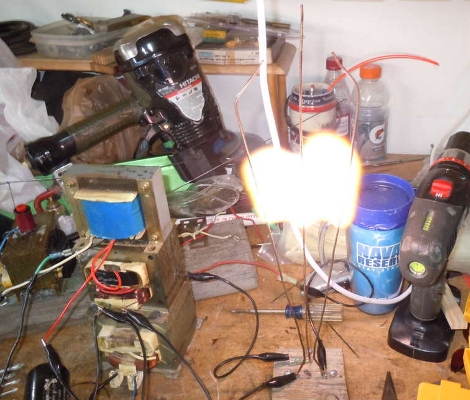
Two sparks are better than one, a sentiment that was never more blindingly illustrated than with this three-conductor Jacob’s Ladder. The build centers around three-phase power, which uses a trio of alternating current sources sharing the same frequency, but offset by 1/3 from one another. If we’re reading the schematic correctly, [Jimmy Proton] is using normal mains as a power source, then connecting three transformers and a capacitor to set up the different phases. Two of the transformers, which were pulled from microwave ovens, are wired in antiparallel, with their cores connected to each other. The third transform is connected in series on one leg of the circuit.

The video after the break starts with the satisfying hum of power, only to be outdone by the wild sparks that traverse the air gap between conductors of the ladder. After seeing the first demonstration we kind of expected something to start on fire but it looks like all is well. We’ll probably stick to a less complicated version of Jacob’s Ladder.

Continue reading “3-phase Jacob’s Ladder” →

Tactical Wifi Cantenna Needs Picatinny Rails

[Wes] built a cool looking Tactical Wifi Cantenna with some parts from a broken airsoft pistol. The antenna is a cookie can type with an added cone to increase performance, as seen in this tutorial. Once the antenna was built it was time to add some kind of handle, [Wes] just so happened to have such a thing on hand. After epoxy puddying the pistol’s grip to his cookie cantenna he observed that the magazine lock was still functioning. Quick thinking and the application of a  hammer in nut allows the whole rig to quickly attach to the tripod. The antenna also sports a plastic lid and textured paint finish for that ultimate tactical look and feel. A USB Alpha AWUSO36H Wifi dongle even mounts on the back of the rig. We wouldn’t go around outside pointing this at stuff attaching and detaching the tripod but the finish looks great, nicely done!

Check out some other various types of cantennas, even a rifle version if you crave more wifi goodness.

Full-featured Battery Tester Puts Them Through Their Paces

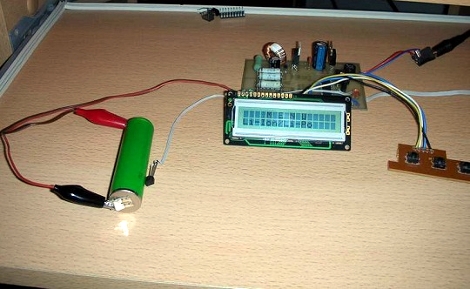
When working on battery-dependent projects you want accurate performance information where a datasheet may not be available. [E. Lelic] set out to build a device that would meter internal battery resistance but ended up with a bench tool that can do much more than that.

A PIC 16F88 microcontroller takes center stage on the meter, taking voltage level readings, monitoring a DS1820 temperature sensor, and controlling an LM2575 step-down regulator. The components provide functionality for measuring Lithium Ion, Lithium Polymer, Nickel Cadmium, Nickel Metal Hydride, and Alkaline batteries. It is capable of fully discharging and fully charging the batteries, measuring time and power consumption during this cycle, and monitoring temperature changes for the NiMH and NiCad versions.

Look for the little red ‘Download’ icon at the bottom of the post linked above. That archive includes a schematic (which we’ve also embedded after the break), board layout in .LAY format, and a HEX firmware file.

If you enjoyed this build you might want to look at this other battery capacity tester.

Continue reading “Full-featured Battery Tester Puts Them Through Their Paces” →

Quick & Dirty USB Phone Charger

usb_phone_charger

Hackaday forum member [Dan Fruzzetti] wrote in to share a simple, yet useful hack he built just the other day. He and his wife both have Evo 4G smartphones and they were pretty disappointed in the lack of portable charging solutions available.

Instead of buying something and modifying it to his needs, [Dan] decided to build a quick and dirty charger instead. His ghetto-mintyboost was built into a cheap project box he found at Radio Shack, which is stocked with a set of four D-cell batteries. The batteries were wired in series and connected to a pair of salvaged USB ports mounted on a small piece of protoboard.

Knowing that most portable devices get 5.7v from their chargers already, he was not worried about hooking his phones straight into the 6v battery pack he built. He says that the phones actually charge pretty quickly, and that he estimates he should be able to get about 50 charges out of the box before he needs to swap the batteries.

This is not a complex hack by any means. It is quick & dirty, solves an annoying problem, and it’s dead simple to build. That’s exactly why we like it.

Reversible Relay-based Motor Controller

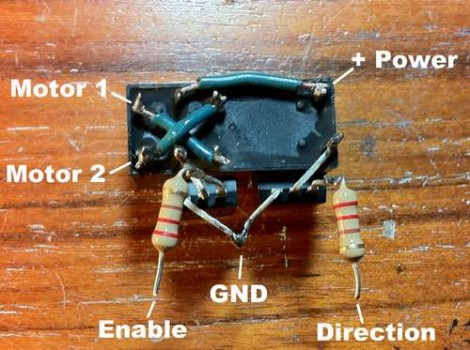
[Nothinglabs] built this motor controller as an alternative to using an H-bridge. They call it the RAT controller which stands for “Relay and Transistors”. You can see above that two Darlington transistors along with their base transistors allow logic signals to switch the relay on and off, driving the motor in one direction or the other based on the open or closed state of the relay. See it working in the video after the break.

It’s a nice little workaround with few parts, but because the relay is mechanical there will be a short lifespan when compared to solid-state motor controllers. That’s okay, because the motivation here was lack of parts on hand, rather than an increase in performance. It’s also worth mentioning that all of these parts can be purchased at your local Radio Shack when you don’t want to wait for component orders by mail. We certainly appreciate that it takes far few components than [David Cook’s] H-bridges. His designs are our favorite – we’ve used them in our own projects – but for quick and dirty you can’t beat five components and the short assembly time needed when using this type of dead-bug style soldering.

Continue reading “Reversible Relay-based Motor Controller” →