Win A Harley In This Design Contest

EBVElectronik of Germany is hosting a design contest based around the STM32F microcontroller. They are inviting engineers and inventors to come up with the best general purpose design ideas, with prizes including a Harley Davidson Motorcycle and a 1000 euro Apple voucher. Even better, they are offering a free STM32 Discovery Kit to anyone who enters, just to get them started. Sound too good to be true? Well, there is one catch. As of right now, entrants are limited to:

Any individual or group of individuals, age 18 and over as of the date of entry and located in EMEA (Europe and Middle East and Africa)

Sorry USA. We have to save some love for the international crowd. Do us a favor and let us know what you are planning to build, or if you win any of the prizes!

DIY Coffee Gripper

Here at Hackaday, we love it when people make home brew versions of elaborate, expensive, and technical equipment. By gathering up some coffee grounds, a balloon, some plastic tubing, and his lungs, [Carlos] has provided a good how-to on making your own coffee grounds robotic hand. Inspired by the U. Chicago, Cornell, and iRobot Collaboration we previously covered, he is one robot and a vacuum pump away from having their setup. Check out his blog for a list of components as well as a couple hints to help the build go smoothly. Be sure to check out the video after the break.

[via Make]

Continue reading “DIY Coffee Gripper”

Test Beds And Jigs With Pogo Pins

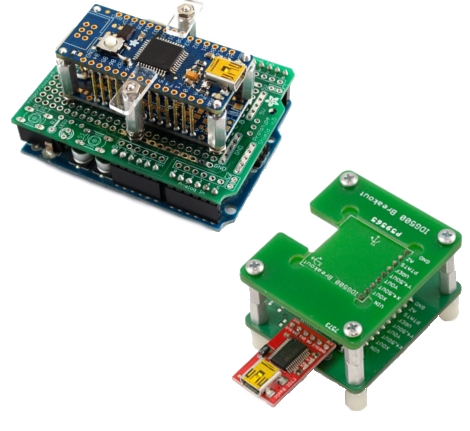
Pogo pins – spring-loaded pin contacts are pretty fun to play with and even cooler when they get used in electronic devices like Adafruit and SparkFun’s test jigs. Check after the break for how these two companies have created their own production hacks. Continue reading “Test Beds And Jigs With Pogo Pins”

RC Bristlebot Shifts Weight For Steering

This large bristlebot has no prolem steering itself by shifting its weight. It’s easy enough to watch the video after the break and see how this works. But there’s still the same air of “I can’t believe that actually works” which we experienced with the original bristlebot.

This is not the first attempt to calm a bristlebots movements, but we don’t remember seeing one you could drive around like an RC car. [Glajten] up-sized the bot with what appears to be a small shop broom cut in half, creating a catamaran design. The vibrating motor, which might have come out of a gaming controller, rides on the back of the bot, centered between the two bristle platforms. On the front a servo motor holds the shaft of a long bolt which has extra weight at the end of it. Steering happens when the weight is offset by a turn of the servo.

Continue reading “RC Bristlebot Shifts Weight For Steering”

Patching Into Android Music Control

Here’s a look at the TRRS cable that Android phones use. [Rich Kappmeier] want to control the music player on his Nexus One while driving. It’s not necessarily a safe endeavor if you’re staring at the screen and poking away with one hand while trying to stay in your lane. A little bit of research helped him figure out how the hardware in a headphone controller worked and he decided to incorporate that into a connector cable for the car.

The control signals rely on a specific resistance between the TRRS function ring and ground. Once he worked out the chart above and targeted the correct resistance values he built a rocker switch for Fast Forward and Reverse, as well as a Play/Pause button into the connector cable. You should be able to use this for more than just music control. Take a look at our Android Development tutorial and see what else you can come up with.

[Thanks Alastair]

RGB Stroboscopic Guitar Tuning

This is [Michael Ossmann’s] RGB LED stroboscopic guitar tuner. If his name is familiar that’s because we mentioned he’d be giving a talk with [Travis Goodspeed] at ToorCon. But he went to DefCon as well and spent the weekend in his hotel room trying to win the badge hacking contest.

Despite adversity he did get his tuner working. It’s built into a toy guitar that he takes on road trips with him. By adding a row of RGB LEDs between two of the frets he can use the vibration frequency of an in-tune string to flash the three different colors. If the string is not in tune the three colors will dance around but matching it with the LED frequency produces a stable color. He then uses that big yellow button to advance to the next string. See his demonstration after the break.

This is basically a built-in plectrum tuner that uses one LED package instead of two.

Continue reading “RGB Stroboscopic Guitar Tuning”

Normal Connectors For Apple Studio Display

[Sherry Wu] sent in a link to her Apple Studio Display hack. She got her hands on the 17″ display which has a proprietary Apple Display Connector that rolls signals for DVI, USB, and 25V power into one plug. Convenient right? Not if you want to use it on a machine that has standard video connections. No problem, she got out her meter and figured out which wires belong to each signal. After some soldering she now has a DVI connector for the video, and a 24V bench supply is standing in for power until a dedicated unit arrives. No luck so far at getting the USB and hotplug detection to work but she plans to keep going until that’s accomplished.

Looks like you can pick these displays up refurbished for as low as $75. Might not be a bad addition to your home setup if you’re willing to do some soldering.