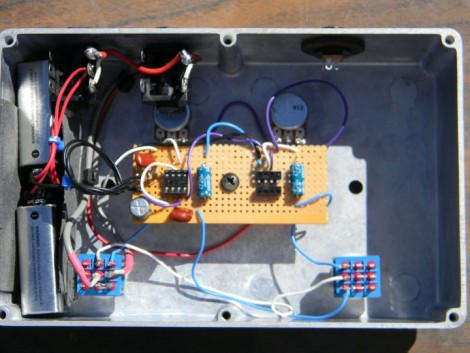
Building A Germanium Fuzz Face Guitar Pedal

Rock in the new year with a guitar pedal you built yourself. [Doug Kovach] took the time to share his project with us in the video after the break. He starts with a bit of history of the artists that have used fuzz pedals similar to this one. It seems great guitarists have been hacking since way back. [Doug’s] rendition uses the warm sounds of germanium transistors in a design that produces professional results. But if you need something a little bit less serious try the stomp-box.

Continue reading “Building A Germanium Fuzz Face Guitar Pedal” →

Tardis Tree Topper

If your holiday tradition means waiting until Christmas to decorate the tree, it’s not too late. Build yourself Dr. Who’s Tardis as a tree topper. [Hybrid Blue] just finished the project, with includes illumination which you can see in the video after the break. The structure is made from balsa wood, painted, then filled with Arduino driven RGB LEDs. It’s sure to please the time lord in your family.

Continue reading “Tardis Tree Topper” →

Hackaday Links: December 26, 2010

Obligatory tech tree

It’s hard to let a Christmas go by without looking in on a geeky Christmas tree project. Luckily, [Peter Davenport] decided to share his Arduino and LCD shield tree.

Blinking USB dude

If you’ve got a 555 timer and some commonly salvageable components give this blinking LED man a try. The version above is USB powered but that’s just to take advantage of the 5V regulated power.

Propeller business card

[Jay’s] business card is packing quite a punch with this Propeller microcontroller. We love seeing electronics design in cards (however unrealistic the price and portability may be), and this is a big processing upgrade compared to the Tiny85 based offering.

Flying high in NYC


We leave you with a spectacular view of New York City. This breathtaking footage is just as fascinating as the first videos we saw from these folks.

Upgrading An Old Polaroid Land Camera For 35mm Rolls

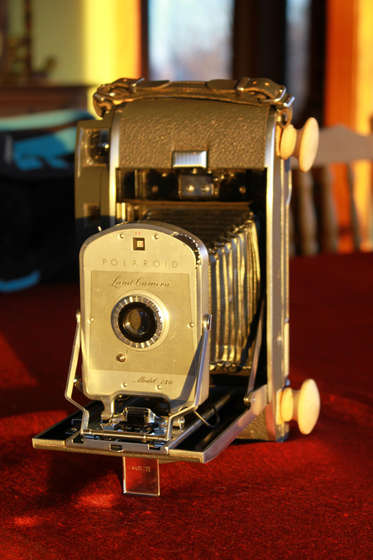
Ok, we recognize that this is a bit of an odd upgrade, since many would probably think that a digital upgrade would be more appropriate. However, we found this interesting anyway. [Marker1024] has taken this old Polaroid land camera and modified it to accept a standard 35mm roll. His list of materials may sound fairly MacGyver-ish with foil and sculpey, but his results look to be well done and fairly sturdy. We have to say that the aesthetics of the camera itself are quite appealing and we could see carrying one of these around. As interesting as the writeup is though, we can’t help but wonder what the pictures look like that came out of it!

Versaloon Can Program Hardware From Several Manufacturers

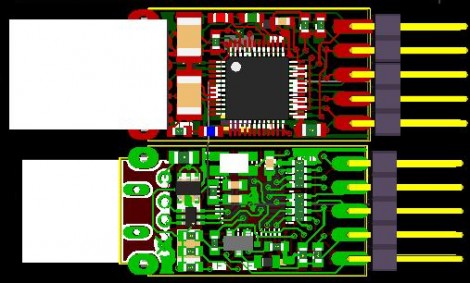
Versaloon is an open source, USB connected project, that centers around an STM32 processor and provides a standard JTAG pinout. Above you see the Nano version which has a 10-pin JTAG connector, but there is also a 20-pin option on the Handy model. Great, another JTAG programmer. Well this can do a bit more than that. With a bit of help from the software it has been turned into a programmer for ten different types of hardware. Obviously this should be able to program anything that works with the JTAG protocol, but the script adapts it to work as an In System (or In Circuit) Programmer too. So far the list of programming targets includes STM32, LPC1000, LPC900, STM8, AR8, MSP430, and a few others.

We had some trouble finding an actual picture of this hardware. If you’ve got one, snap a picture and leave a link to it in the comments along with your thoughts on the device.

[Thanks Geekabit]

A Hacker’s Marginal Security Helps Return Stolen Computer

Gather round and hear the story of how a hacker outsmarts a criminal. [Zoz] was robbed and they got his desktop computer. Gone, right? Nope. Because of a peculiar combination of his computer’s configuration, and the stupidity of the criminal, he got it back. He shares the tale during his Defcon 18 talk (PDF), the video is embedded after the break.

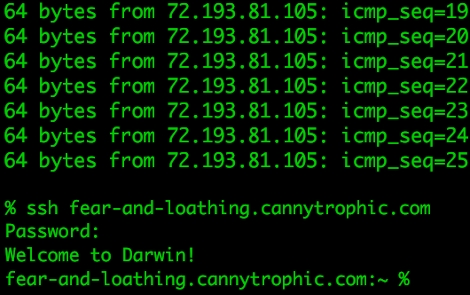
[Zoz’s] first bit of luck came because he had set up the machine to use a dynamic DNS service, updated via a script. Since the criminal didn’t wipe the hard drive he was able to find the machine online. From there he discovered that he could SSH into it, and even use VNC to eavesdrop on the new owner. This, along with a keylogger he installed, got him all the information he needed; the guy’s name, birth date, login and password information for websites, and most importantly his street address. He passed along this juicy data to police and they managed to recover the system.

Continue reading “A Hacker’s Marginal Security Helps Return Stolen Computer” →

Crash Course In HTML Manipulation From A Shell Script

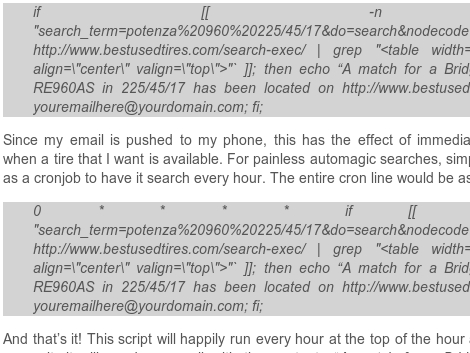
Automating something involving data from the Internet can be confusing when it comes to pages generated by user input. For instance, let’s say you want to scrape data from a page that loads after using a search box. [Andrew Peng] posted a quick and dirty example to help you write your own scripts. The example he used checks stock on one of the websites he frequents. His process outlines finding the link that all searches are submitted to, establishing the method used to send the search string, and grabbing the resulting data. He parses it and sends off an email if it finds what he’s looking for. But this could be used for a lot of things, and it shouldn’t be a problem to make it alert you in any way you can imagine. Maybe we’ll use this to add some functionality to our rat.