Making Nixie Tubes At Home

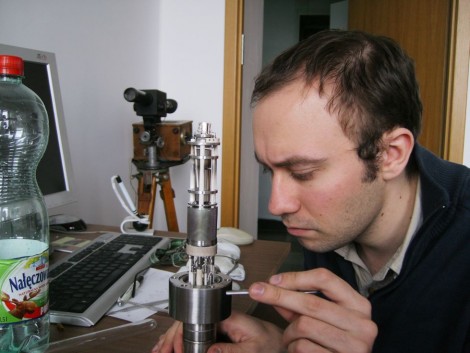
[Aleksander Zawada] makes vacuum tubes in his home. One of the most challenging builds he has taken on is to produce a working Nixie tube. He describes the process in a PDF (Internet Archive, updated 2024), covering his success and failure. It seems the hardest part is to get the tube filled with the proper gas, at the proper pressure, and firmly seal it. In the end he managed to make a tube with three digits (0, 1, and 2) that worked for about 700 hours before burning out.

[Aleksander] joins [Jeri Ellsworth] on the short list of hackers who can pull off extreme industrial manufacturing at home. Kudos.

[Thanks Duncan]
Air Freshener Hacking

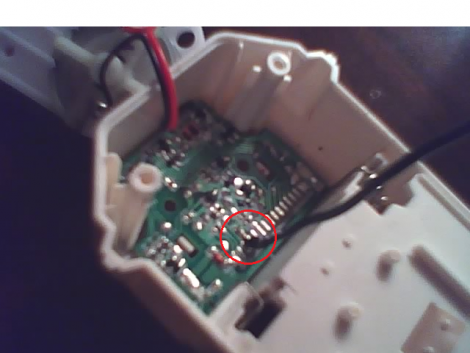
In an effort to improve his marital standing [Tech B] hacked an air freshener to make it Internet controllable. The main component here is a Glade Sense and Spray. It cost him $7 and is meant to spray out some sweet smells when it senses motion in the room. The unit also has a manual spray button which he patched into with the help of a relay. From there some Arduino code and an IRC bot take over, letting him unleash freshness from anywhere he has IRC access.

When reading about this we were also thinking: “motion sensing circuitry available at local stores for just $7?”. We may have to conduct an investigation into the alternative usefulness of that package.

If you have another brand of automatic freshener around it should be just as easy to hack as this one was.

6809 Computing

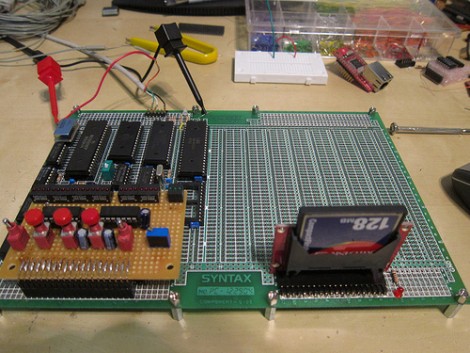
[Matthew Arnoff] built an 8-bit computer around the Motorola 6809 processor. He chose this processor because it seems there are a lot of Z80 builds out there and he wanted to try something different.

This actually packs quite a punch. He’s clocking the machine at 2 MHz with 512 KB of SRAM memory. Compact Flash that is FAT formatted provides mass storage. He’s using a serial connection for a user interface. After the break you can see his oscilloscope is used as the monitor. This was easy to accomplish by connecting the serial out to Terminalscope, one of his previous projects. Continue reading “6809 Computing” →

Web-enabled LED Pegboard

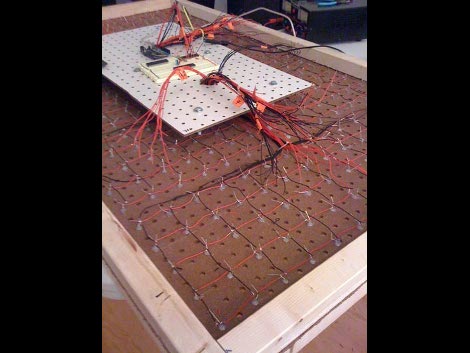
[Norm Santos] whipped up an LED light board that you can draw on through their web interface. We tried it out but unfortunately the live feed is currently offline. That doesn’t diminish our appreciation for the time-lapse build video after the break. Indeed it was a mountain of hot glueing and a couple of days of soldering. Our only beef is that for every LED on the board there are three empty peg holes. To us this is just begging to be augmented with blue, green, and white LEDs for a more spectacular result. What they have now encompases 350 LEDs managed by five microcontrollers, which took about two days to solder (for five people) and to hammer out some code. Continue reading “Web-enabled LED Pegboard” →

More Automated Wire Cutting

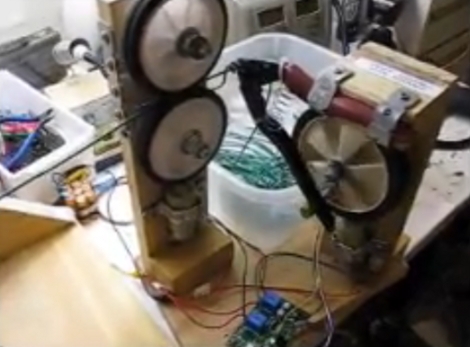
[MC] realized he had forgotten about an order for 2000 cut wires that was now due in a few days. Rather than dropping everything to complete the task, he whipped up this machine to cut the wires for him. A PIC 16F628 board drives a couple of battery-powered drill motors. One of them powers two lawnmower wheels for the feed, and the other turns a pin that squeezes the wire cutters. It’s not as advanced as the cutter/stripper from last year, but it gets the job done.

After the break you can see it does what is intended. The final product took about $80 and 12 hours of his time to build.  [MC’s] planned improvements include more accurate wire measurement, plus an LCD and button based user interface.

Continue reading “More Automated Wire Cutting” →

HOPE Badge Proximity Sensor

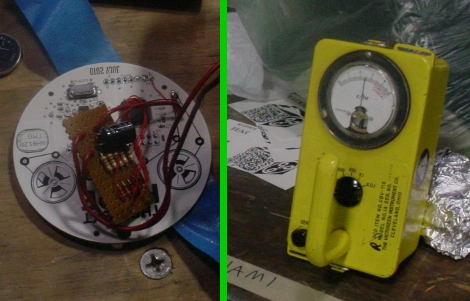
The HOPE conference was last weekend and [Nathan] spent some time with fellow members of Makers Local 256 developing this badge proximity sensor. They took one of the HOPE badges, which have a radio on board for the tracking network, and wrote code for its MSP430 to detect other badges nearby. It uses a Geiger counter they brought with them as an enclosure, re-purposing the analog gauge to reflect the level of active radio signals in the area. You’ll find their demo clip embedded after the break.

If you managed to get your hands on one of these badges, don’t be shy about sharing your hacks. We want to see them.

Continue reading “HOPE Badge Proximity Sensor” →