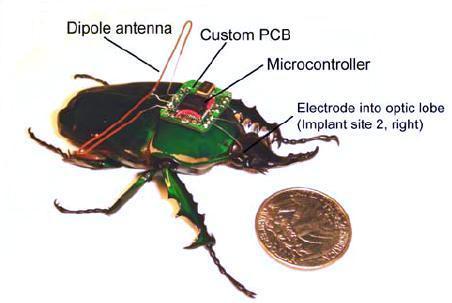
Earlier this year we were amazed when University of California researchers controlled a beetle via electrical implants. The video available at the time of the original report showed beetles tethered in place while electrical stimuli was applied via the chip. New video of free flight is has now been posted. Although the motion is rather sporadic, it is obvious that simple commands to start flight, stop flight, and turn left or right are having their intended effect. Check out this cyborg action after the break. Is DARPA one step closer to unleashing legions of insect warriors on unsuspecting masses? Continue reading “Radio Controlled Beetle Flight Footage”
Eee PC Bios Resurrection

Hot on the heels of our post about reading passwords from EEPROM, [n0th1n6] tipped us off about a similar hack used to resurrect an Eee PC from a bad bios flash. After discovering that a factory repair for a dead bios costs about $200, [CutenaCute_7] took on the challenge herself. She disassembled the computer and desoldered the bios chip from the board. After writing a program to flash the chip using C#, she temporarily soldered jumpers to make sure the flash worked. Looks like this is a zero cost hack, plus the time savings from not having to ship her computer somewhere. Bravo.
Google To Trolls: Please Flame EVERY Web Site

Google has unveiled their latest web app. It’s called Google Sidewiki and makes it easy to “Contribute helpful information to any webpage”. We’re not quite so sure. If you have the Google Toolbar installed on your browser, Sidewiki allows you to open a side-panel, add your comments about the page, and read the comments of others.
In a Utopian Internet (Utopernet?) the world’s most predominant experts on all subjects would be browsing websites dropping off clairvoyant nuggets of wisdom like Greek oracles. In reality, letting anyone add to any web page does not equate to instant insight. We’re all familiar with long comment threads and forum posts that contain very low percentages of useful information.
Google considered this “white noise” as a possible problem and implemented a ranking system for which comments are displayed first. This raises another flag, will this become a type of advertising? At some point in the future will comments linking to other pages be ranked based not only on popularity, but on a kickback to the Big G in return for increased exposure?
There is also the consideration that web pages might not like what comments are being left in Sidewiki. We’ve noticed that emails referencing the Labor Movement often have link advertisements in Gmail about how to prevent Unionization. What would the Sidewiki for pages covering controversial topics such as religion, sexual persuasion, and abortion look like?
We will admit this is a well intentioned idea with a lot of potential. But everything depends on how well it is executed.

With Zipit, Who Needs A Netbook?
[youtube=http://www.youtube.com/watch?v=x_LrI2g2VT8]
[Hunter Davis] keeps rolling out the hacks for the Zipit. In the past he showed us how to run DOSbox, and then how to get NES emulation working on this tiny device. Now he’s got Linux kernel 2.6.29 running Fluxbox with mouse (newly added), audio, and WiFi functionality. Follow his step-by-step flashing instructions to load the kernel into the Zipit. Once flashed, a partitioned microSD card servers as the filesystem and swap.
Who needs a 10.1 inch screen or an Atom processor when you can get this 2.8″ QVGA beauty with an XScale processor for around $40?
[Thanks Matt]
Tear Your IMac’s Insides Out

Saying that [Ian] had some overheating issues with his iMac G5 would be an understatement. After losing three hard drives due to heat he decided to do something about it. The first step was replacing the thermal paste with Arctic Silver. The solution for the hard drive was a little more unorthodox.
[Ian] picked up a 320GB Western Digital Caviar Blue drive because of its very low noise rating. He used rubber grommets to mount it outside the case and ran SATA data and power extension cables through a quarter inch hole to the motherboard. He mentioned to us that the cutout seen above the drive is from a previous mod.
This certainly will fix an overheating problem but it doesn’t do much for the sexy style we’re accustomed to with Apple hardware.
Junk Bots Win Awards In Vietnam

In a national competition for creativeness in children, junk bots have reigned supreme. Pictured above is a detail from one of [Vu Van Thankg]’s junk bots. Created entirely from parts pulled from the trash, this thing has 11 motors which supposedly allow full arm and hand control. We know you’ll be upset at how little information there is, but the pictures alone show so much. Just look at the rig he put together for this arm. If that isn’t inspiring, we don’t know what is.
[via BoingBoing]
Edison Cylinder Recordings Need More Cowbell

[Norman] spent three years developing and building his own Edison cylinder phonograph with electric pickup. We’re glad he did, and that he shared it with the world because the product is a thing of beauty. Every part is clean and precise with plenty of room for adjustments to accommodate differences in media. He’s reused the head from a VCR and attached it to a CNC machined polypropylene mandrel. The needle is interfaced with the cylinder via a delicate passively driven carriage. This consists of an aluminum rod with the cartridge at one end, and two wheels at the other. The wheels travel along a precision rod, propelled by the needle tracking the groove in the wax. Wonderful!
We’ve embedded a video of the device playing a recording of Sousa’s El Capitan from the late 19th century. Although familiar with these cylinder recordings, we were surprised by how little recording space there is available on one. Continue reading “Edison Cylinder Recordings Need More Cowbell”