GPS Alarm Clock

We spotted an interesting app in Gizmodo’s iPhone roundup for the week. iNap is designed for commuters that don’t want to miss their train stop. Just pick any location you can find on Google Maps, set the distance for the alert radius and the alarm tone, and it’s ready. It’s a great app and only costs $1.

The app actually reminds us of the first time we heard about Bug Labs. The modular gadget building system was described to us as a way to build unconventional consumer electronics. They specifically talked about one person that built an alarm clock with GPS because he kept falling the asleep on the train. Thanks to convergence we’re seeing a lot of devices expand from their initial intentions, whether it’s an iPhone GPS alarm clock or an N95 being used auto upload your bike ride to Flickr.

Boston LED Sweatshirt Arrestee Interviewed

In today’s episode of Boing Boing tv, [Xeni] interviews [Star Simpson]. She was arrested a year ago at Boston’s Logan airport for wearing a sweatshirt with a breadboard and some LEDs attached. With a collective groan, we watched this event unfold just months after Boston was held captive by Mooninites. After many court dates, [Star] is being forced to apologize and perform community service. She has since left MIT, disappointed with their nonexistent support, and left Boston entirely. Watch the interview for her side of the story. She’s posted how to recreate the sweatshirt.

Palin Email Hack Post Mortem

A few days ago a lone individual decided to crack [Governor Sarah Palin]’s private Yahoo! email account. He did this by navigating the password reset procedure. [Gov. Palin]’s birthday was publicly available and Wasilla only had two zip codes to guess. The follow up question “Where did you meet your spouse” required some more research. They met in high school so a few more guesses turned up “Wasilla high” as the answer. The original poster then read every single email only to discover that there really wasn’t anything of interest there. Frustrated, he posted the details to 4chan to let any wonk have at it. /b/ members began posting screenshots of the account, but very little came of it.

One screenshot of her inbox even revealed her daughter Bristol’s cell phone number. While there was no groundbreaking political information revealed, it is important to point out that it appears that Gov. Palin was using this private account to correspond to her assistants about potentially sensitive government information. This security breach should serve as a wake-up call to many public officials by showing how dangerous it can be to have a private e-mail account, especially when a free web-based service such as Yahoo! is used.

Daily Photo Aging Project On Steroids

We’ve seen those videos where people take a picture of themselves every day. [Dan Hanna] took it to a much further level.  He built a camera rig and took pictures of himself for 17 years.  That is not a typo, 17 years. The rig consists of a ring that holds two cameras opposing each other.  He centers his head facing a target that he increments around the ring every day before taking a picture.  The ring can be split into 4 sections for portability.  Check out the low resolution video after the break.

Continue reading “Daily Photo Aging Project On Steroids”

No More Updates To Wii Backup Loader

[youtube=http://www.youtube.com/watch?v=9yBTsNwOO1I]

You can now play backups on your Wii without a mod chip. A beta version of the bootloader made by [Waninkoko] has been leaked onto the net. Keep in mind that it is unfinished, so your results may vary. All you need is the bootloader and a legal copy of Zelda.  After a few patches and some installing, you’re ready to play backups, no mod chip necessary.  We covered this before, but there is a twist this time. Unfortunately, [Waninkoko] states that this project has been officially abandoned, probably due to the leak. Apparently crackers get hurt by leaks too.

[via Gizmodo]

Open Source Neural Activity Monitors

Yesterday we linked to an OCZ Neural Acutator Interface teardown. Several in the comments wanted to know more about the sensor electrodes. Check out the OpenEEG project and OpenEEG mailing list for information on sensing, amplifying, and recording brain activity (EEG). The OpenEEG project maintains an open source Simple ModularEEG design. Two other open source variants of the ModularEEG are the MonolithEEG and [Joshua Wojnas’] Programmable Chip EEG BCI. All three projects use Atmel microcontrollers, with designs in Cadsoft Eagle.

Brain activity is measured using passive or active electrodes. Passive electrodes require a conductive paste to make proper contact with the skin (examples: 1, 2). Active EEG sensors don’t need conductive goop because they have an amplifier directly on the electrode (examples: 1, 2, 3).

[via anonymous reader, comments]

How-To: Web Server On A Business Card (Part 1)

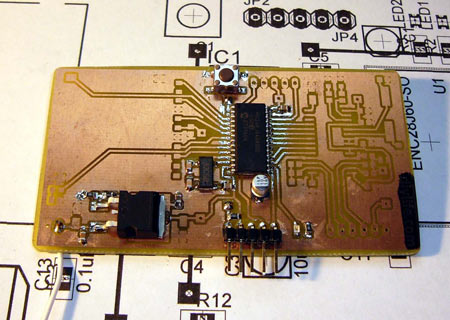
For years, Microchip PIC microcontrollers dominated; PIC16F84 hacks and projects are everywhere. The 8-bit 16F and 18F lines are supported by several coding environments and easy-to-build serial port programmers. Microchip’s 16-bit PIC24F is cheaper, faster, and easier to work with, but largely absent from hacks and projects.

We recently used a Microchip PIC24F microcontroller in a mini web server project, but didn’t find many introductory references to link to. In this article we’ll cover some PIC 24F basics: support circuitry and programming options. We’ll also talk about our favorite features, and how we figured them out. Our next article will outline a web server on a business card based on the PIC 24F.

Continue reading “How-To: Web Server On A Business Card (Part 1)”