Build A Lifeform For Io9


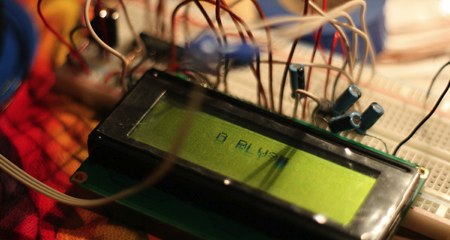
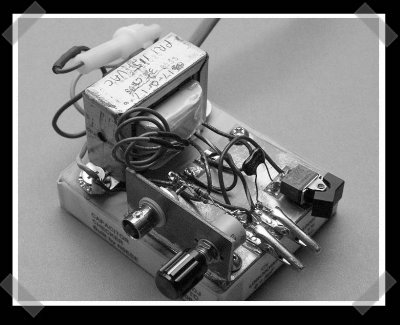
Whether you consider yourself a bona fide mad scientist or you simply think your horrifying mutant creations are misunderstood, you’ll want to enter io9’s Build a Lifeform contest.

The contest doesn’t require any actual primordial soup, just a concept of a synthetic lifeform you think would be useful or interesting. There are two categories with different prizes for each one. The first category asks contestants to use the BioBricks registry of standard biological parts to design a lifeform that could be created in a lab. Descriptions of how it would be made, what it would do, and potential hazards in creating it must all be included with the entry. The winner of this category will recieve an all-expenses-paid trip to the Synthetic Biology Conference in Hong Kong in October.

The second category is more focused on creativity, asking for the same descriptions as the first category without any BioBricks data. While this is the more speculative category, proposed lifeforms must still be plausible to create using current technology. The prize is $1000 and a signed drawing of your lifeform rendered by “a cool comic book artist.”

Both categories offer pretty good loot for your concepts, just be sure they’re more original than an esquilax if you intend to win.

For the background on BioBricks, check out [Drew Endy]’s Hacking DNA talk from last year. He’s one of the judges for the contest.
Pulse, The Emotional Visualization Organism


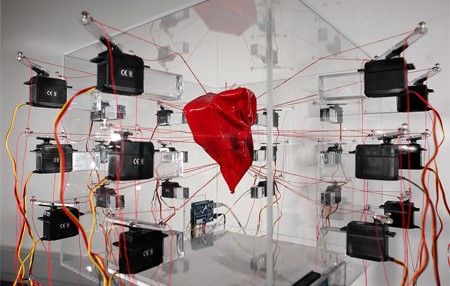
[Markus Kison] built a device called Pulse, which is part art installation and part data visualization tool. What the emotional visualization organism called Pulse actually does is scan new posts on Blogger.com blogs for synonyms of keywords related to 24 distinct emotions from eight emotional groups. A red cone in the center expands when keywords are detected, in effect acting as a mood indicator for Blogger.com blogs.

The 24 distinct emotions are based on [Robert Plutchik]’s psychoevolutionary theory of emotion, and the device itself is built from a glass case, various servo motors, and custom controller for the servos. This is a compelling idea, but we wonder whether it scans for modifying words or just the keywords alone. It wouldn’t make a lot of sense to have the sadness region expand drastically if many people simultaneously post the sentence “I’m not sad at all.” Video embedded after the break.

Continue reading “Pulse, The Emotional Visualization Organism” →

Eee PC Tablet Build


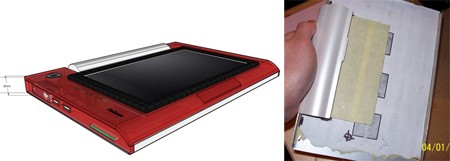
OCAU member [Bismar] was in the market for an e-book reader, but all of his commercial options were too expensive. He decided to build one himself, and what he came up with is the Tabeee MK1, an e-book reader made from a 7″ Eee PC, a touchscreen, and a custom case.

The project is far from completion, still in the midst of its first objective: building the case. [Bismar] cut an old Lian Li case for the aluminum base, then made sure the motherboard from the Eee fit properly. The next major step was bending and cutting an acrylic sheet to form the exterior of the case. He hit a few snags bending the sheet, but forum members offered some ideas on how to do this effectively. The project is still rolling along, and we’ll be sure to show you the Tabeee MK1 when it is finished.

Hack A Day Is Still Hiring


We’ve added a handful of contributors in the last couple months, which you can see in our new How-Tos. We’re still looking for people to contribute daily posts and help expand the site though.

This is a paid, freelancing position that requires professionalism, consistency, and reliability. We want to hear from people that are passionate about software/hardware hacking and growing Hack a Day. To apply, send the following to jobs@hackaday.com

  • A short bio about yourself
  • 3 example daily posts written in the style of Hack a Day
  • 3 software or hardware how-tos you’d like to see. For examples of work we’ve done in the past, look here, here, here, and here.
  • A couple sentences on how you would improve the site either through features or content
  • Any additional reasons why you would make a good fit for Hack a Day

Do not send any attachments. Having your own blog you can show off is a definite plus.

[photo:fbz]

StereoData Maker


So you got CHDK working on your camera, and the histograms, raw image files, variable shutter speeds and other added functions are amazing, but stereo imaging is what you really want. If you have two or more CHDK-ready cameras, it’s cheap and easy to run StereoData Maker, a system that synchronizes the shutter and flash of multiple cameras.

The first step in getting SDM to work is installing the software on your SD card. You’ll need to find the correct version for you camera; a list is available on the main SDM page. If you are running Windows XP or Vista, run the installer in the zip file. Otherwise, load the files on the SD card and run the installer directly from the camera. Then decide whether this will be the right or left camera and repeat the steps for your second camera.

Next, you’ll need to prepare a switch unit, essentially a set of synchronized USB remotes. There are many ready made commercial units available, but building one on your own shouldn’t be much trouble, and a few ideas are provided on the SDM instruction page.

You’re basically ready to start shooting stereo images, just take a few test shots to get used to it and to customize the configuration on the cameras.

The Rock-afire Explosion Movie Trailer


A small group of enthusiasts have apparently been restoring and reprogramming the animatronic bands from the former Showbiz Pizza Place chain. Original engineer [Aaron Fechter] and car salesman/choreographer [Chris Thrash] have started performing modern pop songs with the bands and have a page where you can bid on new songs to perform. This feels like Billy Bass hacking on a much larger scale. The original machines were controlled by a four track reel, but now they’re using a hard disk recorder. The trailer above is worth watching just for the rows of partially assembled bears performing on the factory floor.

[via Waxy]