Your Arduino Packaging Could Sway A Court Case

Our friends over at Adafruit just made an interesting suggestion regarding the Arduino vs. Arduino saga. They noticed that the packaging for the Arduino UNO includes a pamphlet that states:

Manufactured under license
from Arduino by
SMART PROJECTS S.r.l.

Wow. That’s pretty interesting. Smart Projects is the former name of Arduino SRL. If you missed it, go back and read some of our previous coverage. Specifically, Arduino SRL is claiming to be the real trademark holder and has gone as far as forking the Arduino IDE and upping the version number in what appears to be an attempt to direct users toward their newly founded Arduino.org website/ecosystem/quagmire. If they feel they own the trademark why would they include this statement in their packaging?

Finding this in the a unit from a September 2014 is interesting. But Adafruit’s post is a call to action. We share their curiosity of discovering how far back official Arduino hardware has included such license notices. So, head on down to your work bench… start peeling back years worth of discarded hacks, clipped leads, fried servos, and other detritus. Find the packaging and take a picture. Bonus points if you have an invoice that associates a date with it. Either way, post the pictures on your social media hub of choice with #TeamArduinoCC. You can also embed it in the comments using HTML IMG tags if you wish.

Standard “I am not a lawyer” disclaimer applies here. We know you aren’t either so let’s all share what we think this means to pending lawsuits in the comments. Does this matter and why?

Hackaday Links Column Banner

Hackaday Links: April 19, 2015

Bang & Olufsen have made some pretty amazing equipment for a long, long time. That last part can become a problem. [Oliver] found the electrolytic caps on his Beomaster 2400 were causing problems. He completely recapped the unit, all the electrolytics anyway, and the pictures of the process are nothing short of eye-candy.

The closure of the Bacman forums marks the end of an era. For years this has been among the top (okay, it’s definitely been the top one but we don’t want to start a flamewar) sites for handheld and console modding. Here’s just one random example of the many projects we covered from that community (note that main link is now sadly 404). The closure message cites the near-absolute death of modding. We haven’t thought about it much, but these mods were futuristic. Then smartphones.

Fans of How It’s Made and 3D printing will want to tune in on April 30th at 9pm EST. The show does a fantastic job of showing off the amazing story behind how all the stuff in our lives comes to be visited LulzBot in Loveland, Colorado for a segment on the manufacturing process of a 3D printer.

We’re not sure why we didn’t lead with this: All celebrate, for humanity is saved! The secret behind getting something out of nothing has been discovered. This reactionless generator has been tested at efficiencies as high as 250%. We’re working on a way to bottle all that extra juice and sell it at outrageous prices.

The thing about free energy is that you become dependent on it. What if the laws of physics return from vacation and the thing stops working? Then you have a robot apocalypse with all kinds of hidden messages and puzzles in it.

Hacklet 43 – Flashlight Projects

Mankind has always looked for ways to light up the night as they walk around. Fires are great for this, but they aren’t very safe or portable. Even kept safe in a lantern, an open flame is still dangerous – especially around cows.  Enter the flashlight, or torch if you’re from the other side of the pond. Since its invention in 1899, the flashlight has become a vital tool in modern society. From patrolling the dark corners of the city, to reading a book under the covers, flashlights enable us to beat back the night. The last decade or so has seen the everyday flashlight change from incandescent bulbs to LEDs as a light source. Hackers and makers were some of the first people to try out LED flashlights, and they’re still tinkering and improving them today. This weeks Hacklet focuses on some of the best flashlight projects on Hackaday.io!
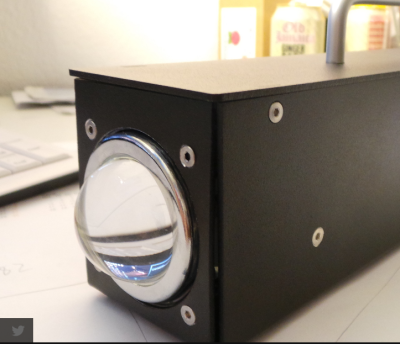
light1We start with [Norman], and the LED Flashlight V2. Norman built a flashlight around a 100 Watt LED. These LEDs used to be quite expensive, but thanks to mass production, they’ve gotten down to around $6 USD or so. Norman mounted his LED a custom aluminum case. At this power level, even LEDs get hot. An extruded aluminum heatsink and fan keeps things cool. Power is from a 6 cell LiPo battery, which powers the LED through a boost converter. It goes without saying that this flashing is incredibly bright. Even if the low-cost LEDs aren’t quite 100 Watts, they still put many automotive headlights to shame! Nice work, [Norman].
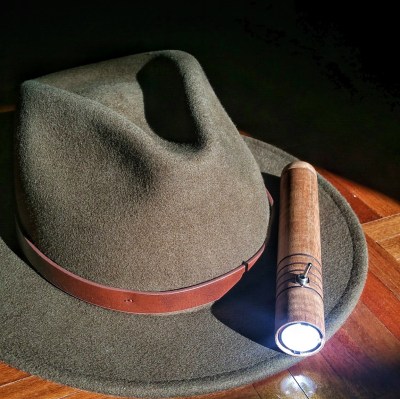
light2A tip of the fedora to [Terrence Kayne] and his Grain-Of-Light LED LIGHT. [Terrence] loves LED flashlights, be he wanted one that had a bit of old school elegance. Anyone familiar with LEDs knows CREE is one of the biggest names in the industry. [Terrence] used a CREE XM-L2 emitter for his flashlight. He coupled the LED to a reflector package from Carlco Optics. The power source is an 18650 Lithium cell, which powers a multi-mode LED driver. [Terrence] spent much of his time turning down the wooden shell and aluminum tube frame of the flashlight. His workmanship shows! Our only suggestion would be to go with a lower profile switch. The toggle [Terrence] used would have us constantly checking our pockets to make sure the flashlight hadn’t accidentally been activated.
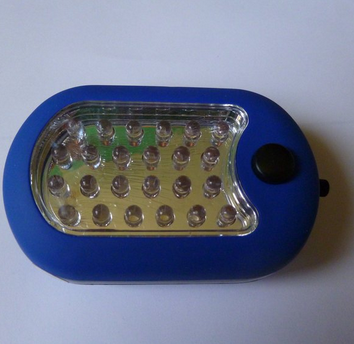
light3Harbor Freight’s flashlights are a lot like their multimeters: They generally work, but you wouldn’t want to trust your life to them. That wasn’t a problem for [Steel_9] since he needed a strobe/party light. [Steel_9] hacked a $5 “27 LED” light into a stylish strobe light. He started by cutting the power traces running to the LED array. He then added in an adjustable oscillator circuit: two BJTs and a handful of discrete components make up an astable multivibrator. A third transistor switches the LEDs. Switching a load like this with a 2N3906 probably isn’t the most efficient way to do things, but it works, and the magic smoke is still safely inside the semiconductors.  [Steel_9] built the circuit dead bug style, and was able to fit everything inside the original plastic case.  Rave on, [Steel_9]!

If you want to see more flashlight projects, check out our new list on Hackaday.io! That’s about all the time we have for this week’s Hacklet. As always, see you next week. Same hack time, same hack channel, bringing you the best of Hackaday.io!


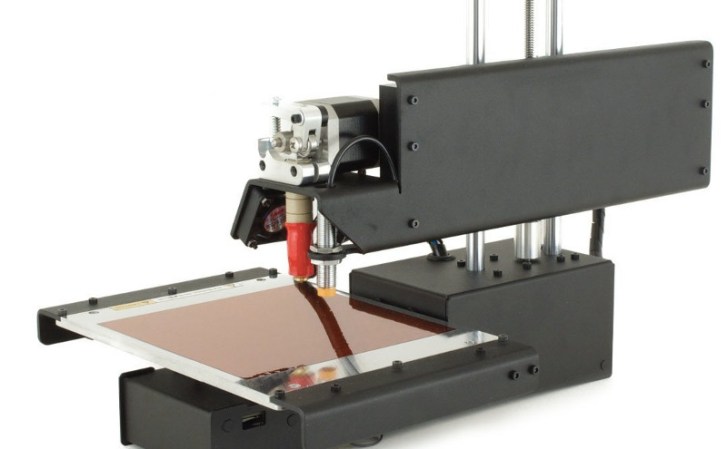
Review: Printrbot Assembled Simple Metal

Hackaday is getting back into the swing of doing reviews, and with that comes reviews of the tool du jour, 3D printers. I have some reservations about reviewing a 3D printer; they’re a new technology, and what may be standard today could be hopelessly outdated in a few months time. Remember geared extruders? The new hotness is, apparently, direct drive extruders.

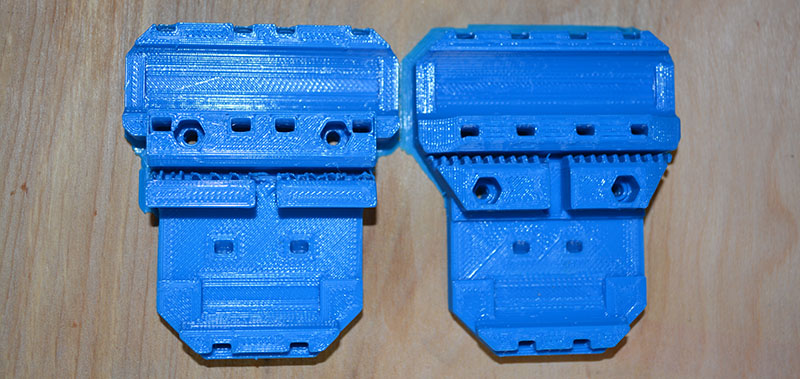
This is a review of the Printrbot Assembled Simple Metal. If you need any evidence that reviews of 3D printers have a shelf life, you only need to look at the Getting Started guides for this printer. When I bought my Simple Metal, the Printrbot recommended software stack was Slic3r and Repetier-Host. Barely three months later, Cura is now the Printrbot recommended software stack. If you think a simple change in software is inconsequential, check out these prints:

prusa parts
Prusa i3 X-carriages. Left sliced by Slic3r, right sliced by Cura

The print on the left was sliced with Slic3r. The print on the right was sliced with Cura. Notice the small teeth that grip the timing belt on each of these prints. With the Cura-sliced print, everything is fine. The Slic3r-sliced print is a complete failure, not of the machine, but the recommended software for the machine.

Therefore, if the goal of writing a review is to have a definitive opinion of a piece of equipment, a number of questions must be addressed. Since most 3D printing software is open source, should software be included in the review? Is the value proposition of a 3D printer simply a function of price to build volume (this seems to be the standard metric now), or are there intangibles? Should the review cover the quality of prints out of the box, or should the review only focus on print quality after dozens of hours of tweaking? I simply don’t know the answers to these questions, and I suspect you couldn’t get any two people to agree on the answers to these questions.

With that said, I feel I have used this printer enough to make a judgment call as to if this printer was a good buy.

Continue reading “Review: Printrbot Assembled Simple Metal”

Caption CERN Contest Week 11

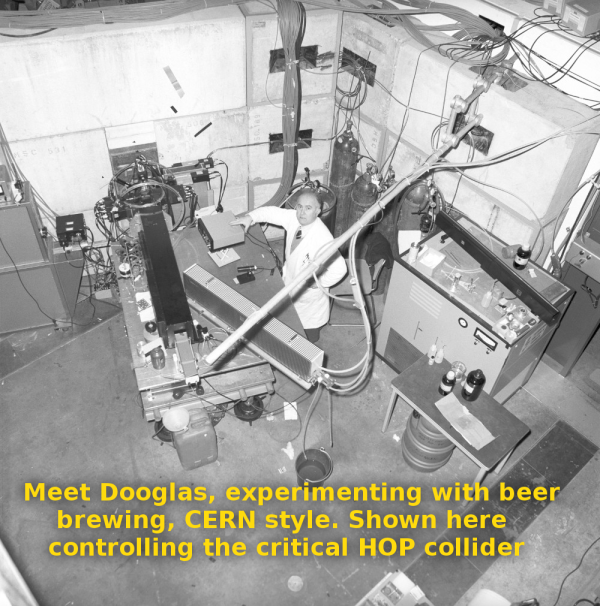
Week 10 of the Caption CERN Contest is a wrap folks! Our surprised scientist brewed up a ton of great captions from our great Hackaday.io community. We may never know what exactly is in that keg/carboy, or what the heck is draining into that bucket. Still, it’s probably safe to say that no one has put this much thought into those particular items since this scientist performed his research.

The Funnies:

  • “After many decades of hard work, Dr. Milton and his research was moved down into basement after he complained one too many times about his missing stapler.” – [joe_pumpernickle]
  • “Parker! Get down here! Ever since that radioactive spider bit you, you’ve crawling up the walls!”-[DainBramage]
  • “It rubs the dielectric grease on its relay contacts or else it gets the hose again” -Team effort from [MechaTweak] and [Nick Sayer]

The winner for this week is [airbuckles] with “Meet Dooglas, experimenting with beer brewing, CERN style. Shown here controlling the critical HOP collider.” [airbuckles] won’t need any buckles for his new Robot T-Shirt From The Hackaday Store!

Week 11: A double-header!

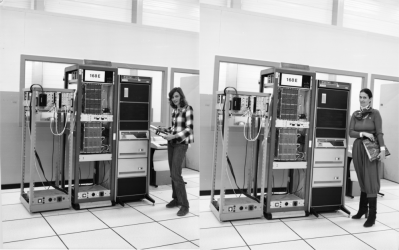
cern-11-smWe’ve got something a bit different for week 11: Two images from CERN’s archives! Both of these images feature a lovely PDP-11 from Digital Equipment in Galway, Ireland. They also feature two CERN researchers. The scientist on the left is wearing typical hacker attire – sneakers, jeans, and a comfy shirt. The hacker on the right went for something which we’re guessing was a bit more stylish back in 1982, but hasn’t quite held up to the test of time.

These scientists must have been doing some heavy-duty number crunching to need a PDP-11. Do you know what that strange hand wired rack of equipment is in the center? Do you have any idea where we can find a pair of harem pants like the woman on the left? Write a caption and let us know!

Add your humorous caption as a comment to this project log. Make sure you’re commenting on the project log, not on the project itself. As always, if you actually have information about the image or the people in it, let CERN know on the  original left CERN image, and original right CERN image.

Good Luck!

We Have A Problem: Health Care Where There Are No Health Care Workers

Hackaday, we have a problem. There are a lot of people on this earth and not a lot of health care workers. Let’s use our skills to help alleviate this problem. What can we do to give medical professionals a wider reach, to bridge the distances between hospital and patient, and make it easier for bystanders to administer lifesaving care.

Scope of the Problem

We’d wager that your most recent and vivid remembrance of a health care worker shortage is the Ebola outbreak in West Africa. The shortage of trained professionals and supplies certainly compounded the situation in the countries worst hit. But it didn’t create the problem. Check out this list of doctors per 1,000 people (sorted lowest-to-highest with 2010 numbers). The three countries hit hardest by the outbreak — Guinea, Liberia, and Sierra Leone — register a whopping 0.0 doctors for every 1000 people. Yeah, that’s years before the outbreak.

Keep scrolling down and you’ll see that this isn’t limited to one geographic location. All over the world there are low numbers, with India and Iraq both at 0.6, and interestingly Cuba and Qatar topping the list at 6.7 and 7.7 respectively.

This isn’t a statistics post so let’s pivot. The point is made that we’re a large world population. What kind of engineering solutions can we wield to help provide everyone with the care they need? Leave your comments below but also considered entering the Hackaday Prize with them. Write down your idea as a Hackaday.io project and tag it 2015 Hackaday Prize.

Proof That We Can Do This

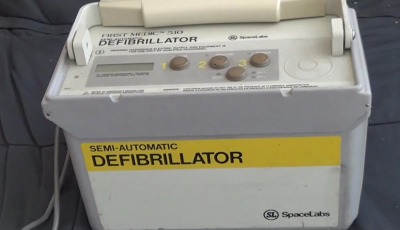
firstmedic-510-aedIt’s safe to say we’ve all seen engineering solve part of this problem already. Over the last decade, Automatic External Defibrillators have become ubiquitous. The life-saving hardware is designed to be used by non-doctors to save someone whose heart rhythms have become irregular. [Chris Nefcy] helped develop AEDs and one ended up saving his life. If that’s not proof that we can change the world with our builds we don’t know what is.

Pull on that thinking cap and jump into this conversation. What can we build? What problems need to be solved right now? Where should each of us be looking to make a difference in the availability of health care in the absence of the trained professionals?


The 2015 Hackaday Prize is sponsored by:

Retro Edition: VCF East X This Weekend

It’s mid-April and time once again for the Vintage Computer Festival East X. The X means 10. It’s a three-day weekend full of interesting people, cool tech, and computers you’ve only heard about. We’ll be there all three days, and if you’re in New York or are unable to pump your own gas (Oregon excluded), it’s a great way to spend the weekend.

The sessions for this Friday will include everything from chiptunes to retr0bright to emulating vintage computers on FPGAs. Sessions of note include our own [Bil Herd] giving a talk on system architecture. Think of this as a bunch of engineers in a room with a whiteboard. How could you not have fun with that. There will also be the first meeting of the Quarternet committee, headed up by [Jim Brain]. This session will be a discussion of implementing a vintage networking protocol across different models and different brands of vintage computers. Confused? It’s a, “two-bit solution for an eight-bit world.” That’s all we know, and I’m pretty sure that’s all anyone knows. It will be interesting.

Saturday and Sunday will feature an incredible number of exhibits that includes everything from Atari 8-bits, Hollerith cards, mainframes, an amateur radio station (KC1CKV) and somehow a Fairlight CMI. Since this is the 50th anniversary of the PDP-8, there will be a few of these ancient machines on display. A freshly restored Straight-8 will be up and working, as will an incredible emulation from hackaday.io.

Just because there are exhibits doesn’t mean the talks end on Friday. On Saturday the guest speaker will be [Brian Kernighan], the guy who literally wrote the book on C. Sunday will feature [Bob Frankston], co-developer of VisiCalc. There will be very important people here all weekend.

Even if vintage computers aren’t your thing, there’s still plenty of stuff to see at the venue. The InfoAge science center has technological curiosities stretching back a century, and recently they’ve rehabbed an old satellite dish and turned it into a radio telescope. Registration happens here, and if the last few paragraphs haven’t sold you on the event, you can check out [The Guru Meditation]’s VCF preview video below. We will, of course, be posting a lot of stuff from the event.

Continue reading “Retro Edition: VCF East X This Weekend”