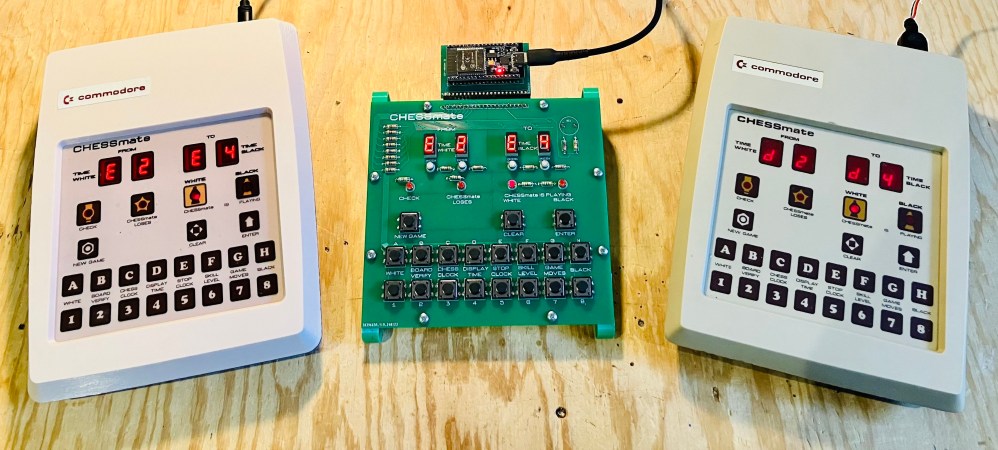
Commodore CHESSmate Replica Runs On The ESP32

The Commodore CHESSmate chess computer might not be terribly well known, but that doesn’t make it any less worthy of being reproduced. If anything it is more important, as it gives more people an opportunity to use one of these devices, yet beyond a purely emulated experience the real user interface is harder to experience.
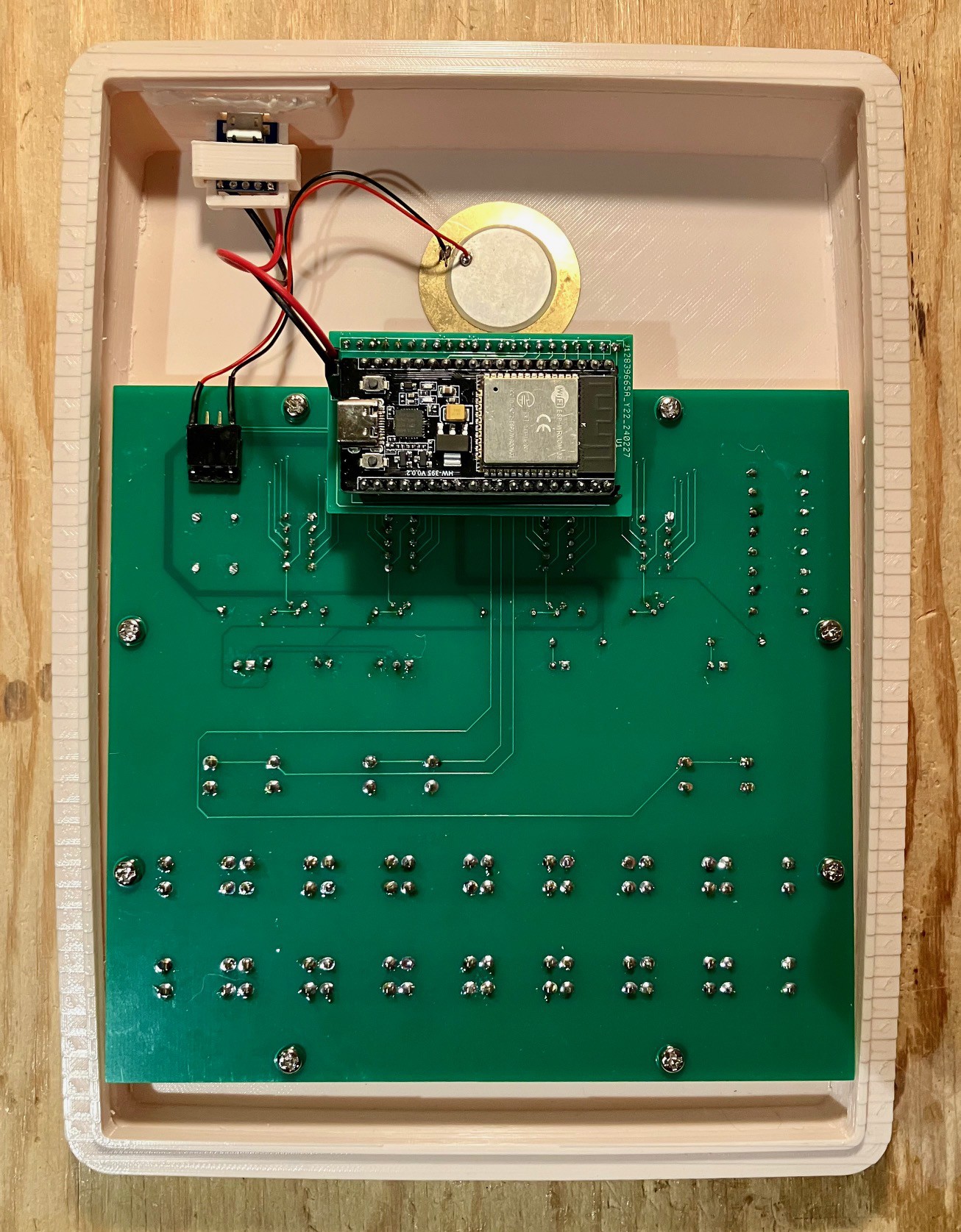
Internals of the reproduction Commodore ChessMate (Credit: Michael Gardi)

This is where [Michael Gardi]’s modernized replica provides a highly accessible version, consisting of a custom PCB with an ESP32 as the brains of the system. Although decidedly overkill next to the 6502 in the original CHESSmate, it makes the project far easier for others to assemble as it contains few components that shouldn’t be readily available.

The ESP32 is mounted on a small daughterboard which plugs into the main PCB with the buttons, LEDs and indicators. The whole stack is then inserted into the 3D printed reproduction case. These 3D models along with the ESP32 port of the CHESSmate firmware can be found in the GitHub repository, along with a minimalist frame and a ‘CHESSmate Lite’ version as alternative enclosure options for those who somehow don’t appreciate the delightful 1980s aesthetics.

We covered the Commodore CHESSmate last year, including a highly faithful reproduction built by [Hans Otten], which [Michael] read the day after meeting [Peter Jennings], the author of MicroChess (which the CHESSmate uses internally) at an event at York University. Taking this as a sign, he set to work on this particular project.

We’re not sure if there’s really a cosmic force directing [Michael] towards his next project, but if there is, we’d like to take this opportunity to thank it for doing a fantastic job so far.
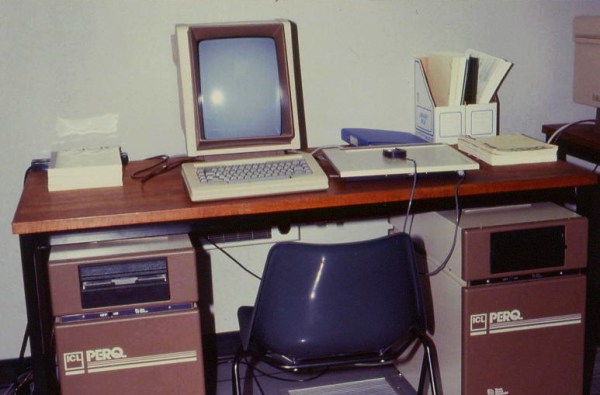
Two ICL PERQ 1 workstation computers, Department of Computer Science, North Machine Hall, James Clerk Maxwell Building, University of Edinburgh. (Credit: J. Gordon Hughes)

The Flex Computer System: UK’s Forgotten Capability Computer Architecture

During the 1970s many different computer architectures were being developed, many of them focused on making computer systems easier and more effective to use. The Flex Machine developed at the UK Ministry of Defence’s Royal Signals and Radar Establishment (RSRE) was one of them, falling in the category of Capability Architectures. These architectures required hardware with programmable microcode, which required either custom hardware, or computer systems like the Xerox Alto-inspired ICL PERQ (pictured). What’s interesting about Flex is that it didn’t just remain in the 1980s as a quaint footnote, but as detailed by [Martin C. Atkins] – who worked on the system – evolved into the Ten15 system, which later got renamed to TenDRA.

Capability architectures have a long history – including the Intel iAPX 432 and more recent implementations – but they all have in common is that they effectively implement an object-based memory architecture, rather than the low-level, flat memory space that we usually see with computer systems. These object-based capabilities, as they were termed, provides a level of memory protection and security that would be hard to implement otherwise. The book Capability-Based Computer Systems by [Henry M. Levy] forms a good introduction here.

Continue reading “The Flex Computer System: UK’s Forgotten Capability Computer Architecture”

PDP-10 Fits In Your Living Room

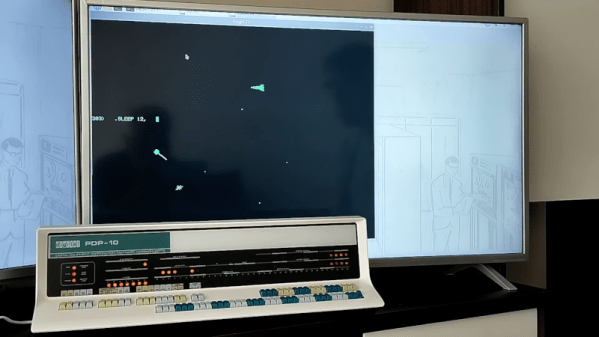
[Oscar] at Obsolescence Guaranteed is well-known for fun replicas of the PDP-8 and PDP-11 using the Raspberry Pi (along with some other simulated vintage computers). His latest attempt is the PDP-10, and you can see how it looks in the demo video below.

Watching the video will remind you of every old movie or TV show you’ve ever seen with a computer, complete with typing noise. The PDP-10, also known as a DECsystem-10, was a mainframe computer that usually ran TOPS-10. These were technically “mainframes” in 1966, although the VAX eclipsed the system. By 1983 (the end of the PDP-10’s run), around 1,500 had been sold, including ones that ran at Harvard, Stanford, Carnegie Mellon, and — of course — MIT. They also found homes at CompuServe and Tymshare.

The original 36-bit machine used transistors and was relatively slow. By the 1970s, newer variants used ICs or ECL and gained some speed. A cheap version using the AM2901 bit-slice CPU and a familiar 8080 controlling the system showed up in 1978 and billed itself as “the world’s lowest cost mainframe.”

The Knight terminals were very unusual for the day. They each used a PDP-11 and had impressive graphics capability compared to similar devices from the early 1970s. You can see some of that in the demo video.

Naturally, anyone who used a PDP-10 would think a Raspberry Pi was a supercomputer, and they wouldn’t be wrong. Still, these machines were the launching pad for Adventure, Zork, and Altair Basic, which spawned Microsoft.

The cheap version of these used bitslice which we’ve been talking about lately. [Oscar] is also known for the KIMUno, which we converted into a COSMAC Elf.

Playing ZX Spectrum’s Manic Miner On The Arduino Uno

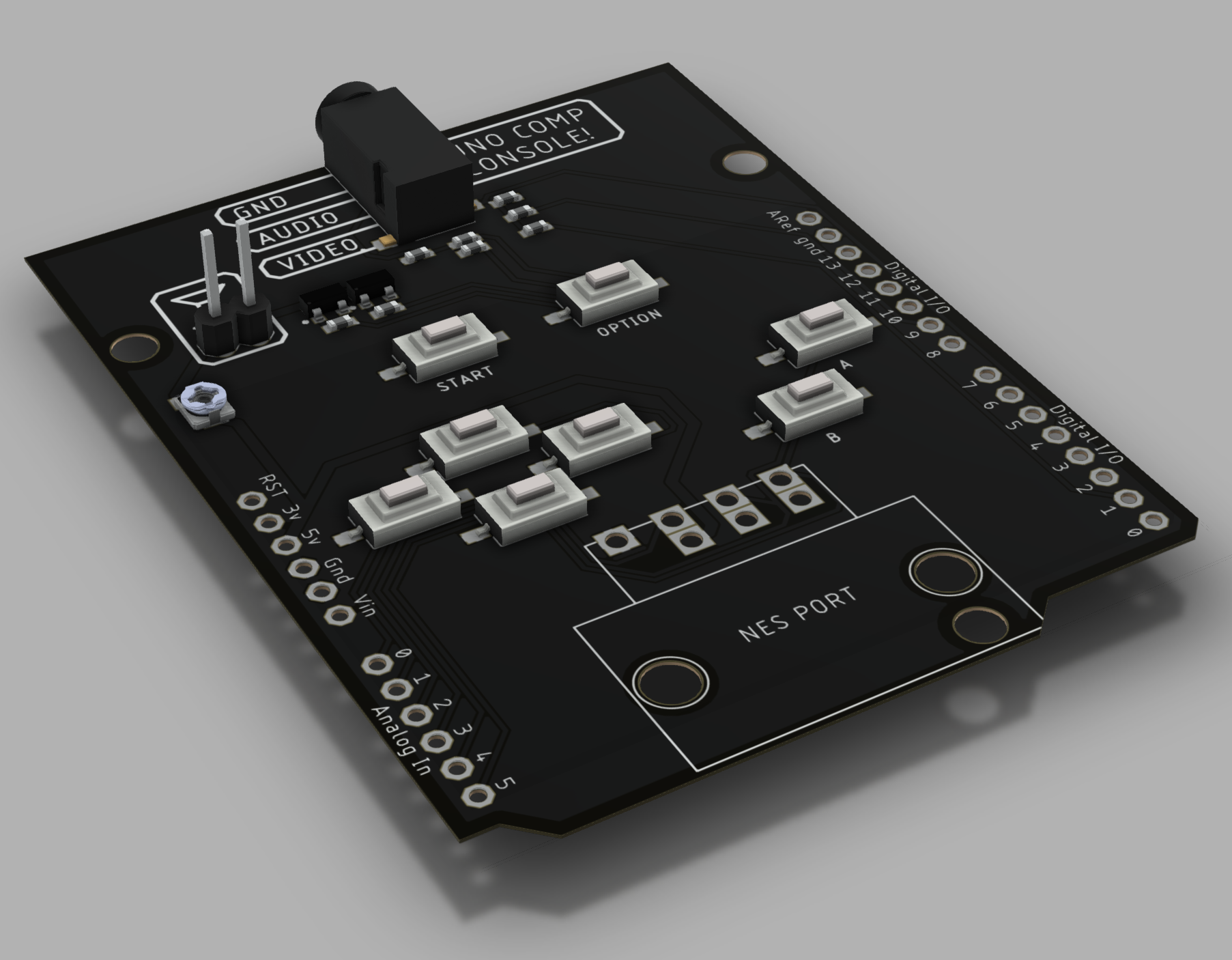
Composite output shield with audio driver and controller inputs for Arduino Uno (Credit: Scott Porter)

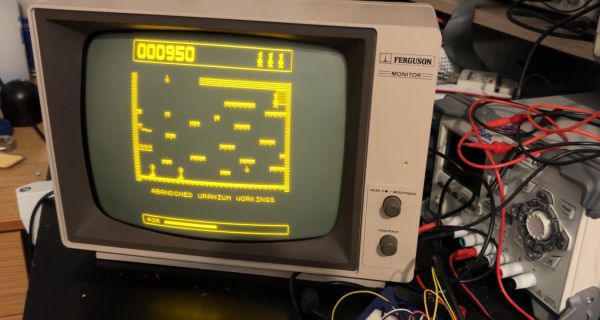
Although it seems many have moved on to 32-bit MCUs these days for projects, there is still a lot of fun to be had in the 8-bit AVR world, as [Scott Porter] demonstrates with a recent Arduino Uno project featuring his game engine running a port of the Manic Miner game that was originally released in 1983 for the ZX Spectrum. For the video and audio output he created an add-on board for the Uno that creates a composite signal using two resistors, along with an audio driver circuit and control inputs either from the onboard buttons or from a NES controller. Audio can be sent either over the composite output or via the audio jack.

A demonstration of the game is provided in a number of videos on [Scott]’s YouTube account, which shows off a few levels, at 256×256 resolution. It contains all 20 original levels, with a few quality of life upgrades with animation. It also features original music, which may or may not work for you, but music can be turned on or off in the main menu. Compared to the 3.5 MHz Z80 MPU in the ZX Spectrum, the 16 MHz AVR of the Uno is a lot beefier, which raises the hope that a color version like the ZX Spectrum one is also in the future, even if it may require an add-on board with a framebuffer. As [Scott] notes, the weakness of the Uno is that the ZX Spectrum has significantly more RAM, which limits what can be done.

Thanks to [256byteram] for the tip.

Continue reading “Playing ZX Spectrum’s Manic Miner On The Arduino Uno”

The 1970s Computer: A Slice Of Computing

What do the HP-1000 and the DEC VAX 11/730 have in common with the video games Tempest and Battlezone? More than you might think. All of those machines, along with many others from that time period, used AM2900-family bit slice CPUs.

The bit slice CPU was a very successful product that could only have existed in the 1970s. Today, if you need a computer system, there are many CPUs and even entire systems on a chip to choose from. You can also get many small board-level systems that would probably do anything you want. In the 1960s, you had no choices at all. You built circuit boards with gates on the using transistors, tubes, relays, or — maybe — small-scale IC gates. Then you wired the boards up.

It didn’t take a genius to realize that it would be great to offer people a CPU chip like you can get today. The problem is the semiconductor technology of the day wouldn’t allow it — at least, not with any significant amount of resources. For example, the Motorola MC14500B from 1977 was a one-bit microprocessor, and while that had its uses, it wasn’t for everyone or everything.

The Answer

The answer was to produce as much of a CPU as possible in a chip and make provisions to use multiple chips together to build the CPU. That’s exactly what AMD did with the AM2900 family. If you think about it, what is a CPU? Sure, there are variations, but at the core, there’s a place to store instructions, a place to store data, some way to pick instructions, and a way to operate on data (like an ALU — arithmetic logic unit). Instructions move data from one place to another and set the state of things like I/O devices, ALU operations, and the like.

Continue reading “The 1970s Computer: A Slice Of Computing”

What’s A Transfluxor?

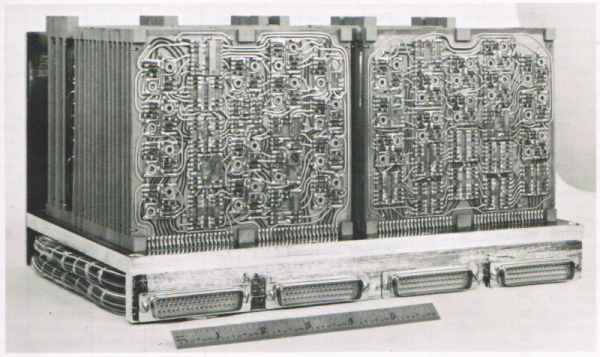
In the 1967 movie The Graduate, a wise older man gives some advice to the title character: plastics. Indeed, plastics would become big business. In 1962, though, a computer-savvy character might have offered a different word: transfluxor. What’s a transfluxor? Well, according to computer history sleuth [Ken Shirriff], it was the heart of a 20-pound transistor computer from Arma. Of course, plastics turned out to be a better bet, but in 1962, the transfluxor seemed to be the wave of the future.

In 1962, most computers were room-sized, but the Arma was “micro” taking up just 0.4 cubic feet — less than an Apple II. It would eventually spawn computers used in ships at sea and airplanes ranging from the Concorde to Air Force One.

Continue reading “What’s A Transfluxor?”