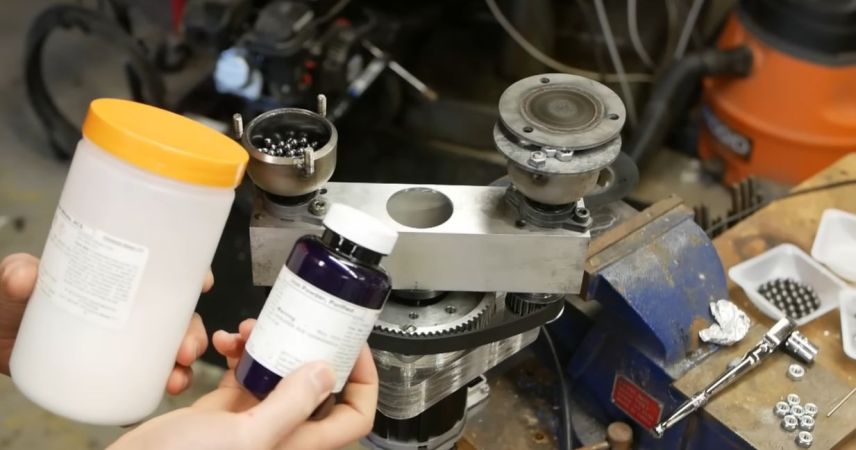
Creating strong permanent magnets without using so-called rare earth elements is an ongoing topic of research. An interesting contestant here are iron nitride magnets (α”-Fe16N2), which have the potential to create permanents magnets on-par with with neodymium (Nd2Fe14B) magnets. The challenging aspect with Fe-N magnets is their manufacturing, with recently [Ben Krasnow] giving it a shot over at the [Applied Science] YouTube channel following the method in a 2016 scientific paper by [Yanfeng Jiang] et al. in Advanced Engineering Materials.
This approach uses a ball mill (like [Ben]’s planetary version) with ammonium nitrate (NH4NO3) as the nitrogen source along with iron. After many hours of milling a significant part of the material is expected to have taken on the α”-Fe16N2 phase, after which shock compaction is applied to create a bulk magnet. After the ball mill grinding, [Ben] used a kiln at 200°C for a day to fix the desired phase. Instead of shock compaction, casting in epoxy was used as alternative.
Recently, [AlphaPhoenix] weighed an airplane. Normally, that wouldn’t be much of an accomplishment. Except in this case, the airplane happened to be in flight at the time. In fact we’re not sure what is more remarkable, as he not only weighed real actual airplanes but a paper airplane too!
The sealed box essentially acts as a pressure sensor.
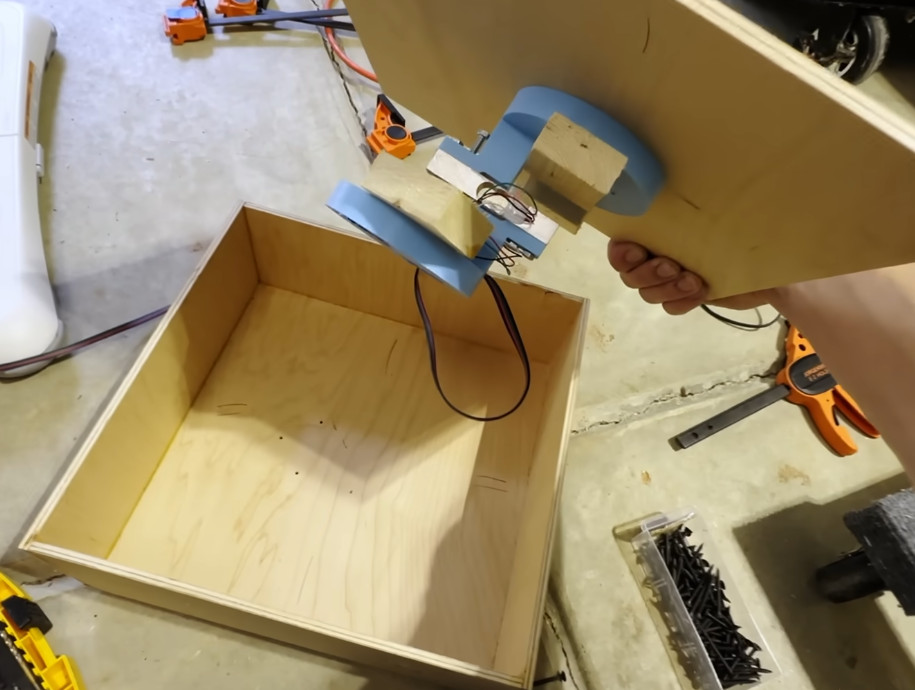
To test the concept, a large scale is made from foamcore and four load cells which feed into an Arduino which in turn is connected to a laptop for a visualization. After a brief test with a toy car, [AlphaPhoenix] goes on to weigh a paper airplane as it flies over the scale. What we learn from the demonstration is that any weight from a flying object is eventually transferred to the ground via the air.
In the second part of the video a new, smaller, type of scale is created and taken to the airport where airplanes flying overhead are weighed over the course of three days. This new apparatus is basically a pressure sensor enclosed in a nominally air-tight box, essentially a fancy type of barometer. Measurements are taken, assumptions are made, and figures are arrived at. Unfortunately the calculated results are off by more than one order of magnitude, but that doesn’t stop this experiment from having been very cool!
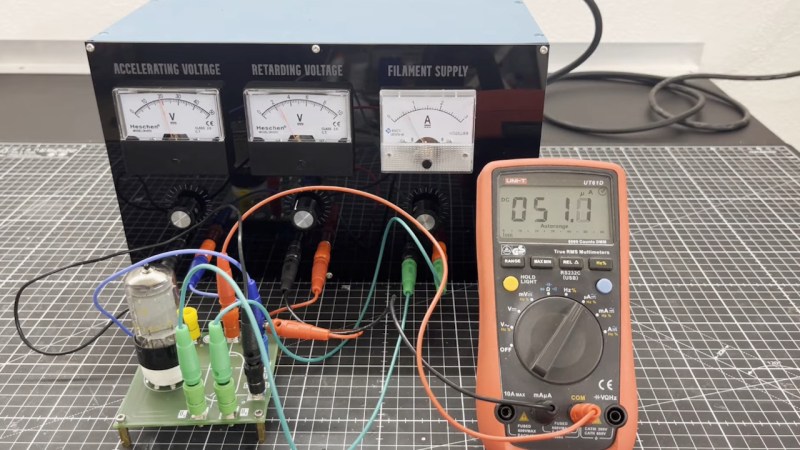
The Franck–Hertz experiment was a pioneering physics observation announced in 1914 which explained that energy came in “packets” which we call “quanta”, marking the beginning of quantum physics. Recently, [Markus Bindhammer] wrote in to let us know he had redone the experiment for himself.
In the original experiment a mercury vacuum tube was used, but in his recreation of the experiment [Markus] uses a cheaper argon tube. He still gets the result he is looking for though, which is quite remarkable. If you watch the video you will see the current readings clump around specific voltage levels. These voltage levels indicate that energy is quantized, which was a revolutionary idea at the time. If you’re interested in how contemporary physics regards, particles, waves, and quanta, check out this excellent presentation: But What Actually Is a Particle? How Quantum Fields Shape Reality.
Before closing we have to say that the quality of [Markus]’s build was exceptional. He made a permanent enclosure for his power supplies, made custom PCBs, used ferrule crimps for all his wire interconnects, included multiple power switches and dials, professionally labeled and insulated everything, and even went to the trouble of painting the box! Truly a first class build. One thing that surprised us though was his use of rivets where we would almost certainly have used bolts or screws… talk about confidence in your workmanship!
Despite the repeated warnings of system administrators, IT personnel, and anyone moderately aware of operational security, there are still quite a few people who will gladly plug a mysterious flash drive into their computers to see what’s on it. Devices which take advantage of this well-known behavioral vulnerability have a long history, the most famous of which is Hak5’s USB Rubber Ducky. That emulates a USB input device to rapidly execute attacker-defined commands on the target computer.
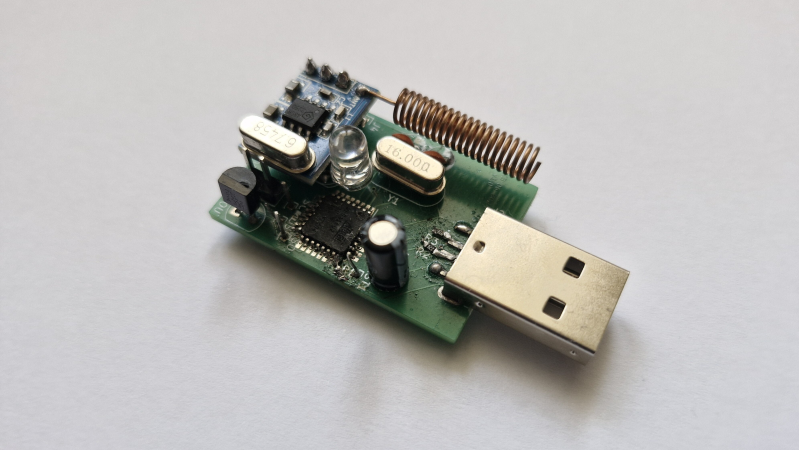
The main disadvantage of these keystroke injection attacks, from the attacker’s point of view, is that they’re not particularly subtle. It’s usually fairly obvious when something starts typing thousands of words per minute on your computer, and the victim’s next move is probably a call to IT. This is where [Krzysztof Witek]’s open-source Rubber Ducky clone has an advantage: it uses a signal detected by a SYN480R1 RF receiver to trigger the deployment of its payload. This does require the penetration tester who uses this to be on the site of the attack, but unlike with an always-on or timer-delayed Rubber Ducky, the attacker can trigger the payload when the victim is distracted or away from the computer.
This project is based around the ATmega16U2, and runs a firmware based on microdevt, a C framework for embedded development which [Krzysztof] also wrote. The project includes a custom compiler for a reduced form of Hak5’s payload programming language, so at least some of the available DuckyScript programs should be compatible with this. All of the project’s files are available on GitHub.
[Bhuvanmakes] says that he has the simplest open source photobioreactor. Is it? Since it is the only photobioreactor we are aware of, we’ll assume that it is. According to the post, other designs are either difficult to recreate since they require PC boards, sensors, and significant coding.
This project uses no microcontroller, so it has no coding. It also has no sensors. The device is essentially an acrylic tube with an air pump and some LEDs.
It’s a problem that few of us will ever face, but if you ever have to calibrate your scanning electron microscope, you’ll need a resolution target with a high contrast under an electron beam. This requires an extremely small pattern of alternating high and low-density materials, which [ProjectsInFlight] created in his latest video by depositing gold nanoparticles on a silicon slide.
[ProjectsInFlight]’s scanning electron microscope came from a lab that discarded it as nonfunctional, and as we’ve seen before, he’s since been getting it back into working condition. When it was new, it could magnify 200,000 times and resolve features of 5.5 nm, and a resolution target with a range of feature sizes would indicate how high a magnification the microscope could still reach. [ProjectsInFlight] could also use the target to make before-and-after comparisons for his repairs, and to properly adjust the electron beam.
Since it’s easy to get very flat silicon wafers, [ProjectsInFlight] settled on these as the low-density portion of the target, and deposited a range of sizes of gold nanoparticles onto them as the high-density portion. To make the nanoparticles, he started by dissolving a small sample of gold in aqua regia to make chloroauric acid, then reduced this back to gold nanoparticles using sodium citrate. This gave particles in the 50-100 nanometer range, but [ProjectsInFlight] also needed some larger particles. This proved troublesome for a while, until he learned that he needed to cool the reaction temperature solution to near freezing before making the nanoparticles.
Using these particles, [ProjectsInFlight] was able to tune the astigmatism settings on the microscope’s electron beam so that it could clearly resolve the larger particles, and just barely see the smaller particles – quite an achievement considering that they’re under 100 nanometers across!
As common as uranium is in the ground around us, the world’s oceans contain a thousand times more uranium (~4.5 billion tons) than can be mined today. This makes extracting uranium as well as other resources from seawater a very interesting proposition, albeit it one that requires finding a technological solution to not only filter out these highly diluted substances, but also do so in a way that’s economically viable. Now it seems that Chinese researchers have recently come tantalizingly close to achieving this goal.
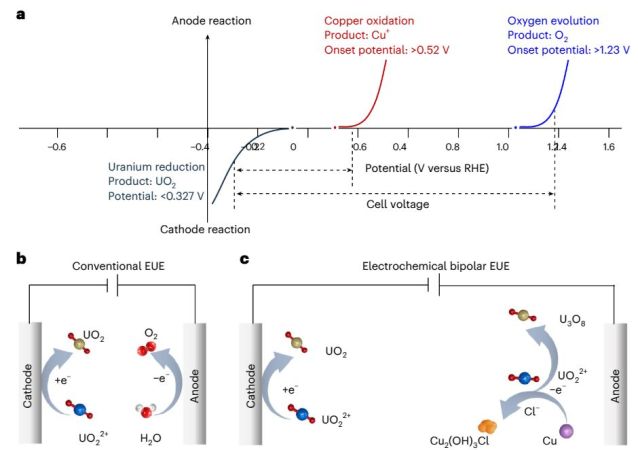
The anode chemical reaction to extract uranium. (Credit: Wang et al., Nature Sustainability, 2025)
The used electrochemical method is described in the paper (gift link) by [Yanjing Wang] et al., as published in Nature Sustainability. The claimed recovery cost of up to 100% of the uranium in the seawater is approximately $83/kilogram, which would be much cheaper than previous methods and is within striking distance of current uranium spot prices at about $70 – 85.
Of course, the challenge is to scale up this lab-sized prototype into something more industrial-sized. What’s interesting about this low-voltage method is that the conversion of uranium oxide ions to solid uranium oxides occurs at both the anode and cathode unlike with previous electrochemical methods. The copper anode becomes part of the electrochemical process, with UO2 deposited on the cathode and U3O8 on the anode.
Among the reported performance statistics of this prototype are the ability to extract UO22+ ions from an NaCl solution at concentrations ranging from 1 – 50 ppm. At 20 ppm and in the presence of Cl– ions (as is typical in seawater), the extraction rate was about 100%, compared to ~9.1% for the adsorption method. All of this required only a cell voltage of 0.6 V with 50 mA current, while being highly uranium-selective. Copper pollution of the water is also prevented, as the dissolved copper from the anode was found on the cathode after testing.
The process was tested on actual seawater (East & South China Sea), with ten hours of operation resulting in a recovery rate of 100% and 85.3% respectively. With potential electrode optimizations suggested by the authors, this extraction method might prove to be a viable way to not only recover uranium from seawater, but also at uranium mining facilities and more.