Triggering Lightning And Safely Guiding It Using A Drone

Every year lightning strikes cause a lot of damage — with the high-voltage discharges being a major risk to buildings, infrastructure, and the continued existence of squishy bags of mostly salty water. While some ways exist to reduce their impact such as lightning rods, these passive systems can only be deployed in select locations and cannot prevent the build-up of the charge that leads up to the plasma discharge event. But the drone-based system recently tested by Japan’s NTT, the world’s fourth largest telecommunications company, could provide a more proactive solution.

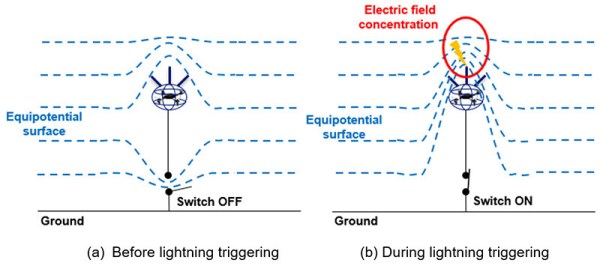
The idea is pretty simple: fly a drone that is protected by a specially designed metal cage close to a thundercloud with a conductive tether leading back to the ground. By providing a very short path to ground, the built-up charge in said cloud will readily discharge into this cage and from there back to the ground.

To test this idea, NTT researchers took commercial drones fitted with such a protective cage and exposed them to artificial lightning. The drones turned out to be fine up to 150 kA which is five times more than natural lightning. Afterwards the full system was tested with a real thunderstorm, during which the drone took a hit and kept flying, although the protective cage partially melted.

Expanding on this experiment, NTT imagines that a system like this could protect cities and sensitive areas, and possibly even use and store the thus captured energy rather than just leading it to ground. While this latter idea would need some seriously effective charging technologies, the idea of proactively discharging thunderclouds is perhaps not so crazy. We would need to see someone run the numbers on the potential effectiveness, of course, but we are all in favor of (safe) lightning experiments like this.

If you’re wondering why channeling lightning away from critical infrastructure is such a big deal, you may want to read up on Apollo 12.

Superconductivity News: What Makes Floquet Majorana Fermions Special For Quantum Computing?

Researchers from the USA and India have proposed that Floquet Majorana fermions may improve quantum computing by controlling superconducting currents, potentially reducing errors and increasing stability.

In a study published in Physical Review Letters that was co-authored by [Babak Seradjeh], a Professor of Physics at Indiana University Bloomington, and theoretical physicists [Rekha Kumari] and [Arijit Kundu], from the Indian Institute of Technology Kanpur, the scientists validate their theory using numerical simulations.

Continue reading “Superconductivity News: What Makes Floquet Majorana Fermions Special For Quantum Computing?”

DIY Penicillin

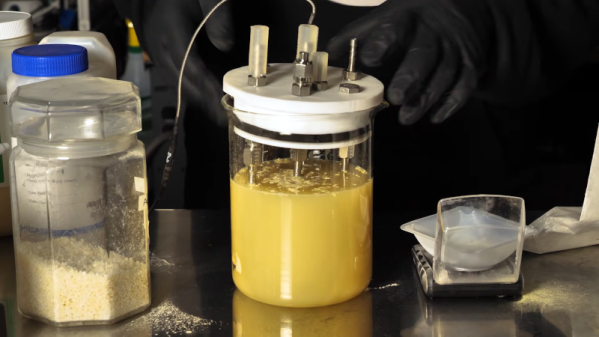
We don’t often consider using do-it-yourself projects as a hedge against the apocalypse. But [The Thought Emporium] thinks we should know how to make penicillin just in case. We aren’t so sure, but we do think it is a cool science experiment, and you can learn how to replicate it in the video below.

If you want to skip the history lesson, you need to fast-forward to about the six-minute mark. According to the video, we are surrounded by mold that can create anti-bacterial compounds. However, in this case, he starts with a special strain of mold made to produce lots of antibiotics.

Continue reading “DIY Penicillin”

Optical Contact Bonding: Where The Macro Meets The Molecular

If you take two objects with fairly smooth surfaces, and put these together, you would not expect them to stick together. At least not without a liberal amount of adhesive, water or some other substance to facilitate a temporary or more permanent bond. This assumption gets tossed out of the window when it comes to optical contact bonding, which is a process whereby two surfaces are joined together without glue.

The fascinating aspect of this process is that it uses the intermolecular forces in each surface, which normally don’t play a major role, due to the relatively rough surfaces. Before intermolecular forces like Van der Waals forces and hydrogen bonds become relevant, the two surfaces should not have imperfections or contaminants on the order of more than a few nanometers. Assuming that this is the case, both surfaces will bond together in a way that is permanent enough that breaking it is likely to cause damage.

Although more labor-intensive than using adhesives, the advantages are massive when considering that it creates an effectively uninterrupted optical interface. This makes it a perfect choice for especially high-precision optics, but with absolutely zero room for error.

Continue reading “Optical Contact Bonding: Where The Macro Meets The Molecular”

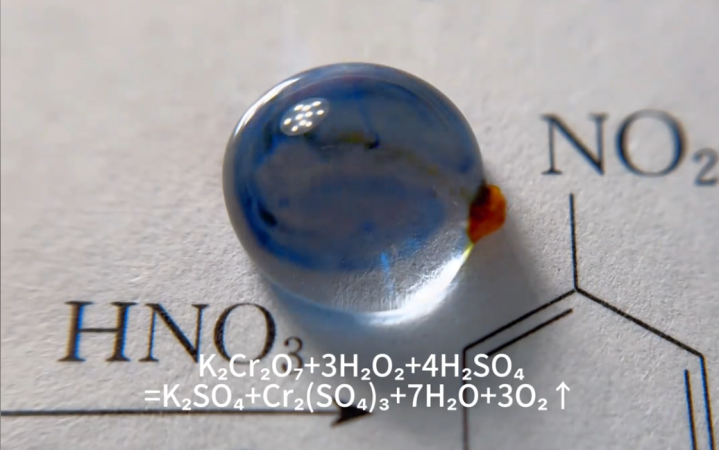
A picture of a single water droplet on top of what appears to be a page from a chemistry text. An orange particle is attached to the right side of the droplet and blue and black tendrils diffuse through the drop from it. Under the water drop, the caption tells us the reaction we're seeing is "K2Cr2O7+ 3H2O2 + 4H2SO4 = K2SO4+Cr2(SO4)3+7H2O+3O2(gas)"

Water Drops Serve As Canvas For Microchemistry Art

If you’re like us and you’ve been wondering where those viral videos of single water drop chemical reactions are coming from, we may have an answer. [yu3375349136], a scientist from Guangdong, has been producing some high quality microchemistry videos that are worth a watch.

While some polyglots out there won’t be phased, we appreciate the captioning for Western audiences using the elemental symbols we all know and love in addition to the Simplified Chinese. Reactions featured are typically colorful, but simple with a limited number of reagents. Being able to watch diffusion of the chemicals through the water drop and the results in the center when more than one chemical is used are mesmerizing.

We do wish there was a bit more substance to the presentation, and we’re aware not all readers will be thrilled to point their devices to Douyin (known outside of China as TikTok) to view them, but we have to admit some of the reactions are beautiful.

If you’re interested in other science-meets-art projects, how about thermal camera landscapes of Iceland, and given the comments on some of these videos, how do you tell if it’s AI or real anyway?

Neutron Flux Impact On Quartz Expansion Rate

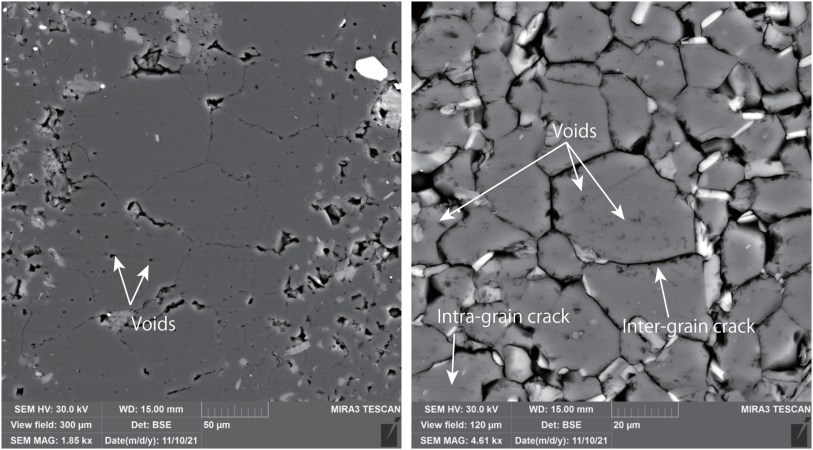
Radiation-induced volumetric expansion (RIVE) is a concern for any concrete structures that are exposed to neutron flux and other types of radiation that affect crystalline structures within the aggregate. For research facilities and (commercial) nuclear reactors, RIVE is generally considered to be one of the factors that sets a limit on the lifespan of these structures through the cracking that occurs as for example quartz within the concrete undergoes temporary amorphization with a corresponding volume increase. The significance of RIVE within the context of a nuclear power plant is however still poorly studied.

A recent study by [Ippei Maruyama] et al. as published in theĀ Journal of Nuclear Materials placed material samples in the LVR-15 research reactor in the Czech Republic to expose them to an equivalent neutron flux. What their results show is that at the neutron flux levels that are expected at the biological shield of a nuclear power plant, the healing effect from recrystallization is highly likely to outweigh the damaging effects of amorphization, ergo preventing RIVE damage.

This study follows earlier research on the topic at the University of Tokyo by [Kenta Murakami] et al., as well as by Chinese researchers, as in e.g. [Weiping Zhang] et al. in Nuclear Engineering and Technology. [Murayama] et al. recommend that for validation of these findings concrete samples from decommissioned nuclear plants are to be examined for signs of RIVE.

Heading image: SEM-EDS images of the pristine (left) and the irradiated (right) MC sample. (Credit: I. Murayama et al, 2022)

Hash Functions With The Golden Ratio

In the realm of computer science, it’s hard to go too far without encountering hashing or hash functions. The concept appears throughout security, from encryption to password storage to crypto, and more generally whenever large or complex data must be efficiently mapped to a smaller, fixed-size set. Hashing makes the process of looking for data much faster for a computer than performing a search and can be incredibly powerful when mastered. [Malte] did some investigation into hash functions and seems to have found a method called Fibonacci hashing that not only seems to have been largely forgotten but which speeds up this lookup process even further.

In a typical hashing operation, the data is transformed in some way, with part of this new value used to store it in a specific location. That second step is often done with an integer modulo function. But the problem with any hashing operation is that two different pieces of data end up with the same value after the modulo operation is performed, resulting in these two different pieces of data being placed at the same point. The Fibonacci hash, on the other hand, uses the golden ratio rather than the modulo function to map the final location of the data, resulting in many fewer instances of collisions like these while also being much faster. It also appears to do a better job of using the smaller fixed-size set more evenly as a consequence of being based around Fibonacci numbers, just as long as the input data doesn’t have a large number of Fibonacci numbers themselves.

Going through the math that [Malte] goes over in his paper shows that, at least as far as performing the mapping part of a hash function, the Fibonacci hash performs much better than integer modulo. Some of the comments mention that it’s a specific type of a more general method called multiplicative hashing. For those using hash functions in their code it might be worth taking a look at either way, and [Malte] admits to not knowing everything about this branch of computer science as well but still goes into an incredible amount of depth about this specific method. If you’re more of a newcomer to this topic, take a look at this person who put an enormous bounty on a bitcoin wallet which shows why reverse-hashing is so hard.